

What Does Heritage Actually Do? — Race, Ancestry, and Biology in Threshold
The previous post established that Threshold's character creation sequence asks questions before presenting mechanics. Step 1 is "What people do you come from?" and Step 2 is "What community raised you?" The separation is deliberate. This post explains why—and what it took to get there.
The Terminology Problem
Before getting into design, it's worth acknowledging that the word used for this concept varies significantly across systems—and the variation isn't cosmetic. It reflects genuine disagreement about what the concept is actually doing.
D&D called it Race for decades, a term borrowed from Tolkien-era fantasy that carries obvious real-world baggage and has been progressively retired. Fifth edition shifted toward Species in its 2024 revision. Pathfinder 2e uses Ancestry, which emphasizes lineage and history. Draw Steel uses Ancestry as well. Daggerheart uses Heritage. Symbaroum uses Race still, though its mechanical treatment is notably different from D&D's. Wildsea uses Bloodline. RuneQuest uses Species. Some systems abandon the category almost entirely.
Threshold uses Heritage. The word was chosen because it implies something carried forward—traits, instincts, biological patterns that your people's long history with the world has produced—without prescribing what that history means culturally or socially. Heritage is what you inherit. What you do with it, and the community that shaped how you think about it, comes later.
The terminology also signals something to players before they read a single rule: this step is about biology and ancestry, not personality, values, or cultural affiliation. Those belong to a different question.
What Heritage-Type Choices Actually Do in TTRPGs
Before explaining what Threshold chose, it's worth asking what this design element is actually supposed to accomplish across the breadth of the hobby. The answer varies more than most players realize, and the variation is instructive.
At minimum, heritage-type choices can serve four distinct functions. Different systems weight these very differently, and the interesting design work often lies in understanding which functions a particular game is asking the choice to carry.
Biological differentiation—giving characters meaningfully different physical capabilities based on their people. Darkvision, size differences, natural weapons, unusual lifespans. You are physically different from other characters because of what you are, and that difference has mechanical expression.
Mechanical identity—giving players a reliable set of capabilities from the moment of character creation, before class, background, or skill investment. Something to build around and count on.
Fictional grounding—establishing the character's place in the world. Who knows what you are when they look at you? What assumptions do they make? What history do you carry by virtue of existing?
Cultural scaffolding—providing values, social context, skill affinities, and behavioral tendencies that emerge from your people's way of life.
Most systems bundle multiple functions together. The interesting design question is which functions belong here versus somewhere else—and whether collapsing them serves the game or creates problems.
What I Learned From Other Systems
Rather than survey systems sequentially, it's more useful to organize by what the heritage choice is primarily doing—because that's the question Threshold had to answer.
Ancestry as Mechanical Differentiation: D&D, RuneQuest
The most familiar model treats ancestry primarily as a mechanical package. You pick a heritage and receive a set of biological capabilities that affect what you can do and how well you do it.
D&D is the obvious reference point. For most of its history, race bundled biological traits, mechanical bonuses, and cultural assumptions into a single inseparable choice. Pick Elf and receive darkvision, weapon proficiencies, ability score bonuses, and implicit cultural scaffolding—elves are graceful, elves value magic and art—all at once. The mechanical evolution across editions reveals the design tension clearly. AD&D 2e used hard class restrictions and level caps to express racial "nature," which functioned as mandatory character limitations. D&D 5e replaced restrictions with bonuses, which created optimal pairings—Half-Orc Barbarian, High Elf Wizard—that turned a fictional choice into an optimization problem. The 2024 revision decoupled ability score bonuses from ancestry entirely, essentially acknowledging that tight mechanical coupling was causing more problems than it solved.
RuneQuest takes mechanical differentiation further and with more intentionality. Species carries genuine biological weight throughout the entire game—not just at character creation—in ways that meaningfully constrain and define capability. The tradeoff is that in a skill-based system, some of those constraints feel punishing rather than characterful when they close off options a player might reasonably want.
Ancestry as Customizable Biological Identity: Draw Steel
Draw Steel's Ancestry system deserves more credit than it usually gets, because it's doing something structurally distinct from the approaches above.
Each ancestry has a Signature Trait—a defining biological feature every member shares—plus a budget of Ancestry Points that players spend to customize purchased traits. A Devil has Silver Tongue as a Signature Trait and 3 Ancestry Points to spend across seven options including Barbed Tail, Hellsight, Impressive Horns, and Wings. A Polder has Shadowmeld and Small as Signature Traits and 4 points to spend. This means two characters of the same ancestry can have meaningfully different capability profiles while sharing the same biological foundation—you're not receiving a predetermined bundle, you're selecting which aspects of your biology are most expressed in your specific character.
What Draw Steel explicitly doesn't do is use ancestry to carry cultural scaffolding. The rulebook states directly that ancestry describes how you were born while Culture describes how you grew up. A Wode Elf raised among Dwarves has Wode Elf biology and Dwarf cultural formation—cleanly separable. This is the same separation Threshold is making, arrived at independently, which suggests the design logic is sound.
Ancestry as Social and Fictional Positioning: Symbaroum, Forbidden Lands
Some systems use the heritage choice primarily to establish the character's position in the world—not what you can do, but what the world does with what you are.
Symbaroum is the clearest example. Heritage carries significant social weight, and that weight is often negative. A Goblin isn't primarily defined by mechanical capabilities; they're defined by how every NPC in the room is going to react to them. What doors are open, what assumptions follow you, what prejudices you'll need to navigate — these are what the choice primarily determines. Forbidden Lands uses a similar approach with its Kin system.
This matters because it's easy to assume that modeling social prejudice through heritage is a science fiction concern. But high fantasy has always done this. Drow face prejudice wherever they go. Orcs are assumed to be violent. Half-elves belong nowhere fully. The social positioning function of the heritage choice is deeply embedded in the genre.
The distinction between fantasy and science fiction here isn't whether social modeling happens—it's the scale and source of that modeling. In high fantasy, inter-group prejudice tends to be relational and historical: specific peoples in tension with each other within a shared world, shaped by proximity and conflict. In science fiction, species-as-sociology operates at a civilizational scale because species often developed in complete isolation before contact. Shadowrun's metatypes exist within a single society that had to suddenly absorb them. Starfinder's species bring the weight of entire civilizations into every interaction. The scope differs even when the design function is similar.
The limitation of pure social-positioning approaches is that if heritage primarily delivers friction, some heritages start to feel like difficulty modes rather than genuine options.
Ancestry as Narrative Permission: Wildsea
At the lightest end of the spectrum, some systems treat heritage almost entirely as fictional permission. Wildsea's Bloodline system describes biological origin and grants access to certain fictional capabilities, but the mechanical expression is largely handled through the broader skill and advancement system rather than front-loaded at character creation. This avoids optimization problems cleanly, but if the heritage choice carries very little mechanical weight, players motivated by mechanical decisions may find the choice feels hollow.
City of Mist: The Closest Philosophical Relative
City of Mist sits closest to the instinct Threshold was reaching for, which is why it's worth covering last. Creation is built around answering questions about your Mythos and your Logos. The mechanics follow the fiction rather than preceding it. That question-first instinct is exactly what Threshold's heritage step is trying to capture. What doesn't translate is City of Mist's specific fictional premise—the tension between mythic identity and ordinary human life is the entire engine of the game. The principle transfers; the premise doesn't.
The Common Thread
What stands out across this survey is that most systems conflate biology with culture at some point in the heritage choice, and that conflation creates compounding problems. When your ancestry tells you who your people are as a civilization, Background ends up doing redundant work. When the same choice carries biological traits, mechanical bonuses, cultural assumptions, and social positioning all at once, none of those things can be handled with real care.
The clearest design insight from surveying the field: these functions need to be separated to be handled well. Draw Steel understands this about biology versus culture. Symbaroum and Forbidden Lands understand it about social positioning versus mechanical capability. The separation Threshold is attempting is more thorough than any of them—Heritage owns biology and innate ability, nothing else.
What Heritage Does in Threshold
Heritage in Threshold covers exactly two things: biological traits and innate abilities. Nothing else.
It does not tell you your values. It does not tell you your skills beyond those that emerge from physical biology. It does not determine your language. It does not prescribe your personality or your cultural assumptions. It does not determine your relationship to magic, your social standing, or your worldview.
What it does tell you is what your body knows and what your people's long history with the world has written into your biology. Tremorsense calibrated by centuries underground. Size and physical mass that no amount of upbringing changes. Innate connection to magical forces that predates any formal training. These are the things Heritage owns—and only these things.
This narrowing required genuine discipline. The temptation when writing heritage entries is to fill them with cultural flavor—this is how these people think, this is what they value. That material is interesting. It belongs in the lore entries, not the mechanical block. The mechanical block answers only the biological question.
The result is that Heritage in Threshold has a smaller footprint than most players expect. That's intentional. The space Heritage doesn't occupy gets filled by Culture.
Heritages of Threshold
Beast-Kin are tribal hunters and defenders organized around four Aspects—Canine, Ursine, Feline, and Avian. Each Aspect produces distinct biological capabilities through the Primal Aspect trait: Canine fighters gain an edge when attacking the same target as a nearby ally; Ursine characters have a higher Wound Threshold; Feline characters can roll to negate fall damage entirely; Avian characters fly. Natural Weapons means every Beast-Kin has claws or talons—they are never unarmed. The four Aspects produce genuinely distinct play without requiring four separate heritage entries, and the biology is functional rather than decorative. A Canine fighting alongside allies is playing a meaningfully different game than an Ursine absorbing damage alone.
Halfling communities sit at the margins of forests and wetlands, invisible to those who don't know to look. Their most distinctive biological trait is Silent Speech—low-bandwidth telepathy that binds them into something closer to a distributed mind than a village, sharing words, emotions, and simple images without language. Forest Shadows lets them attempt to hide when only lightly obscured, and spend Strain to reroll failed Stealth checks. A Halfling separated from their community isn't just socially isolated—they're navigating a world that communicates in ways that feel impoverished by comparison. They are not reclusive out of fear. They simply watched the world grow louder and more destructive and chose not to participate.
Thul are descended from giants who once tended Aethara's ecosystems and carry that purpose in their biology. Giant Sense—ten minutes of contact with the ground—reveals structural stability, water sources, underground passages, vibration and movement, and the health of living ecosystems within Close range. It tells you what is wrong with a place and what it needs. Prophesied Purpose gives each Thul a choice at creation: the Sand-Singer path, oriented toward restoration and accelerating natural healing; or the War-Leader path, oriented toward defending maintained ecosystems in combat. The heritage isn't just large and physically imposing. It is oriented—built to read the land and act on what it finds. Technology-aligned peoples call them eco-terrorists. The Thul don't dispute it.
An Elf in Threshold calcifies rather than ages. Elven skin slowly takes on the texture and hue of the stone native to their ancestral lands; the oldest among them are nearly indistinguishable from weathered rock—still-eyed and deliberate in all things. Ancient Memory gives a bonus to History and Arcana checks that doubles for events or magic older than a century. Measured Response lets them interrupt an opponent's action with their own, once per rest, by spending a Reaction. A thousand years of memory is not wisdom automatically; it is weight. The calcification makes the age visible and strange in a way that "graceful and ancient" never quite achieved.
Orc society is structured around oath and consequence. An oath is not a promise—it is a spiritual bond that other Orcs can sense, and that the oathbreaker carries as a visible wound. Oath-Bound gives a bonus die when acting in accordance with a sworn promise, a sense of when an oath is close to breaking, and imposes spiritual corruption—a penalty to all rolls until atonement—when one is violated. Other Orcs sense oath-breakers. Tempered Spirit lets them channel their spiritual connection inward for a physical bonus once per rest, at a Strain cost, with the explicit note that they could do more—but the First Oath forbids it. The warrior reputation precedes them everywhere they go. The biology underneath it is about integrity and spiritual consequence, not aggression.
Gnome occupies an uncomfortable position in Threshold's world: they believe magic and technology are the same problem approached differently, which earns them distrust from traditionalist mages and pure engineers alike. Their communities are organized around workshops and experimental collectives. Experimental Mind gives a bonus die when attempting something never tried before—a bonus that disappears once that specific task succeeds, which creates a genuinely different relationship to skill mastery than most heritages produce. Magical Tinkering grants +2 AP that must be spent on magic Form skills; if a player chooses not to invest in magic at all, they gain a bonus to Engineering when combining multiple disciplines instead. If any heritage is most implicated in how Threshold's world arrived at its current crisis, it is Gnomes—not through malice, but through an irrepressible compulsion to find out what happens when you push further.
Dwarf bodies generate furnace-level heat. Their breath fogs in warm rooms. Master smiths can work metal with bare hands. Their beards are not hair but cultivated moss and fungi, grown over decades and shared through inoculation when a master takes an apprentice—the visible mark of a forge lineage that may span centuries. Furnace Body makes them immune to conditions caused by cold, lets them heat metal for crafting, and gives them a combat touch attack dealing fire damage and applying Burning. Stonecunning is automatic knowledge when examining worked stone or crafted items: approximate age, maker's lineage if Dwarf-made, structural weaknesses, hidden features. The beard detail is illustrative of the broader approach—take the familiar archetype, find what's genuinely interesting at its core, and replace the conventional surface with something that carries the same spirit in a stranger, more specific form.
Humanity in Threshold is defined by urgency. They live shorter natural lives than almost everyone they share Aethara with and behave accordingly—faster to commit, faster to build, faster to decide that waiting is not a strategy. Resourceful grants +2 AP at character creation, giving Humans more starting investment than any other heritage. Driven lets them reroll a failed skill check once per full rest. Their relentless extraction from an already vulnerable world has done little to slow the current crisis. They are now, with characteristic urgency, among the most frantically engineering solutions to a problem they helped deepen. Whether that speaks to adaptability or denial depends entirely on who is asking.
Gremlin are the shortest-lived playable heritage at 50 to 70 years, and among the most relentlessly curious—a combination that produces very little patience for doing things the established way. Scrap Savant turns any mechanism into a puzzle: spend ten minutes disassembling it with an Engineering or Crafting check, and on a success you understand it completely and can reassemble it. Fail, and it's in pieces. Crafting with scrap reduces the Wealth cost by 2; temporary items built from scrap require no Wealth Test at all. Mechanical Climber reflects a physiology optimized for small spaces and vertical movement—they climb without checks, squeeze through spaces too small for their size, and can redirect falls laterally.
Selachii are matriarchal ocean predators who came to surface diplomacy because Dead Zones don't stop at the shoreline and their food chains were collapsing. They are comfortable with silence in a way that unnerves land-dwellers, patient in a way that reads as threatening, direct in a way that bypasses social conventions other peoples consider mandatory. Blood in the Water gives +2 damage against targets already Wounded or Bleeding, plus a natural bite weapon. Deep Dweller is full aquatic capability: underwater breathing and movement, clear vision in murky water or complete darkness, no penalties from deep pressure or cold water. They are not trying to be intimidating. They are simply built that way.
Why These Ten
The heritage list didn't start with the ten heritages. It started with a grid.
Threshold's world operates along two philosophical axes: Nature, Technology, and Spirit on one axis; Tradition, Neutrality, and Progress on the other. These aren't just cultural categories—they represent genuinely different relationships to the world, to magic, and to the ecological crisis at the center of the setting. Every heritage occupies a position on that grid, and the grid needed to be populated before individual heritages could be designed. Starting from the philosophy meant starting from the world rather than from a list of cool creatures.
The first constraint was practical. Three heritages needed to be present regardless of where they landed philosophically: Humans, Elves, and Dwarves. This was a deliberate onboarding decision. Threshold is built to be accessible to players coming from D&D and other mainstream fantasy, and presenting ten entirely unfamiliar heritages creates friction at the table before the game has even started. Having these three as recognizable anchors gives new players something to hold onto while the rest of the list introduces them to what's different about Aethara. The familiar scaffolding earns the unfamiliar choices.
With those three placed, the grid started to fill in organically through world-building rather than through a checklist.
Gnomes came early because the setting needed a catalyst. Gnomes already carry an engineering identity in most fantasy contexts, so the leap to "what if they learned magic from Elves and applied it with none of the Elves' patience or conservatism" felt natural. This created an interesting secondary effect: Elves, long-lived and deliberate, watching their students burn through the world's resources at a pace they couldn't have anticipated, carry a collective guilt about it. They failed as guardians. That guilt now shapes how Elves move through the world—not with arrogance, but with the particular heaviness of people who know they could have said no and didn't.
Elves in most fantasy are defined by their connection to nature. That was pushed against deliberately, partly because a different kind of ancient was needed. The idea that emerged was calcification—Elves don't age so much as slowly turn to stone. The solidity and weight often associated with Dwarves felt like a better expression of what it actually means to live for a thousand years than grace and woodland elegance. Carrying more history than most peoples generate is not automatically wisdom. It's weight. This also gives literal meaning to living with the weight of their regret.
Dwarves kept the craftsman identity but it was pushed much further than the standard archetype takes it. The social implications of a master craftsman taking on an apprentice became significant: it's a guarantee of that child's future, a lineage encoded in shared technique. The beard detail came from a design question: why do underground-dwelling species have hair? Keeping eyes made sense—low-light vision is useful. But beards made no practical sense underground. The answer that emerged was that Dwarf beards aren't hair at all—they're cultivated moss and fungi, shared through inoculation when a master takes an apprentice. The visible mark of a forge lineage. And if Dwarves run hot enough to work metal with bare hands, the moss becomes a practical insulator as much as a cultural marker. The biology and the craft tradition reinforce each other.
Halflings needed to avoid two traps: the jolly-homebody archetype that dominates mainstream fantasy, and a direct copy of Dark Sun's Halflings, whose lore is inseparable from that specific world's history. The two inspirations that proved most useful were the Ghostwise Halflings from D&D's Forgotten Realms—a subrace with low-bandwidth telepathy that never made it into mainstream consciousness—and the Migurd tribe from Mushoku Tensei, a people who communicated differently from everyone around them and had adapted their entire social structure around that difference. The combination produced a heritage defined by Silent Speech: not a power, but the infrastructure of Halfling community life. They are not reclusive out of fear. They simply chose not to participate.
Beast-Kin emerged from asking what a Nature-Tradition heritage actually meant at its most direct. Plant heritages were considered—treefolk, dryads, myconids—but experience with other TTRPGs suggested that anthropomorphized animals would be more appealing to a broader range of players. The initial design was purely feline, originally called Panthera to represent the big cats specifically. Expanding to include wolves, bears, and birds came from a previous world-building project, but the real design challenge was scope: assigning them into the full families—Feline, Canine, Ursine, Avian—rather than specific species opened up representation for almost any animal in those categories. A Canine character might be wolf, dog, fox, or jackal, all under the same mechanical structure. There are some outliers the system doesn't handle cleanly yet (flightless birds for Avian characters), but those feel like sidebar problems rather than structural ones.
Thul came from asking what Nature-Progress meant. Progress toward what? The answer that felt right was ecological restoration—a heritage oriented toward making new natural areas, not just protecting existing ones. The inspirations here were explicit: the Fremen from Dune, who sought to transform Arrakis into a lush planet, and the Aiel from Wheel of Time, who share structural similarities (warrior traditions alongside mystical women holding spiritual authority, resource customs rooted in scarcity, feared as outsiders). The world-building that emerged was that Aethara was once a lush world tended by Giants—the Thul's direct ancestors—who saw through premonition what was coming and spent generations teaching their children how to prepare for it. The Dead Zones appearing across Aethara are, to the Thul, the fulfillment of a prophecy they've been training toward.
Orcs took the most winding path to their final position. The initial placement was Technology-Neutral—fierce warriors who sought whatever made them stronger, supplementing physical power with craft and smithing. The Elder Scrolls series was an influence here; Orcs in that setting are renowned as master smiths, their warrior identity inseparable from their relationship to metalwork and material advantage. That framing was coherent, but it created a problem: Humans were also a natural fit for Technology-Neutral, and the two heritages were competing for the same grid position without clear differentiation.
Looking for an alternative, World of Warcraft's Orcish history became a useful jumping-off point—not to copy it, but to think differently. In Azeroth's lore, Orcs were originally a shamanistic people before being corrupted away from that connection. The idea of Orcs as inherently spirit-aligned, rather than technology-aligned, opened up a more interesting design space. The question then became: what would make Orcs Spirit-Neutral specifically, rather than Spirit-Tradition or Spirit-Progress?
The answer came from setting history. What if Orcs discovered the connection between magical use and Dead Zones before anyone else did? A conflict intense enough—shamanic magic deployed without restraint—devastated their homeland entirely. Faced with that loss, and with the frightening silence of a place stripped of magical life, they made a collective decision to never repeat it. The First Oath. Magic turned inward, toward self-discipline and spiritual consequence rather than outward projection. The oath-breaker carries their failure visibly; other Orcs can sense it. That heritage belongs at Spirit-Neutral not because it sits passively between tradition and progress, but because it made a deliberate, permanent choice about its relationship to spiritual power and has enforced that choice ever since. Moving Orcs to Spirit-Neutral resolved the grid conflict cleanly—Technology-Neutral opened up for Humans, which proved to be the more accurate fit for both.
Gremlins came from modern mythology rather than fantasy tradition. The word entered popular folklore during World War II as an explanation for aircraft malfunctions—mischievous creatures that tampered with machinery, immortalized in the Twilight Zone episode "Nightmare at 20,000 Feet." The creative pivot was asking: what if the destruction isn't malicious but curious? What if Gremlins tear machines apart not because they want to break things but because they need to understand how they work? The Ork engineers from Warhammer 40K were a useful reference—a culture where things work partly because enough people believe they will, where the engineering logic is alien but functional. Gremlins rebuild what they disassemble in configurations that seem haphazard but operate through intuitive understanding the builder couldn't fully articulate. Their extremely short lifespan is not incidental to this. Reckless curiosity at scale has a cost.
Humans were the last heritage to find their grid position. The initial instinct was Technology-Progress, but the more that was examined, the less it fit—Humans innovate, but they're also deeply connected to nature and spirit in ways that resist a purely progressive framing. Moving Humans to Technology-Neutral after Orcs shifted back to Spirit-Neutral produced a more accurate characterization: adaptable and urgent rather than innovative and ambitious. Their relentless extraction from a vulnerable world has done little to slow the current crisis. They are now among the most frantically engineering solutions to a problem they helped deepen. Whether that speaks to adaptability or denial depends entirely on who is asking.
Selachii came from a different direction entirely. The grid was full, but something felt missing—a heritage that sat outside the philosophical framework rather than within it. The ocean was the answer. No matter how much other peoples have sailed it, built on it, used it for their own purposes, the ocean continues. It has never cared about the philosophical debates happening on land. The Selachii—named from the taxonomic order Selachimorpha—carry that same indifference. They are True Neutral not because they've found a balance between philosophies but because the question is alien to them. The only thing that has disturbed their relationship to the world is the Dead Zones spreading into their food chains. They didn't come to the surface because they wanted to participate. They came because the ocean was dying underneath them.
Ten felt like the right number to stop at. More heritages are planned for future expansions—arthropods, plant species, and others—but ten gives players enough genuine variation without creating paralysis at character creation. The philosophical grid also leaves clear gaps that future heritages could fill, which makes expansion feel like completion rather than addition.
What Heritage Doesn't Decide
This is worth stating explicitly because it runs counter to most players' expectations.
Your Heritage does not determine your language. A Dwarf raised in a coastal maritime community may never learn Dwarvish. An Elf raised nomadically may speak three regional dialects and no Elvish at all. Linguistic knowledge belongs to the community that raised you, not the biology you were born with.
Your Heritage does not determine your relationship to magic. Heritage can produce innate magical connection—Gnomes carry this—but it doesn't determine whether magic is part of your character's identity at all. That decision belongs to Step 7.
Your Heritage does not determine your values, your personality, or your worldview. A Halfling raised in an Urban Scavenger culture thinks about community and trust very differently from a Halfling raised in a Forest community. The biology is the same. The person is not.
The discipline required to hold these boundaries is real. It would be easier to let Heritage do more work. The separation is worth the discipline because it produces characters who can't be read from their Heritage alone—which is exactly the point.
What Went Wrong
The early heritage list was closer to standard fantasy than the current one. Dwarves were underground craftsmen, Elves were graceful and ancient, Orcs were physically dominant warriors. These weren't wrong exactly—the problem was that they arrived pre-loaded with player assumptions that proved difficult to work against. When a player sits down with decades of Tolkien-lineage fantasy in their head, a Dwarf who is primarily a craftsman underground confirms everything they already expect. The heritage does no new work. It just agrees with the assumptions.
The first response was to overcorrect. Several heritages swung so aggressively against player expectations that they created a different problem—players who came to the table with a clear concept for an Orc or an Elf found themselves fighting against a heritage that seemed determined to be something else entirely. Subversion only works if there's enough of the familiar to push against. Pure replacement without reference to the original archetype just produces confusion.
The final versions land on a middle path. The question for each heritage wasn't "how do we make this different" but "what is actually interesting here, and what does this heritage mean in a world defined by ecological pressure, magical consequence, and civilizational friction?" Keep what serves those questions. Replace what doesn't—but replace it with something that carries the same spirit in a stranger, more specific form rather than discarding it entirely.
One heritage didn't get a middle path—it got a full replacement. Goblin carried enough accumulated baggage across decades of fantasy that reshaping it felt like fighting the word itself. The assumptions about brutality, disposability, and tribal hierarchy were too deeply embedded to work around. Gremlin emerged from asking what was actually interesting about that corner of the fantasy roster—small, quick, improvisation-oriented—and building something new from those elements without the inherited connotations. The result is a heritage defined by curiosity and mechanical instinct rather than one defined by what it's not.
The Dwarf beard-as-cultivated-moss-and-fungi isn't a departure from Dwarven identity. It's a more honest expression of what that identity was always gesturing toward—craft as lineage, technique as inheritance, the body itself as a record of who taught you. The Orc built around oath and spiritual consequence isn't less of a warrior heritage than the standard version. The biology that makes oath-breaking visible as a wound, that lets other Orcs sense when one of their own has broken faith—that is exactly why Orcs became warriors in the first place.
The test that proved useful: does removing the label leave something that still feels coherent? If a heritage only holds together because it's called "Dwarf" or "Elf," it's still coasting on borrowed assumptions. If it holds together on its own terms—if the biology, the traits, and the setting position form a complete picture—then the label is just a name for something that already exists.
What's Next
The next post covers Culture—what community-based identity does in TTRPGs, how Threshold's ten Cultures are organized, and what the philosophy alignment axis communicates about the world before players ever encounter it in play.
Questions
When you choose a heritage or ancestry in a TTRPG, what are you actually deciding? Is it primarily a mechanical choice, a fictional one, or something in between—and does the system make that clear?
For designers: how do you handle the gap between what a heritage is supposed to be and what players expect it to be? Do you lean into the familiar, subvert it, or find a middle path?
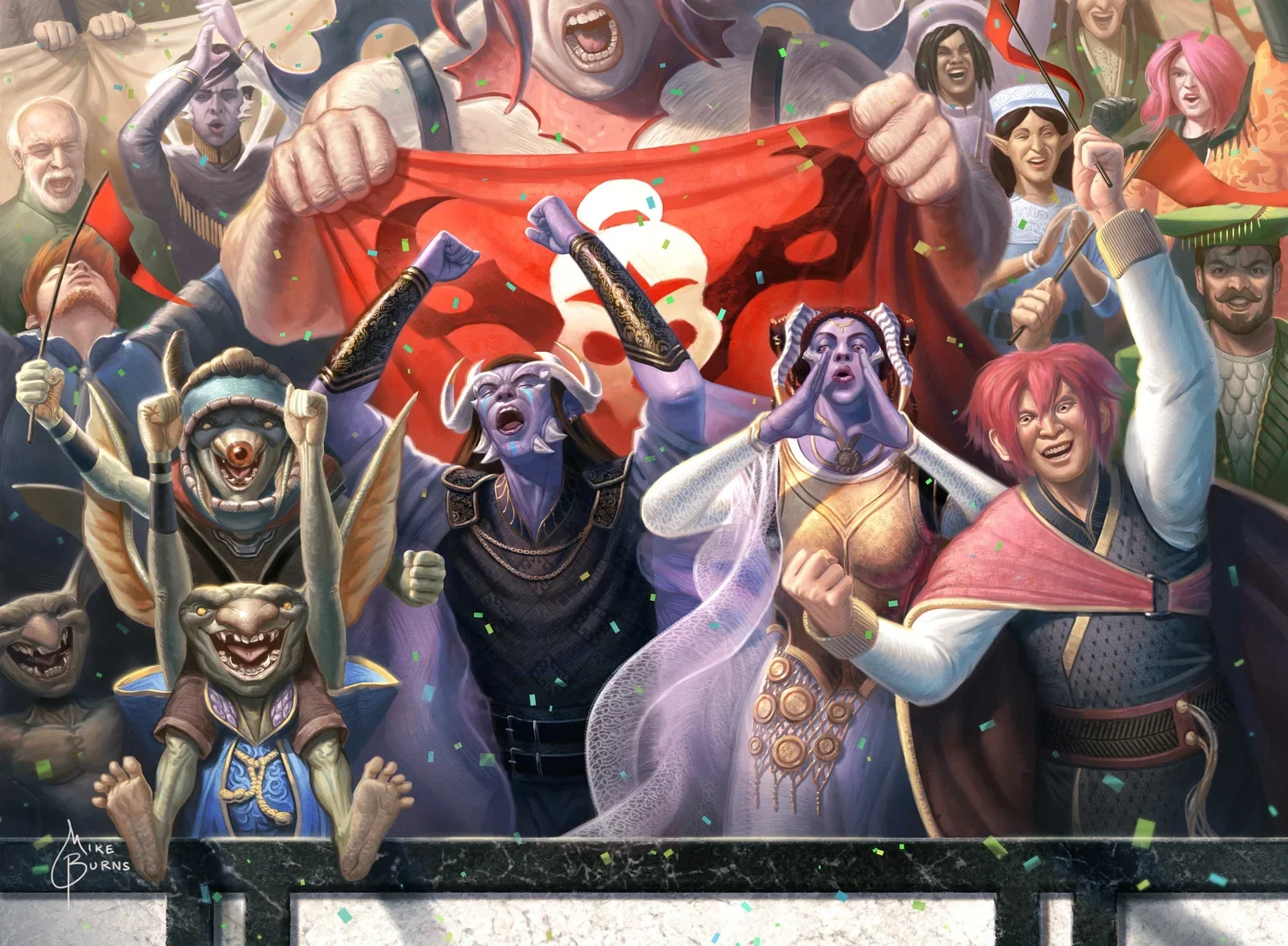
Art Credit: “The Crowd Goes Wild” by Mike Burns, from Battlebond © Wizards of the Coast