
Ability Scores: Deciding What a Character Is
I originally planned for this post to be about dice resolution. Once I started outlining it, though, I kept running into the same issue: the resolution system only makes sense if you understand what the game thinks a character is. What counts as capability, how growth is expressed, and what kinds of distinctions actually matter all get decided before you ever roll anything.
So before talking about how actions are resolved in Threshold, I want to step back and talk about ability scores.
Not just the ones I ended up with, but the role ability scores play in tabletop RPGs more broadly. If you only know them through the lens of D&D, it's easy to assume they're a fixed structure rather than a design choice. They aren't. They're one of the clearest ways a game communicates what it values.
What Ability Scores Are Actually Doing
In most tabletop RPGs, ability scores are treated as a given. Strength, Dexterity, Intelligence, and so on show up so often that it's easy to assume they're a universal solution rather than a specific design choice.
But ability scores aren't neutral. They encode assumptions. They're a statement about what the game thinks matters.
At a basic level, an ability score system answers a few core questions, whether the designer intends it to or not:
What kinds of competence does the game care about?
How granular should those distinctions be?
Are abilities descriptive, prescriptive, or both?
Do they define who a character is, or how well they perform?
Different games answer those questions in very different ways, and those answers ripple outward into progression, challenge, and tone.
The Kind of Characters I Wanted
Before I could decide what the ability scores in Threshold should be, I had to be clear about the kind of characters the game was meant to support.
I like heroic fantasy. I enjoy games where characters grow into figures of myth, where power scales dramatically and the stakes escalate until reality itself is on the line. That can be fun.
It just isn't the fantasy I wanted to design around here.
I'm more interested in games where characters remain recognizably human. Competent. Skilled. Dangerous in the right circumstances. Games like Blades in the Dark, Star Wars, or Cyberpunk tend to frame characters as people operating inside larger systems rather than standing above them. You learn. You adapt. You gain leverage. You survive longer. But you're never a one-person army.
That difference matters over time.
In traditional heroic fantasy, power growth is often vertical and exponential. Characters gain access to abilities that fundamentally rewrite the scale of the world. At higher levels, it becomes increasingly difficult to challenge players without resorting to equally absurd threats. The fiction starts to strain under the weight of the mechanics.
For Threshold, I wanted something else: grounded protagonists.
Characters who grow through experience, skill, and technique. Characters whose influence expands even when their raw power does not. Characters who remain mortal throughout the campaign, even at high tiers of play.
That goal shaped every decision that followed.
Familiar Approaches (and Their Tradeoffs)
The most recognizable model is the traditional six-ability framework popularized by D&D. Strength, Dexterity, Constitution, Intelligence, Wisdom, and Charisma cover a broad range of physical and mental capability, and they're intentionally generic. That generality makes them flexible, but it also means they carry a lot of historical baggage. Over time, they've accumulated assumptions about class roles, optimal builds, and "dump stats" that often matter more than what's happening in the fiction.
Different games give ability scores different jobs. Understanding which job your game needs them to do is the first step toward choosing the right approach.
Ability Scores as Physical and Mental Traits
The most familiar approach is to treat ability scores as fundamental traits of the character's body and mind. Strength represents physical force. Dexterity represents coordination. Intelligence represents reasoning ability.
This model is intuitive and easy to explain, and it maps cleanly to real-world concepts. You can usually look at a character sheet and immediately understand what the character is supposed to be good at.
The tradeoff is that these scores tend to do a lot of work at once. A single number often determines what a character can attempt, how often they succeed, and how effective they are when they do. Over time, that can collapse distinctions between characters and encourage optimization around a small subset of "important" traits, especially in combat-heavy systems.
Ability Scores as Broad Competence Bands
Other games use fewer, broader stats instead of six or eight narrow ones. Instead of many attributes, you get a few that represent general modes of action.
Games like Savage Worlds or Cortex Prime often take this approach. Characters are broadly capable, and the system relies on context, skills, or situational modifiers to differentiate outcomes.
The upside is speed and flexibility. Characters are rarely hard-locked out of an action, and the game can move quickly without referencing many separate stats. The downside is that it can become harder to express how characters differ in meaningful ways unless additional layers are added elsewhere in the system.
Ability Scores as Roles or Modes of Action
Other designs move away from physical traits entirely and define abilities around what characters do in the fiction. Instead of Strength or Intelligence, you might see attributes tied to aggression, caution, empathy, authority, or adaptability.
This is common in narrative-forward games such as Fate Core, where abilities help determine not just whether an action succeeds, but what kind of story that success produces. A character isn't just "strong"; they're effective when acting forcefully, decisively, or boldly.
The strength of this approach is clarity of intent. The ability score tells you how a character tends to solve problems. The limitation is that these systems rely heavily on shared understanding at the table. Without that, the boundaries between abilities can feel subjective or inconsistent.
Ability Scores as Resource Interaction
In some systems, ability scores primarily determine how characters interact with resources—stamina, stress, luck, momentum, or narrative currency—rather than how likely they are to succeed at individual actions.
Games like Blades in the Dark use attributes to govern stress, resistance, and long-term pressure more than moment-to-moment task resolution. Your abilities tell you how much strain you can absorb, how often you can push yourself, and what kinds of consequences you're best equipped to handle.
This approach works particularly well for games focused on attrition, risk management, or emotional endurance. It shines in longer campaigns where pressure accumulates and characters are defined as much by what they survive as by what they accomplish.
Ability Scores as Fictional Permission
Finally, some games treat ability scores less as numbers and more as permissions. Having a high score doesn't just make you better at something—it establishes that this is a space where your character belongs.
You can see this in games influenced by Powered by the Apocalypse design, such as Apocalypse World, where attributes determine which moves you have access to and how reliably you can trigger certain kinds of outcomes. In these systems, the numbers matter, but the fictional positioning often matters more.
This model is excellent for reinforcing character identity and spotlight protection. The challenge is maintaining flexibility without erasing meaningful differences between characters.
The Question Beneath All of These
All of these approaches work. They fail in different ways, and they excel at different things.
The real question isn't "Which ability scores are best?" It's "What job are these scores doing in this game?"
Are they there to gate access to actions, differentiate characters, shape narrative tone, manage pressure over time, or reinforce genre expectations?
Once you can answer that honestly, the actual list of abilities becomes much easier to reason about.
That question is what kept pulling me away from familiar models and toward something more specific for Threshold.
The Problem I Kept Running Into
For Threshold, the usual models kept breaking in subtle ways.
I wanted a game where:
Capability felt contextual rather than absolute
Characters could be broadly competent without becoming interchangeable
Growth was meaningful without turning into numerical inflation
The environment and situation mattered as much as raw aptitude
Traditional ability scores tended to collapse too many ideas into a single number. Either a character was "good at Strength things" or they weren't. That worked fine for combat math, but it didn't do much to support the kinds of decisions Threshold is built around.
On the other end of the spectrum, systems that flattened attributes too much made characters feel less distinct than I wanted. Everyone could attempt everything, but it became harder to express how they were different beyond narrative description.
What I needed was a way to separate what a character is capable of from how refined or reliable that capability is.
Progression Without Becoming Untouchable
One of the biggest pressures on any attribute system is how it handles progression.
I wanted advancement to feel meaningful and rewarding, but also sustainable over the lifespan of a long campaign. The game is meant to be played for years. That means the system has to support continued growth without turning the characters into something the setting can no longer meaningfully respond to.
That ruled out a few things early on.
I didn't want ability scores that inflated endlessly. I didn't want a system where higher numbers alone solved problems. I didn't want challenge to depend on constantly escalating threats just to keep pace with the characters.
Instead, I wanted progression to be mostly horizontal, punctuated by occasional moments of vertical growth. Players should gain more options, more reliability, more ways to approach problems. They should become better at navigating complexity, not simply overpowering it.
Ability scores, then, couldn't just be a measure of "how strong you are." They needed to express how a character engages with the world.
The Core Idea Behind Threshold's Ability Scores
The solution I kept circling back to was splitting ability into two related but distinct parts.
In Threshold, ability isn't a single value. It's expressed through Domains and Qualities.
Domains describe where a character is broadly capable. They're intentionally coarse. They answer questions like: what kinds of situations does this character meaningfully operate in? What spheres of action are within their reach?
Qualities describe how that capability manifests. They represent refinement, control, resilience, or precision within a Domain. Two characters can share a Domain and still feel very different because their Qualities shape how reliably or effectively they act within it.
This separation let me avoid a lot of problems I kept running into elsewhere. Domains establish scope. Qualities establish depth. Neither one has to do all the work alone.
What I kept running into was the need to separate two different ideas that are often collapsed into a single number:
Where a character is capable of acting, and
How they express that capability
In Threshold, those ideas are represented by two intersecting axes.
Domains describe scope. They answer the question: what part of existence does this character meaningfully operate in? Body, Mind, and Spirit aren't skills and they aren't traits. They're arenas of interaction.
Qualities describe expression. They answer the question: how does this character apply themselves within that arena? Force, Finesse, and Essence represent different ways of acting, not different power levels.
Neither axis works on its own. It's the intersection that matters.
Why This Fit the Setting
This structure also aligned cleanly with the kind of world Threshold is set in.
In a setting where magic, ecology, and environment are tightly linked, raw capability isn't enough. Context matters. A character might be powerful in one region and constrained in another. They might be broadly capable but lack the control to use that power safely.
By separating breadth from refinement, the system leaves room for:
Environmental pressure to matter
Consequences to scale naturally
Growth to feel earned rather than automatic
It also avoids tying identity too tightly to early decisions. Characters can expand into new Domains over time or deepen existing ones without locking themselves into a rigid progression path.
Threshold is a world defined by tension: between nature, technology, and magic; between tradition and progress; between preservation and exploitation. Those tensions aren't just political or philosophical. They're embodied in how people act, what they value, and how they apply power.
A character might have the strength to act, but not the restraint. Another might have deep internal conviction but limited ability to express it physically. Those distinctions matter in a world where consequences ripple outward and power always leaves marks.
Why I Wanted Scores to Matter
There was another pressure shaping this system, one that might sound mundane but turned out to matter: I don't like modifiers.
In a lot of games—especially ones descended from D&D—the number written on your character sheet isn't the number you actually use. Your Strength might be a 16, but what matters at the table is the +3 next to it. The score becomes a lookup value, rather than a decision-making tool.
I've always found that awkward.
It adds a small but constant layer of friction. When I want to do something, I have to mentally translate my character's ability into a different number before I can even think about the roll. Over the course of a long campaign, that translation happens hundreds of times, and it never gets more interesting.
More importantly, it disconnects the fiction from the mechanics. If my ability score doesn't participate directly in resolution, then it stops feeling like a measure of capability and starts feeling like bookkeeping.
For Threshold, I wanted the number you see to be the number you use. Fewer conversions. Fewer derived values. When you look at a stat, you should immediately understand what it means in play, without consulting a table or remembering a formula.
That preference pushed me away from systems where ability scores are largely ceremonial, and toward a structure where the score itself is the thing being used.
This also reinforced the decision to cap stats at a human scale. If the number you see is the number you use, it needs to stay legible. Six means something. One means something. There's no hidden math smoothing it out behind the scenes.
This emphasis on direct use fed naturally into the Domain and Quality grid. If stats are going to be used as-is, they need to describe how a character engages with the world, not just how large a bonus they provide.
Seeing the Structure
Once I stopped thinking about ability as a single value and started treating it as the intersection of two ideas, the structure became easier to reason about visually than verbally.
I sketched the system as a simple grid: Qualities running vertically, Domains running horizontally. Each stat lives at the intersection of where a character acts and how they act.
I've included the grid below. It's rough, but it captures the core idea more clearly than a paragraph of explanation ever could.
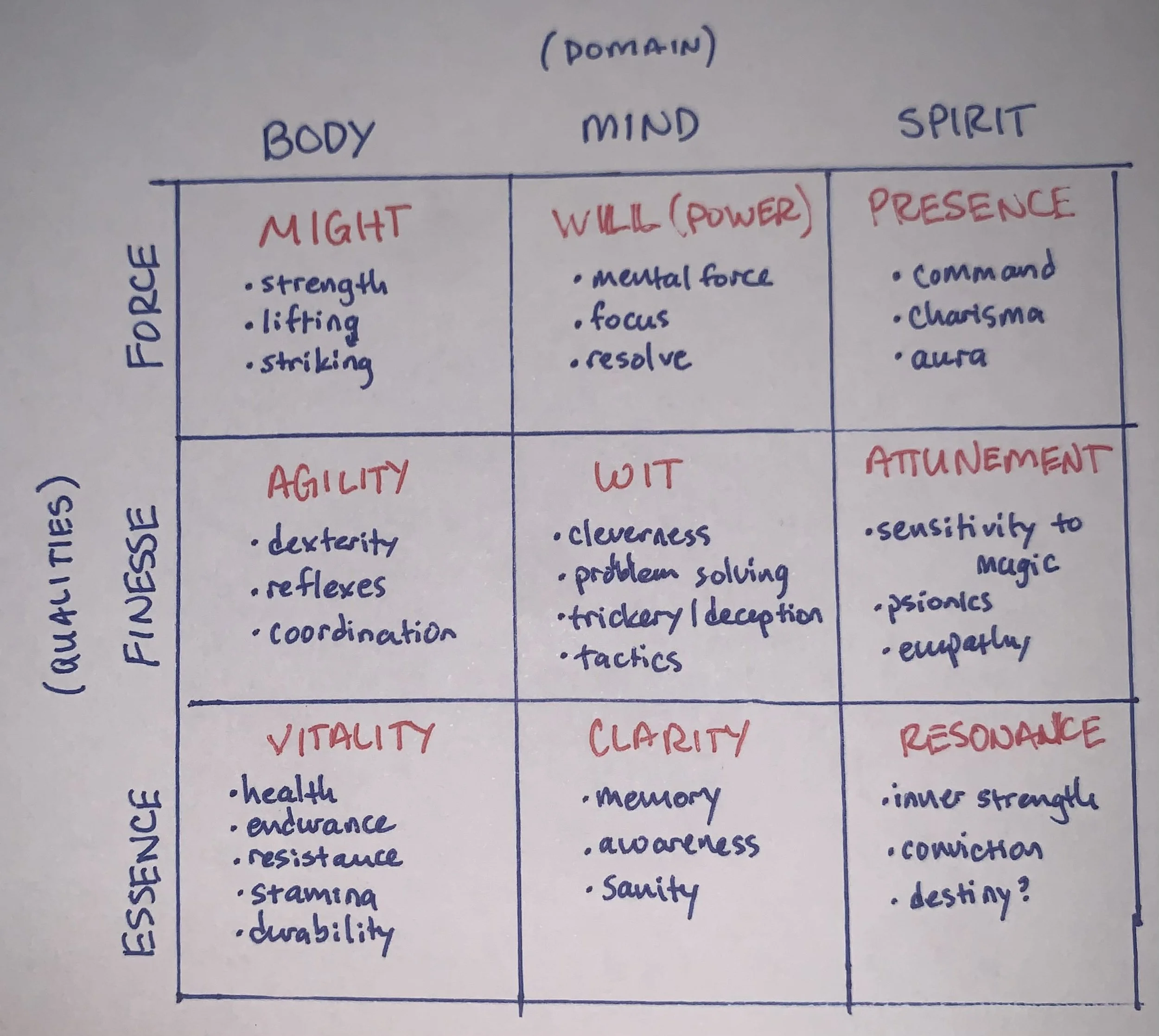
How I ended up drawing my stat grid.
The Attribute Grid
When you combine those two axes, you end up with nine derived attributes.
Force applied to the Body becomes Might. Applied to the Mind, it becomes Will. Applied to the Spirit, it becomes Presence.
Finesse expresses itself as Agility through the Body, Wit through the Mind, and Attunement through the Spirit.
Essence becomes Vitality, Clarity, and Resonance depending on where it's applied.
Each stat is rated from 1 to 6, with 6 representing peak human capability rather than superhuman extremes. Everyone has some baseline ability. No stat ever drops to zero. Characters aren't defined by what they can't do so much as how they choose to engage.
What matters more than the numbers is what the grid allows the system to express.
Two characters might both be capable in the same Domain, but express that capability very differently. Another might share a Quality but apply it in entirely different arenas. This lets characters feel distinct without forcing them into narrow archetypes or rigid class identities.
This caps-at-six approach reinforces the grounded protagonist goal: influence grows faster than raw power. You don't become untouchable. You become experienced.
What This Sets Up Mechanically
I'm intentionally stopping short of mechanics here.
What matters for now is that this ability score structure directly informs how the dice system works. It affects how pools are built, how success is measured, and how failure creates momentum instead of dead ends.
In the next post, I'll talk about how Domains and Qualities feed into the resolution system, why I chose a dice pool approach, and how outcomes are structured to support fast play with visible consequences.
What I Worked On
For this phase of design, I focused on pressure-testing the Domain and Quality grid conceptually.
I mapped it against the kinds of situations the game is meant to handle, compared it to earlier drafts, and checked whether it could support long-term play without collapsing into a single dominant approach.
What Went Wrong
Early versions either flattened distinctions too much or pushed too much weight onto a single axis and reintroduced the same problems I was trying to avoid.
Some drafts made Domains feel like reskinned attributes. Others turned Qualities into disguised power stats. In both cases, the system drifted away from the grounded feel I was aiming for.
Finding the balance took longer than expected.
What I Changed
Once I clarified that Domains handle scope and Qualities handle expression—and that stats emerge from their intersection rather than from raw power—the rest of the system stabilized.
What I'm Testing Next
The next step is integrating this attribute structure fully into the dice resolution system.
If the resolution mechanics don't reinforce this split—if they collapse it back into a single measure of success—then the entire approach fails. That's what the next post will focus on.
Questions
Do you prefer character progression that expands options over time, or progression that increases raw power?
At what point does "heroic" stop feeling grounded for you in a long campaign?
