



What Did Your Community Make You?—Culture, Social Class, and Formation in Threshold
Heritage answers "what people do you come from?" Culture answers "what community raised you?" Social Class answers "what position did you occupy before this?" The previous post covered Heritage. This post covers the other two—and why separating all three was harder than it looked.
The Problem These Steps Are Solving
Most TTRPGs collapse the questions of ancestry, community, and social standing into one or two choices. You pick a race or ancestry that tells you what you are biologically and often what your people value culturally. You pick a class that tells you what you do. Somewhere between those decisions, the community that shaped your instincts, the philosophical convictions you absorbed before you could articulate them, the social position you were born into—all of that gets either bundled into one of the primary choices or relegated to an afterthought.
Threshold separates these into three distinct steps because they are answering genuinely different questions that produce genuinely different people. Heritage is biology. Culture is formation. Social Class is circumstance. A Dwarf raised in a Forge community from a Low social class had a fundamentally different life than a Dwarf raised in the same Forge community from a Middle class—and both had a different life than a Dwarf raised in an Urban environment entirely. Same biology. Radically different people.
The argument of this post is that those differences matter enough to deserve their own mechanical and fictional space—and that the design path to getting there was longer and more complicated than anticipated.
What Culture-Type Choices Do in TTRPGs
Before explaining what Threshold chose, it's worth examining how other systems handle the question of community-based identity.
D&D Background—Skills, Equipment, and a Story Nobody Reads
I have never felt quite comfortable with how D&D handles this step. A Background grants skill proficiencies, tool proficiencies, starting equipment, sometimes a language, and a feature—then appends a paragraph of flavor text plus a traits, ideals, bonds, and flaws section that, in my experience as a GM, most players fill out in session zero and never reference again. Folk Hero, Criminal, and Sage are cultural identities with real fictional weight, but in practice they function as mechanical packages with names attached.
The problem is that the outputs drive the choice. Players don't ask "what community would have shaped this character?" They ask "which Background gives me the skills I need?" The fictional question of what it actually meant to grow up in a particular community gets reduced to a label stretched over a mechanical decision made for entirely different reasons.
This became worse in D&D 2024, when ability score modifiers were moved from ancestry to Background. I understand the logic—it was far less problematic to say "your upbringing shaped your capabilities" than "everyone of your race is stronger or smarter"—and that reasoning is sound. But the outcome compounded the problem. Now the Background choice carries even more mechanical weight, which means the optimization pressure on the fictional choice increased further. Players aren't choosing a community; they're choosing a stat package with a name attached.
D&D also never fully resolved the bundling problem from ancestry. If your race already implies something about your people's cultural tendencies, and your Background tells you about your pre-adventuring life, the two choices overlap in ways that create redundancy without clarity.
PF2e Background—Cleaner but Still Mechanical
Pathfinder 2e handles Background more cleanly by making it a distinct pillar alongside Ancestry and Class. The separation is clearer. The limitation is the same: ability boosts, skill training, and a feat still dominate the choice. The fictional question of what community shaped this character is present but secondary. PF2e is an optimization-friendly game and its character creation reflects that honestly.
Ars Magica—Social Role as Identity
Ars Magica takes a structurally different approach worth examining here. Rather than a culture or community step, it distinguishes between Magi, Companions, and Grogs—a hierarchy of narrative importance and mechanical scope that determines how much of the game's systems a character accesses.
This isn't Heritage and it isn't Culture in the way Threshold uses those terms. It's social role—a statement about what position your character occupies in the world and what kind of story they're part of. A Grog isn't a different species from a Magus. They're a different class of person within the same society, with dramatically different mechanical footprints and narrative focus.
What Ars Magica understands that most systems don't is that social position is a genuine character creation variable—that where you stand in a community's hierarchy shapes what you can do and what the game expects of you as fundamentally as any biological trait. That insight informed Threshold's decision to treat Social Class as the step that handles social position rather than folding it into a skill package.
Draw Steel Culture—The Closest Structural Relative
Draw Steel explicitly separates Ancestry from Culture and states clearly that Ancestry describes how you were born while Culture describes how you grew up. The separation is the same one Threshold is making.
Draw Steel's cultures are setting-specific—they reference particular factions, locations, and in-world organizations, which gives them real fictional weight but ties them to Draw Steel's specific world. The mechanical contribution is also broader than Threshold's, granting skills, languages, and sometimes additional features. It's doing more work per step, which fits Draw Steel's design but would create overlap problems in Threshold's tighter division between Culture and Social Class.
Daggerheart Community—Setting-Agnostic by Design
Daggerheart makes the ancestry/community separation explicit and handles it with an interesting structural choice: the nine community names—Highborne, Loreborne, Orderborne, Ridgeborne, Seaborne, Skyborne, Underborne, Wanderborne, Wildborne—are deliberately setting-agnostic. They describe environment type and social context rather than specific in-world cultures. Each grants a single community feature and a list of six personality adjectives as roleplay prompts.
The adjectives are worth noting—they're an explicit acknowledgment that community shapes personality, but rather than encoding that mechanically, Daggerheart offers them as creative springboards. The tradeoff is that setting-agnostic communities feel generic. "Wildborne" is evocative but thin. Threshold's cultures are grounded in Aethara's particular tensions, and that specificity is what makes them feel like actual communities rather than demographic categories.
The Common Thread
What most systems share is a tendency to treat community-based identity as a mechanical supplement to the more "important" choices of ancestry and class. Skills get granted. Features get appended. Social position gets folded into flavor text or abandoned entirely. Threshold's response is to strip each step down to exactly what it legitimately produces—and to give social standing its own step where it can be taken seriously on its own terms.
What Culture Does in Threshold
Culture in Threshold answers one question: what community raised you?
Mechanically, it grants 2 free skill trainings that don't count against your starting AP budget—one from Environment and one from Upbringing. These represent competence you didn't choose. Things you know because of where you came from and what your community did, not because you decided to invest in them.
Everything else Culture produces is fiction. The values it instilled, the philosophical conviction it shaped, the social assumptions it built into how your character navigates the world—these have no additional mechanical expression. No bonus features. No bonus languages. No secondary mechanical package.
This restraint matters. Culture's job is formation—what your community made you. It shouldn't also be doing the job of Social Class. Keeping them distinct lets each step answer its own question cleanly.
The Four Axes of Culture
Culture in Threshold is not a list of named cultures to choose from. It's a compositional system built across four axes: Environment, Upbringing, Creed, and Order. Together these four choices describe a specific community without requiring that community to have a name on a list.
Environment—Where You Grew Up
Environment describes the physical and ecological context your community inhabited—not what your people believed or how they were organized, but where they lived and what that place demanded of them. The skill each Environment grants reflects what that context universally produces in the people who grow up inside it.
Coastal/Maritime—Athletics(Swimming). A lifetime of working on or near water builds physical capability that no amount of dryland training fully replicates.
Forest—Survival. Not wilderness romance but practical knowledge of living systems: what's edible, what's dangerous, how to move through terrain that doesn't accommodate you.
Urban—Insight. The specific attentiveness that develops when you're constantly reading people and navigating dense social terrain where missing a signal has consequences.
Desert/Borderland—Perception. Calibrated by environments where threats are distant and the horizon matters more than what's immediately underfoot.
Underground—Perception. Trained differently: sensing structural instability, reading darkness, knowing what sounds wrong in enclosed space.
Mountain—Athletics (Climbing). Built from altitude and difficult terrain rather than water—climbing, carrying, enduring cold, moving through environments that punish hesitation.
Nomadic—Survival. The particular skill of reading geography for what it can offer a community on the move: where to shelter, where water might be found, which routes will sustain people across seasons.
Rural/Agrarian—Animal Handling. A lifetime of working with and around animals builds intuitive understanding of behavior, need, and trust that no formal training fully substitutes.
The doubled skills—Forest and Nomadic both producing Survival, Desert and Underground both producing Perception—were a deliberate decision. The fiction justifies it: desert Perception and underground Perception are the same skill expressing itself through different demands. Forcing artificial differentiation between environments that genuinely produce similar competencies would have violated the principle that mechanics follow fiction rather than the reverse.
Upbringing—Your Formative Role
Upbringing describes the social role you filled within your community before adventuring—not a job exactly, but the position that shaped your practical knowledge and your relationship to the community's work. The skill each Upbringing grants reflects what that role universally develops.
Artisan—Crafting (with specialization). The specific craft your community practiced, whether smithing, weaving, carpentry, or something else entirely. The skill is the same; the hands that hold it remember different things.
Scholar—Any one Knowledge skill (Arcana, Engineering, Geography, History, Nature, Politics, Religion, or Warfare). Not all scholars study the same things, and the difference matters. The choice reflects which body of knowledge your education prioritized.
Warrior—Warfare. The practical understanding of conflict, tactics, and organized violence that comes from training in it rather than merely surviving it.
Ritualist—Religion. Not faith necessarily, but knowledge of ceremony, doctrine, and the institutional structures through which communities organize their spiritual lives.
Outcast—Insight. A different path to the same attentiveness that Urban environments develop, earned through social exclusion rather than social saturation. When you're consistently outside the group, you learn to read it carefully.
Trader—Influence (Persuasion). Commerce is fundamentally a social practice, and people who grew up in trading families learned to move people toward decisions before they could reach the numbers.
Illegal—Skullduggery. Not a moral judgment but an honest accounting of what certain kinds of survival actually teach.
Healer—Medicine. Whether that means formal training, apprenticeship to a physician, or knowledge passed through family tradition.
Sailor/Caravaner—Piloting (with specialization). The specific vehicle your community operated, whether ship, wagon, or something else.
Creed—Your Philosophical Conviction
Creed is where Culture intersects with Aethara's central tensions. Every community has a relationship to the questions of how to live in a world where magic drains the land and technology reshapes it. Creed is the conviction your community instilled about those questions—the lens through which you learned to see the conflict between nature, technology, and spirit.
Six Creeds cover the philosophical landscape.
Naturalist communities believe the natural world has primacy—that the land, the living systems that depend on it, and the magic that sustains them are not resources to be managed but relationships to be maintained. Naturalists oppose environmental extraction whether it comes from reckless magical use or from technological advancement that clears land, pollutes water, or displaces living systems for material gain. For a Naturalist community, the line between working with the land and taking from it is the most important moral distinction that exists.
Traditionalist communities believe that what has been tested and survived carries authority—not because change is impossible but because the burden of proof falls on the new. Tradition is not nostalgia; it is respect for accumulated knowledge. Traditionalist communities may disagree sharply about what the tradition is, but they share the conviction that deliberate, tested practice has earned its place in a way that innovation has not yet.
Magist communities believe that magic is a tool like any other—that its use is a technical rather than moral question, and that the consequences of its use are engineering problems to be solved rather than ethical lines to be respected. Magists are not callous; they may care deeply about outcomes. But they locate the problem in technique rather than in the act of casting.
Technologist communities believe that material progress and innovation represent the path forward—that the world's problems are resource management and engineering challenges, and that the answer is better tools, better methods, and better understanding of how things work. Like Magists, Technologists are not indifferent to consequences; they simply believe the solution lies in advancing capability rather than constraining it.
Spiritualist communities believe that the relationship between the material world and what lies beyond it—ancestors, spirits, forces that don't reduce to physics or magic—is the fundamental context in which everything else happens. The world's current difficulties are, to a Spiritualist community, symptoms of a deeper relational disruption that no amount of technical solution will address at the root.
Unaligned communities have deliberately refused commitment to any of these positions—through pragmatism, exhaustion, competing internal factions, or a genuine belief that the question is more complicated than any single Creed acknowledges. Unaligned is not indifference; it is a refusal to let one answer foreclose the others.
Creed doesn't grant skills. What it grants is faction Standing—a floor and ceiling on your relationship to organizations aligned with your Creed before play begins. A character from a Naturalist community starts with established credibility among Naturalist factions and some presumed tension with Magist or Technologist ones. This isn't destiny; it's starting position.
Order—Your Community's Governance
Order describes how your community organized itself and made decisions. This is the axis most players are least accustomed to thinking about as a character creation variable—but governance structure shapes people as fundamentally as anything else. A community that operates through formal institutional hierarchies produces people who know how to navigate bureaucracy. A community where authority concentrates in a single person's will produces people who learned early to read power and respond accordingly.
Five Orders each grant a narrative-permission feature rather than a skill.
Bureaucratic grants “Writ of Standing”—recognized standing within formal institutions, a title or credential that grants audience or access through official channels without needing to prove yourself first. You know how the system works because you grew up inside one.
Communal grants “Guest-Right”—any community sharing your Order provides basic shelter, food, and safe passage as an obligation rather than a favor, and you're expected to extend the same to others. You grew up in a world where mutual obligation was the social infrastructure.
Meritocratic grants “Proven Hand”—demonstrating a relevant feat or skill in front of witnesses earns you provisional authority or deference on the spot, without prior introduction or credentials. Your proof travels ahead of you because you learned that's the only currency that matters.
Anarchic grants “First to Move”—in a situation with no existing authority, you can step into a leadership role and get quick, provisional buy-in from strangers purely because someone had to and you didn't hesitate. You grew up in communities where structure was something people built on the spot when it was needed.
Authoritative grants “Bow or Vanish”—you learned early, out of necessity rather than temperament, to read who holds real power in a room within moments, and to instinctively pick the safer of two responses: offering practiced, disarming deference to win favor, or making yourself forgettable enough to pass unnoticed entirely. This isn't loyalty—it's survival literacy, developed by anyone who grew up where one person's mood could matter more than any law. It works anywhere authority concentrates in a single person or bloodline, not just the specific court you may have come from.
These features don't gate actions—any character can attempt to invoke authority or find shelter in a crisis. What Order determines is whether those attempts come with social credibility already attached, or whether you're building it from scratch.
What Social Class Does in Threshold
Social Class answers a different question from Culture: not what community raised you, but what position you occupied within that world before adventuring.
Mechanically, Social Class does one thing: it sets your starting Wealth Score. Your social position before adventuring determines the economic resources you're working with.
Marginal (WS 1)—Exiles, runaways, the dispossessed, people with nothing to lose and no fixed place in society.
Low (WS 2)—Laborers, soldiers, farmers, sailors, people with modest means and practical skills.
Middle (WS 3)—Artisans, merchants, scholars, minor officials, people with professional standing who chose to leave it, lost it, or were pushed out.
Elevated (WS 4)—Officers, guild masters, minor nobles, senior clergy. Rare at the table and requiring a specific reason why someone with that much standing is here at all.
Everything else Social Class produces is fiction: the circumstances that brought you to adventuring, the relationships you left behind, the rupture that made ordinary life no longer possible or sufficient. What did you do before? That question belongs to Culture's Upbringing axis. Social Class asks something narrower: what position did you occupy while you were doing it?
The distinction matters because Culture and Social Class interact without being the same thing. An Artisan Upbringing describes what you did and what skills you developed. Social Class describes what your position within that work actually was—whether you were the master craftsman's child from a guild family or the apprentice whose family couldn't cover the fees. The community shaped your competences either way. The position shaped everything else.
If we go back to those same two Dwarves from the opening: same Heritage, same Forge Environment, same Artisan Upbringing, same Traditionalist Creed, same Bureaucratic Order—but one comes from a Middle class background and one from Low. The Middle class Dwarf had professional standing to lose when something changed. The Low class Dwarf had something to escape. Same community. Different life.
What Went Wrong
The current system is not what was originally designed. The path to it was longer than expected, and the failures along the way are instructive enough to examine directly.
The Fixed Grid
The first version of Culture was a fixed list of ten named cultures mapped onto the same 3×3 philosophy grid used for Heritage, plus one Universal outlier: Forest, Coastal/Maritime, Urban Scavenger, Arcane Academy, Nomadic, Shamanic, Forge, Mercantile, Industrial, and Outsider. Each granted two free skill trainings.
The fundamental problem was that these ten cultures were a grab-bag of different kinds of things. Some were environments—Forest, Coastal/Maritime, Nomadic. Some were upbringings or vocational contexts—Arcane Academy, Forge, Mercantile. Some were philosophical orientations dressed as communities—Shamanic. Some combined economic role with social position—Urban Scavenger. They were answering different questions while pretending to answer the same one.
A character couldn't be both Coastal and Mercantile even if their community was a seafaring trading port. They couldn't be both Forge and Traditionalist even if their craft community was steeped in ancestral technique. The named cultures forced a single choice to represent what were actually several overlapping and independent characteristics. The more carefully the list was examined, the clearer it became that the problem wasn't which ten cultures to include—it was that "name a culture" was the wrong question entirely.
The second problem was trope contamination in the skill assignments. Urban Scavenger producing Skullduggery reflects fantasy assumptions about city life rather than a genuine claim about what urban upbringings universally produce. Mountain communities appearing nowhere on the list at all was an oversight that revealed how geography-driven the thinking had been at the expense of other community types. The assignments that existed weren't honest claims about what environments and upbringings actually form in people—they were shortcuts to familiar archetypes.
The Compositional Pivot
The redesign started from a simpler question: what is culture actually answering? The answer was four genuinely distinct questions. Where did you live? What role did you fill? What did your community believe? How did your community organize itself? These are independent variables that can combine in any configuration. A Nomadic community can be Naturalist or Magist. A Forge community can be Traditionalist or Meritocratic. An Urban community can be Anarchic or Bureaucratic. The fixed grid had been treating correlated characteristics as definitional ones.
When I reached the structure of Environment, Upbringing, and Creed, I noticed that Draw Steel had independently arrived at a similar compositional approach for their Culture system. This was both validating and clarifying. It confirmed the underlying design logic was sound. It also helped crystallize the fourth axis: Draw Steel's governance element became the direct inspiration for Order. What I had inadvertently built alongside Threshold's Creed system, Draw Steel had already formalized—and seeing their implementation helped sharpen what Order specifically needed to do in Threshold's context.
The Culture and Social Class Question
Separating Culture from Social Class was a question that stayed open longer than expected. The temptation to fold Social Class into Culture is understandable on the surface—both are about formation and circumstance, both shape who a character is before the campaign starts. The argument for collapsing them is that your social position was itself a product of the community you grew up in.
The argument against is stronger. Culture answers what your community made you—the skills it developed, the convictions it instilled, the governance structure you internalized. Social Class answers what position you occupied while all of that was happening. An Artisan Upbringing describes competences developed through craft work. Social Class describes whether that craft work happened from a position of guild standing or economic precarity. The community shaped the competences either way. The position shaped the stakes, the access, and the thing that eventually changed.
Collapsing them would have required Social Class to either become a modifier on Culture choices—messy, and it privileges certain combinations—or disappear into flavor text, which loses the economic reality entirely. Keeping them separate lets each do its job cleanly.
What's Next
Culture and Social Class together establish who your character was before the campaign started. Along with previous posts, this was the final piece in how a character is created in Threshold. The next post moves into the advancement system—how AP works, what the tier structure means in practice, and why horizontal progression is the primary design goal rather than numerical escalation.
Questions
When you build a character, how much does the question of community actually shape who they become at the table? Does the system give you enough to work with, or does upbringing get lost somewhere between ancestry and class?
For designers: how do you prevent culture from becoming a skill package with a story attached? What does a community need to contribute to feel like it's doing real work without doing too much?

What Does Heritage Actually Do? — Race, Ancestry, and Biology in Threshold
The previous post established that Threshold's character creation sequence asks questions before presenting mechanics. Step 1 is "What people do you come from?" and Step 2 is "What community raised you?" The separation is deliberate. This post explains why—and what it took to get there.
The Terminology Problem
Before getting into design, it's worth acknowledging that the word used for this concept varies significantly across systems—and the variation isn't cosmetic. It reflects genuine disagreement about what the concept is actually doing.
D&D called it Race for decades, a term borrowed from Tolkien-era fantasy that carries obvious real-world baggage and has been progressively retired. Fifth edition shifted toward Species in its 2024 revision. Pathfinder 2e uses Ancestry, which emphasizes lineage and history. Draw Steel uses Ancestry as well. Daggerheart uses Heritage. Symbaroum uses Race still, though its mechanical treatment is notably different from D&D's. Wildsea uses Bloodline. RuneQuest uses Species. Some systems abandon the category almost entirely.
Threshold uses Heritage. The word was chosen because it implies something carried forward—traits, instincts, biological patterns that your people's long history with the world has produced—without prescribing what that history means culturally or socially. Heritage is what you inherit. What you do with it, and the community that shaped how you think about it, comes later.
The terminology also signals something to players before they read a single rule: this step is about biology and ancestry, not personality, values, or cultural affiliation. Those belong to a different question.
What Heritage-Type Choices Actually Do in TTRPGs
Before explaining what Threshold chose, it's worth asking what this design element is actually supposed to accomplish across the breadth of the hobby. The answer varies more than most players realize, and the variation is instructive.
At minimum, heritage-type choices can serve four distinct functions. Different systems weight these very differently, and the interesting design work often lies in understanding which functions a particular game is asking the choice to carry.
Biological differentiation—giving characters meaningfully different physical capabilities based on their people. Darkvision, size differences, natural weapons, unusual lifespans. You are physically different from other characters because of what you are, and that difference has mechanical expression.
Mechanical identity—giving players a reliable set of capabilities from the moment of character creation, before class, background, or skill investment. Something to build around and count on.
Fictional grounding—establishing the character's place in the world. Who knows what you are when they look at you? What assumptions do they make? What history do you carry by virtue of existing?
Cultural scaffolding—providing values, social context, skill affinities, and behavioral tendencies that emerge from your people's way of life.
Most systems bundle multiple functions together. The interesting design question is which functions belong here versus somewhere else—and whether collapsing them serves the game or creates problems.
What I Learned From Other Systems
Rather than survey systems sequentially, it's more useful to organize by what the heritage choice is primarily doing—because that's the question Threshold had to answer.
Ancestry as Mechanical Differentiation: D&D, RuneQuest
The most familiar model treats ancestry primarily as a mechanical package. You pick a heritage and receive a set of biological capabilities that affect what you can do and how well you do it.
D&D is the obvious reference point. For most of its history, race bundled biological traits, mechanical bonuses, and cultural assumptions into a single inseparable choice. Pick Elf and receive darkvision, weapon proficiencies, ability score bonuses, and implicit cultural scaffolding—elves are graceful, elves value magic and art—all at once. The mechanical evolution across editions reveals the design tension clearly. AD&D 2e used hard class restrictions and level caps to express racial "nature," which functioned as mandatory character limitations. D&D 5e replaced restrictions with bonuses, which created optimal pairings—Half-Orc Barbarian, High Elf Wizard—that turned a fictional choice into an optimization problem. The 2024 revision decoupled ability score bonuses from ancestry entirely, essentially acknowledging that tight mechanical coupling was causing more problems than it solved.
RuneQuest takes mechanical differentiation further and with more intentionality. Species carries genuine biological weight throughout the entire game—not just at character creation—in ways that meaningfully constrain and define capability. The tradeoff is that in a skill-based system, some of those constraints feel punishing rather than characterful when they close off options a player might reasonably want.
Ancestry as Customizable Biological Identity: Draw Steel
Draw Steel's Ancestry system deserves more credit than it usually gets, because it's doing something structurally distinct from the approaches above.
Each ancestry has a Signature Trait—a defining biological feature every member shares—plus a budget of Ancestry Points that players spend to customize purchased traits. A Devil has Silver Tongue as a Signature Trait and 3 Ancestry Points to spend across seven options including Barbed Tail, Hellsight, Impressive Horns, and Wings. A Polder has Shadowmeld and Small as Signature Traits and 4 points to spend. This means two characters of the same ancestry can have meaningfully different capability profiles while sharing the same biological foundation—you're not receiving a predetermined bundle, you're selecting which aspects of your biology are most expressed in your specific character.
What Draw Steel explicitly doesn't do is use ancestry to carry cultural scaffolding. The rulebook states directly that ancestry describes how you were born while Culture describes how you grew up. A Wode Elf raised among Dwarves has Wode Elf biology and Dwarf cultural formation—cleanly separable. This is the same separation Threshold is making, arrived at independently, which suggests the design logic is sound.
Ancestry as Social and Fictional Positioning: Symbaroum, Forbidden Lands
Some systems use the heritage choice primarily to establish the character's position in the world—not what you can do, but what the world does with what you are.
Symbaroum is the clearest example. Heritage carries significant social weight, and that weight is often negative. A Goblin isn't primarily defined by mechanical capabilities; they're defined by how every NPC in the room is going to react to them. What doors are open, what assumptions follow you, what prejudices you'll need to navigate — these are what the choice primarily determines. Forbidden Lands uses a similar approach with its Kin system.
This matters because it's easy to assume that modeling social prejudice through heritage is a science fiction concern. But high fantasy has always done this. Drow face prejudice wherever they go. Orcs are assumed to be violent. Half-elves belong nowhere fully. The social positioning function of the heritage choice is deeply embedded in the genre.
The distinction between fantasy and science fiction here isn't whether social modeling happens—it's the scale and source of that modeling. In high fantasy, inter-group prejudice tends to be relational and historical: specific peoples in tension with each other within a shared world, shaped by proximity and conflict. In science fiction, species-as-sociology operates at a civilizational scale because species often developed in complete isolation before contact. Shadowrun's metatypes exist within a single society that had to suddenly absorb them. Starfinder's species bring the weight of entire civilizations into every interaction. The scope differs even when the design function is similar.
The limitation of pure social-positioning approaches is that if heritage primarily delivers friction, some heritages start to feel like difficulty modes rather than genuine options.
Ancestry as Narrative Permission: Wildsea
At the lightest end of the spectrum, some systems treat heritage almost entirely as fictional permission. Wildsea's Bloodline system describes biological origin and grants access to certain fictional capabilities, but the mechanical expression is largely handled through the broader skill and advancement system rather than front-loaded at character creation. This avoids optimization problems cleanly, but if the heritage choice carries very little mechanical weight, players motivated by mechanical decisions may find the choice feels hollow.
City of Mist: The Closest Philosophical Relative
City of Mist sits closest to the instinct Threshold was reaching for, which is why it's worth covering last. Creation is built around answering questions about your Mythos and your Logos. The mechanics follow the fiction rather than preceding it. That question-first instinct is exactly what Threshold's heritage step is trying to capture. What doesn't translate is City of Mist's specific fictional premise—the tension between mythic identity and ordinary human life is the entire engine of the game. The principle transfers; the premise doesn't.
The Common Thread
What stands out across this survey is that most systems conflate biology with culture at some point in the heritage choice, and that conflation creates compounding problems. When your ancestry tells you who your people are as a civilization, Background ends up doing redundant work. When the same choice carries biological traits, mechanical bonuses, cultural assumptions, and social positioning all at once, none of those things can be handled with real care.
The clearest design insight from surveying the field: these functions need to be separated to be handled well. Draw Steel understands this about biology versus culture. Symbaroum and Forbidden Lands understand it about social positioning versus mechanical capability. The separation Threshold is attempting is more thorough than any of them—Heritage owns biology and innate ability, nothing else.
What Heritage Does in Threshold
Heritage in Threshold covers exactly two things: biological traits and innate abilities. Nothing else.
It does not tell you your values. It does not tell you your skills beyond those that emerge from physical biology. It does not determine your language. It does not prescribe your personality or your cultural assumptions. It does not determine your relationship to magic, your social standing, or your worldview.
What it does tell you is what your body knows and what your people's long history with the world has written into your biology. Tremorsense calibrated by centuries underground. Size and physical mass that no amount of upbringing changes. Innate connection to magical forces that predates any formal training. These are the things Heritage owns—and only these things.
This narrowing required genuine discipline. The temptation when writing heritage entries is to fill them with cultural flavor—this is how these people think, this is what they value. That material is interesting. It belongs in the lore entries, not the mechanical block. The mechanical block answers only the biological question.
The result is that Heritage in Threshold has a smaller footprint than most players expect. That's intentional. The space Heritage doesn't occupy gets filled by Culture.
Heritages of Threshold
Beast-Kin are tribal hunters and defenders organized around four Aspects—Canine, Ursine, Feline, and Avian. Each Aspect produces distinct biological capabilities through the Primal Aspect trait: Canine fighters gain an edge when attacking the same target as a nearby ally; Ursine characters have a higher Wound Threshold; Feline characters can roll to negate fall damage entirely; Avian characters fly. Natural Weapons means every Beast-Kin has claws or talons—they are never unarmed. The four Aspects produce genuinely distinct play without requiring four separate heritage entries, and the biology is functional rather than decorative. A Canine fighting alongside allies is playing a meaningfully different game than an Ursine absorbing damage alone.
Halfling communities sit at the margins of forests and wetlands, invisible to those who don't know to look. Their most distinctive biological trait is Silent Speech—low-bandwidth telepathy that binds them into something closer to a distributed mind than a village, sharing words, emotions, and simple images without language. Forest Shadows lets them attempt to hide when only lightly obscured, and spend Strain to reroll failed Stealth checks. A Halfling separated from their community isn't just socially isolated—they're navigating a world that communicates in ways that feel impoverished by comparison. They are not reclusive out of fear. They simply watched the world grow louder and more destructive and chose not to participate.
Thul are descended from giants who once tended Aethara's ecosystems and carry that purpose in their biology. Giant Sense—ten minutes of contact with the ground—reveals structural stability, water sources, underground passages, vibration and movement, and the health of living ecosystems within Close range. It tells you what is wrong with a place and what it needs. Prophesied Purpose gives each Thul a choice at creation: the Sand-Singer path, oriented toward restoration and accelerating natural healing; or the War-Leader path, oriented toward defending maintained ecosystems in combat. The heritage isn't just large and physically imposing. It is oriented—built to read the land and act on what it finds. Technology-aligned peoples call them eco-terrorists. The Thul don't dispute it.
An Elf in Threshold calcifies rather than ages. Elven skin slowly takes on the texture and hue of the stone native to their ancestral lands; the oldest among them are nearly indistinguishable from weathered rock—still-eyed and deliberate in all things. Ancient Memory gives a bonus to History and Arcana checks that doubles for events or magic older than a century. Measured Response lets them interrupt an opponent's action with their own, once per rest, by spending a Reaction. A thousand years of memory is not wisdom automatically; it is weight. The calcification makes the age visible and strange in a way that "graceful and ancient" never quite achieved.
Orc society is structured around oath and consequence. An oath is not a promise—it is a spiritual bond that other Orcs can sense, and that the oathbreaker carries as a visible wound. Oath-Bound gives a bonus die when acting in accordance with a sworn promise, a sense of when an oath is close to breaking, and imposes spiritual corruption—a penalty to all rolls until atonement—when one is violated. Other Orcs sense oath-breakers. Tempered Spirit lets them channel their spiritual connection inward for a physical bonus once per rest, at a Strain cost, with the explicit note that they could do more—but the First Oath forbids it. The warrior reputation precedes them everywhere they go. The biology underneath it is about integrity and spiritual consequence, not aggression.
Gnome occupies an uncomfortable position in Threshold's world: they believe magic and technology are the same problem approached differently, which earns them distrust from traditionalist mages and pure engineers alike. Their communities are organized around workshops and experimental collectives. Experimental Mind gives a bonus die when attempting something never tried before—a bonus that disappears once that specific task succeeds, which creates a genuinely different relationship to skill mastery than most heritages produce. Magical Tinkering grants +2 AP that must be spent on magic Form skills; if a player chooses not to invest in magic at all, they gain a bonus to Engineering when combining multiple disciplines instead. If any heritage is most implicated in how Threshold's world arrived at its current crisis, it is Gnomes—not through malice, but through an irrepressible compulsion to find out what happens when you push further.
Dwarf bodies generate furnace-level heat. Their breath fogs in warm rooms. Master smiths can work metal with bare hands. Their beards are not hair but cultivated moss and fungi, grown over decades and shared through inoculation when a master takes an apprentice—the visible mark of a forge lineage that may span centuries. Furnace Body makes them immune to conditions caused by cold, lets them heat metal for crafting, and gives them a combat touch attack dealing fire damage and applying Burning. Stonecunning is automatic knowledge when examining worked stone or crafted items: approximate age, maker's lineage if Dwarf-made, structural weaknesses, hidden features. The beard detail is illustrative of the broader approach—take the familiar archetype, find what's genuinely interesting at its core, and replace the conventional surface with something that carries the same spirit in a stranger, more specific form.
Humanity in Threshold is defined by urgency. They live shorter natural lives than almost everyone they share Aethara with and behave accordingly—faster to commit, faster to build, faster to decide that waiting is not a strategy. Resourceful grants +2 AP at character creation, giving Humans more starting investment than any other heritage. Driven lets them reroll a failed skill check once per full rest. Their relentless extraction from an already vulnerable world has done little to slow the current crisis. They are now, with characteristic urgency, among the most frantically engineering solutions to a problem they helped deepen. Whether that speaks to adaptability or denial depends entirely on who is asking.
Gremlin are the shortest-lived playable heritage at 50 to 70 years, and among the most relentlessly curious—a combination that produces very little patience for doing things the established way. Scrap Savant turns any mechanism into a puzzle: spend ten minutes disassembling it with an Engineering or Crafting check, and on a success you understand it completely and can reassemble it. Fail, and it's in pieces. Crafting with scrap reduces the Wealth cost by 2; temporary items built from scrap require no Wealth Test at all. Mechanical Climber reflects a physiology optimized for small spaces and vertical movement—they climb without checks, squeeze through spaces too small for their size, and can redirect falls laterally.
Selachii are matriarchal ocean predators who came to surface diplomacy because Dead Zones don't stop at the shoreline and their food chains were collapsing. They are comfortable with silence in a way that unnerves land-dwellers, patient in a way that reads as threatening, direct in a way that bypasses social conventions other peoples consider mandatory. Blood in the Water gives +2 damage against targets already Wounded or Bleeding, plus a natural bite weapon. Deep Dweller is full aquatic capability: underwater breathing and movement, clear vision in murky water or complete darkness, no penalties from deep pressure or cold water. They are not trying to be intimidating. They are simply built that way.
Why These Ten
The heritage list didn't start with the ten heritages. It started with a grid.
Threshold's world operates along two philosophical axes: Nature, Technology, and Spirit on one axis; Tradition, Neutrality, and Progress on the other. These aren't just cultural categories—they represent genuinely different relationships to the world, to magic, and to the ecological crisis at the center of the setting. Every heritage occupies a position on that grid, and the grid needed to be populated before individual heritages could be designed. Starting from the philosophy meant starting from the world rather than from a list of cool creatures.
The first constraint was practical. Three heritages needed to be present regardless of where they landed philosophically: Humans, Elves, and Dwarves. This was a deliberate onboarding decision. Threshold is built to be accessible to players coming from D&D and other mainstream fantasy, and presenting ten entirely unfamiliar heritages creates friction at the table before the game has even started. Having these three as recognizable anchors gives new players something to hold onto while the rest of the list introduces them to what's different about Aethara. The familiar scaffolding earns the unfamiliar choices.
With those three placed, the grid started to fill in organically through world-building rather than through a checklist.
Gnomes came early because the setting needed a catalyst. Gnomes already carry an engineering identity in most fantasy contexts, so the leap to "what if they learned magic from Elves and applied it with none of the Elves' patience or conservatism" felt natural. This created an interesting secondary effect: Elves, long-lived and deliberate, watching their students burn through the world's resources at a pace they couldn't have anticipated, carry a collective guilt about it. They failed as guardians. That guilt now shapes how Elves move through the world—not with arrogance, but with the particular heaviness of people who know they could have said no and didn't.
Elves in most fantasy are defined by their connection to nature. That was pushed against deliberately, partly because a different kind of ancient was needed. The idea that emerged was calcification—Elves don't age so much as slowly turn to stone. The solidity and weight often associated with Dwarves felt like a better expression of what it actually means to live for a thousand years than grace and woodland elegance. Carrying more history than most peoples generate is not automatically wisdom. It's weight. This also gives literal meaning to living with the weight of their regret.
Dwarves kept the craftsman identity but it was pushed much further than the standard archetype takes it. The social implications of a master craftsman taking on an apprentice became significant: it's a guarantee of that child's future, a lineage encoded in shared technique. The beard detail came from a design question: why do underground-dwelling species have hair? Keeping eyes made sense—low-light vision is useful. But beards made no practical sense underground. The answer that emerged was that Dwarf beards aren't hair at all—they're cultivated moss and fungi, shared through inoculation when a master takes an apprentice. The visible mark of a forge lineage. And if Dwarves run hot enough to work metal with bare hands, the moss becomes a practical insulator as much as a cultural marker. The biology and the craft tradition reinforce each other.
Halflings needed to avoid two traps: the jolly-homebody archetype that dominates mainstream fantasy, and a direct copy of Dark Sun's Halflings, whose lore is inseparable from that specific world's history. The two inspirations that proved most useful were the Ghostwise Halflings from D&D's Forgotten Realms—a subrace with low-bandwidth telepathy that never made it into mainstream consciousness—and the Migurd tribe from Mushoku Tensei, a people who communicated differently from everyone around them and had adapted their entire social structure around that difference. The combination produced a heritage defined by Silent Speech: not a power, but the infrastructure of Halfling community life. They are not reclusive out of fear. They simply chose not to participate.
Beast-Kin emerged from asking what a Nature-Tradition heritage actually meant at its most direct. Plant heritages were considered—treefolk, dryads, myconids—but experience with other TTRPGs suggested that anthropomorphized animals would be more appealing to a broader range of players. The initial design was purely feline, originally called Panthera to represent the big cats specifically. Expanding to include wolves, bears, and birds came from a previous world-building project, but the real design challenge was scope: assigning them into the full families—Feline, Canine, Ursine, Avian—rather than specific species opened up representation for almost any animal in those categories. A Canine character might be wolf, dog, fox, or jackal, all under the same mechanical structure. There are some outliers the system doesn't handle cleanly yet (flightless birds for Avian characters), but those feel like sidebar problems rather than structural ones.
Thul came from asking what Nature-Progress meant. Progress toward what? The answer that felt right was ecological restoration—a heritage oriented toward making new natural areas, not just protecting existing ones. The inspirations here were explicit: the Fremen from Dune, who sought to transform Arrakis into a lush planet, and the Aiel from Wheel of Time, who share structural similarities (warrior traditions alongside mystical women holding spiritual authority, resource customs rooted in scarcity, feared as outsiders). The world-building that emerged was that Aethara was once a lush world tended by Giants—the Thul's direct ancestors—who saw through premonition what was coming and spent generations teaching their children how to prepare for it. The Dead Zones appearing across Aethara are, to the Thul, the fulfillment of a prophecy they've been training toward.
Orcs took the most winding path to their final position. The initial placement was Technology-Neutral—fierce warriors who sought whatever made them stronger, supplementing physical power with craft and smithing. The Elder Scrolls series was an influence here; Orcs in that setting are renowned as master smiths, their warrior identity inseparable from their relationship to metalwork and material advantage. That framing was coherent, but it created a problem: Humans were also a natural fit for Technology-Neutral, and the two heritages were competing for the same grid position without clear differentiation.
Looking for an alternative, World of Warcraft's Orcish history became a useful jumping-off point—not to copy it, but to think differently. In Azeroth's lore, Orcs were originally a shamanistic people before being corrupted away from that connection. The idea of Orcs as inherently spirit-aligned, rather than technology-aligned, opened up a more interesting design space. The question then became: what would make Orcs Spirit-Neutral specifically, rather than Spirit-Tradition or Spirit-Progress?
The answer came from setting history. What if Orcs discovered the connection between magical use and Dead Zones before anyone else did? A conflict intense enough—shamanic magic deployed without restraint—devastated their homeland entirely. Faced with that loss, and with the frightening silence of a place stripped of magical life, they made a collective decision to never repeat it. The First Oath. Magic turned inward, toward self-discipline and spiritual consequence rather than outward projection. The oath-breaker carries their failure visibly; other Orcs can sense it. That heritage belongs at Spirit-Neutral not because it sits passively between tradition and progress, but because it made a deliberate, permanent choice about its relationship to spiritual power and has enforced that choice ever since. Moving Orcs to Spirit-Neutral resolved the grid conflict cleanly—Technology-Neutral opened up for Humans, which proved to be the more accurate fit for both.
Gremlins came from modern mythology rather than fantasy tradition. The word entered popular folklore during World War II as an explanation for aircraft malfunctions—mischievous creatures that tampered with machinery, immortalized in the Twilight Zone episode "Nightmare at 20,000 Feet." The creative pivot was asking: what if the destruction isn't malicious but curious? What if Gremlins tear machines apart not because they want to break things but because they need to understand how they work? The Ork engineers from Warhammer 40K were a useful reference—a culture where things work partly because enough people believe they will, where the engineering logic is alien but functional. Gremlins rebuild what they disassemble in configurations that seem haphazard but operate through intuitive understanding the builder couldn't fully articulate. Their extremely short lifespan is not incidental to this. Reckless curiosity at scale has a cost.
Humans were the last heritage to find their grid position. The initial instinct was Technology-Progress, but the more that was examined, the less it fit—Humans innovate, but they're also deeply connected to nature and spirit in ways that resist a purely progressive framing. Moving Humans to Technology-Neutral after Orcs shifted back to Spirit-Neutral produced a more accurate characterization: adaptable and urgent rather than innovative and ambitious. Their relentless extraction from a vulnerable world has done little to slow the current crisis. They are now among the most frantically engineering solutions to a problem they helped deepen. Whether that speaks to adaptability or denial depends entirely on who is asking.
Selachii came from a different direction entirely. The grid was full, but something felt missing—a heritage that sat outside the philosophical framework rather than within it. The ocean was the answer. No matter how much other peoples have sailed it, built on it, used it for their own purposes, the ocean continues. It has never cared about the philosophical debates happening on land. The Selachii—named from the taxonomic order Selachimorpha—carry that same indifference. They are True Neutral not because they've found a balance between philosophies but because the question is alien to them. The only thing that has disturbed their relationship to the world is the Dead Zones spreading into their food chains. They didn't come to the surface because they wanted to participate. They came because the ocean was dying underneath them.
Ten felt like the right number to stop at. More heritages are planned for future expansions—arthropods, plant species, and others—but ten gives players enough genuine variation without creating paralysis at character creation. The philosophical grid also leaves clear gaps that future heritages could fill, which makes expansion feel like completion rather than addition.
What Heritage Doesn't Decide
This is worth stating explicitly because it runs counter to most players' expectations.
Your Heritage does not determine your language. A Dwarf raised in a coastal maritime community may never learn Dwarvish. An Elf raised nomadically may speak three regional dialects and no Elvish at all. Linguistic knowledge belongs to the community that raised you, not the biology you were born with.
Your Heritage does not determine your relationship to magic. Heritage can produce innate magical connection—Gnomes carry this—but it doesn't determine whether magic is part of your character's identity at all. That decision belongs to Step 7.
Your Heritage does not determine your values, your personality, or your worldview. A Halfling raised in an Urban Scavenger culture thinks about community and trust very differently from a Halfling raised in a Forest community. The biology is the same. The person is not.
The discipline required to hold these boundaries is real. It would be easier to let Heritage do more work. The separation is worth the discipline because it produces characters who can't be read from their Heritage alone—which is exactly the point.
What Went Wrong
The early heritage list was closer to standard fantasy than the current one. Dwarves were underground craftsmen, Elves were graceful and ancient, Orcs were physically dominant warriors. These weren't wrong exactly—the problem was that they arrived pre-loaded with player assumptions that proved difficult to work against. When a player sits down with decades of Tolkien-lineage fantasy in their head, a Dwarf who is primarily a craftsman underground confirms everything they already expect. The heritage does no new work. It just agrees with the assumptions.
The first response was to overcorrect. Several heritages swung so aggressively against player expectations that they created a different problem—players who came to the table with a clear concept for an Orc or an Elf found themselves fighting against a heritage that seemed determined to be something else entirely. Subversion only works if there's enough of the familiar to push against. Pure replacement without reference to the original archetype just produces confusion.
The final versions land on a middle path. The question for each heritage wasn't "how do we make this different" but "what is actually interesting here, and what does this heritage mean in a world defined by ecological pressure, magical consequence, and civilizational friction?" Keep what serves those questions. Replace what doesn't—but replace it with something that carries the same spirit in a stranger, more specific form rather than discarding it entirely.
One heritage didn't get a middle path—it got a full replacement. Goblin carried enough accumulated baggage across decades of fantasy that reshaping it felt like fighting the word itself. The assumptions about brutality, disposability, and tribal hierarchy were too deeply embedded to work around. Gremlin emerged from asking what was actually interesting about that corner of the fantasy roster—small, quick, improvisation-oriented—and building something new from those elements without the inherited connotations. The result is a heritage defined by curiosity and mechanical instinct rather than one defined by what it's not.
The Dwarf beard-as-cultivated-moss-and-fungi isn't a departure from Dwarven identity. It's a more honest expression of what that identity was always gesturing toward—craft as lineage, technique as inheritance, the body itself as a record of who taught you. The Orc built around oath and spiritual consequence isn't less of a warrior heritage than the standard version. The biology that makes oath-breaking visible as a wound, that lets other Orcs sense when one of their own has broken faith—that is exactly why Orcs became warriors in the first place.
The test that proved useful: does removing the label leave something that still feels coherent? If a heritage only holds together because it's called "Dwarf" or "Elf," it's still coasting on borrowed assumptions. If it holds together on its own terms—if the biology, the traits, and the setting position form a complete picture—then the label is just a name for something that already exists.
What's Next
The next post covers Culture—what community-based identity does in TTRPGs, how Threshold's ten Cultures are organized, and what the philosophy alignment axis communicates about the world before players ever encounter it in play.
Questions
When you choose a heritage or ancestry in a TTRPG, what are you actually deciding? Is it primarily a mechanical choice, a fictional one, or something in between—and does the system make that clear?
For designers: how do you handle the gap between what a heritage is supposed to be and what players expect it to be? Do you lean into the familiar, subvert it, or find a middle path?
Art Credit: “The Crowd Goes Wild” by Mike Burns, from Battlebond © Wizards of the Coast

Building a Person, Not a Stat Block — Character Creation in Threshold
Every system makes a statement with its character creation sequence. The order of steps, what gets a full page versus a sidebar, what's mechanical and what's fiction — all of it communicates what the game thinks a character is. This post covers how Threshold approaches that question, why the sequence is built the way it is, and what fell apart before the current version came together.
The Foundational Problem
Character creation is the first thing a player does with your game. It's the system's handshake—the moment when an abstract rulebook becomes a specific person at a specific table. Get it wrong and players arrive at session one feeling like they assembled a spreadsheet. Get it right and they arrive already invested.
The tension at the heart of character creation design is between two legitimate needs: players need enough mechanical structure to make informed choices, and they need enough creative space to feel like they're building someone real. These pull against each other constantly. More mechanical front-loading gives players clarity but turns creation into optimization. More narrative front-loading gives players immersion but risks leaving them adrift when the numbers have to be filled in.
Most systems resolve this tension by sequencing mechanics first—abilities, class, race—and then appending fiction as a finishing step. Personality traits, backstory, physical description come last, after everything that "matters" is locked in. The implicit message is clear: the numbers are the character. The fiction is decoration.
I didn't want that message in Threshold.
The design philosophy here is fiction first. Not fiction only—this is still a game with statistics and dice pools. But the sequence is built around a simple conviction: players should be constructing an actual person before they're constructing a collection of stats. Whether most players follow that sequence faithfully is beside the point. A dedicated min-maxer will skip ahead to the numbers regardless of what the book says. But for the average player—especially someone newer to TTRPGs—the order of questions communicates what the game values. If the first question is "what are your ability scores," the implicit answer is that ability scores are what a character is. If the first question is "who are you and why do you adventure," the implicit answer is different.
The sequence in Threshold is structured as a series of questions, each one building on the last. Every step asks the player something specific about the person they're creating before asking them to make a mechanical choice. That structure isn't accidental—it's the whole point.
What I Learned From Other Systems
Character creation sequences are a design statement, and the variety across systems is worth examining closely before explaining why Threshold made the choices it did.
D&D 5e — Two Sequences, Neither Starting With Concept
Fifth edition is the reference point for most players coming to Threshold, which makes it worth examining carefully. What's less commonly noted is that D&D 5e doesn't have one character creation sequence—it has at least two, and they don't match each other.
The Player's Handbook recommends: Race > Class > Ability Scores > Describe (alignment, background, personality) > Equipment. DNDBeyond—the platform most players actually use—presents: Class > Background > Species > Ability Scores > Equipment. The two official sources for the same game give meaningfully different sequences. Neither one leads with concept. In both versions, mechanical identity—what you are, what role you fill—comes before fictional identity—who you are, what drives you, why any of this matters.
That inconsistency reveals something. It suggests D&D treats sequence as largely arbitrary—a practical guide through a checklist rather than a deliberate design statement about what a character fundamentally is. The implicit message in both versions is consistent even if the order isn't: the numbers are what matter. The fiction fits around them wherever it lands.
PF2e — ABCs and Mechanical Clarity
Pathfinder 2e does something D&D doesn't: it gives you a mnemonic. Don't forget your ABCs—Ancestry, Background, Class. The three-pillar structure is clean, memorable, and clearly delineated. Each pillar contributes specific mechanical outputs, and players always know what they're getting from each step.
What I genuinely admired here was the separation of Ancestry from Background. These are genuinely different things—biology and circumstance—and treating them as distinct steps acknowledges that distinction rather than collapsing everything into a single "race" choice. The limitation is that both pillars are primarily mechanical in their presentation. The fiction exists in flavor text you read before checking boxes. PF2e is an optimization-friendly game, and its creation sequence reflects that honestly: it's designed for players who want mechanical clarity and build depth, and it delivers both.
PbtA Games — The Playbook Model
Blades in the Dark, Monster of the Week, Kids on Bikes, and most Powered by the Apocalypse games use playbooks: pre-packaged character concepts that bundle fiction and mechanics together from the start. You don't choose a class and figure out who you are afterward—you choose an identity and the mechanics follow from it. The playbook tells you simultaneously what your character does, how they're perceived by the world, and where their mechanical strengths lie.
This is enormously efficient and accessible. New players can be up and running in minutes because the conceptual heavy lifting has been done for them. The limitation is the other side of the same coin: you're choosing from a curated menu of identities rather than constructing one from scratch. The fiction is bundled, not built. For Threshold—a classless system specifically designed around freeform character construction—the specificity of playbooks would be a constraint rather than a feature.
Lifepath Systems — Cyberpunk, Traveller
Cyberpunk RED and Traveller use Lifepath generation: you move through a sequence of life events that produce your character's history and statistics simultaneously. The fiction and the mechanics are generated together, sometimes with randomness involved. Your backstory isn't something you write—it's something that happened to you during creation.
Lifepath systems produce characters with genuine, often surprising history. They can also be slow, can generate characters with significant mechanical disadvantages if luck runs badly, and require players to surrender meaningful control over the outcome. Classic Traveller famously allowed characters to die during generation—a feature some players loved and others found baffling. For a game like Threshold where mechanical choices are interconnected and intentional, surrendering that control creates more friction than it resolves.
OSR and the Random Generation Tradition
Mörk Borg, Cairn, and most OSR games lean into randomness even further. Roll your stats, roll your starting equipment, roll your background—sometimes roll your class. The resulting character is a surprise, and the creative act is building fiction around whatever the dice produced.
There's genuine design wisdom here. Random generation forces players out of optimization thinking—you can't min-max a character you didn't choose. The character that emerges from the dice often feels more distinct and unexpected than one built deliberately. But Threshold's systems are interconnected enough that random stat generation could produce characters who are mechanically misaligned with their concept in ways that aren't interesting to play around. The randomness that liberates in a rules-light OSR context creates problems in a more structured system.
City of Mist — Questions as Creation
City of Mist sits closest to what I was reaching for philosophically, which is why I'm covering it last. Creation in City of Mist is built around answering questions about your character's Mythos—the legendary archetype you embody—and your Logos—your mundane human identity. Theme cards emerge from those answers. The mechanics follow the fiction rather than preceding it. You never feel like you're filling out a form; you feel like you're discovering someone.
The question-driven approach is exactly the instinct I was trying to capture. The limitation is that City of Mist's question structure is inseparable from its specific fictional premise—the tension between mythic identity and ordinary life is the entire engine of the game. That premise doesn't translate to a general fantasy system. What does translate is the underlying principle: if the questions are right, the character builds itself.
What I Took Away
Every approach above is optimized for something. D&D's flexibility serves players who already know what they want. PF2e's structure serves optimization depth and build clarity. Playbooks serve accessibility and speed. Lifepaths serve emergent, surprising narrative. Random generation serves the anti-optimization impulse and forces creative problem-solving. City of Mist's question structure serves character-first construction at the cost of fictional specificity.
What I wanted for Threshold was something that borrowed the core instinct from City of Mist—questions driving decisions—without being locked to a specific premise. A sequence that teaches players how to think about their character by asking the right things in the right order. Not a playbook. Not random. Not mechanics-first. A guided conversation, where each step follows naturally from the last and the mechanical choices feel like they're serving a person rather than producing one.
The Sequence
Threshold's character creation has ten numbered steps and one optional callout. Each step is anchored to a specific question. The questions aren't decorative—they're the point. The mechanical choices exist to answer them.
Step 0: Concept — "Who are you, and why do you adventure?"
Before touching a single number, settle on an idea. Who is this person? What do they want? What are they running toward, or away from? What would they refuse to do regardless of the stakes?
This step has no mechanical output. Nothing here goes on the character sheet. It exists entirely to establish the person that every subsequent decision should serve. Some players will arrive at the table with a concept already locked—a character they've been thinking about for weeks. For them, this step is a confirmation. For everyone else, it's permission to think about a person before thinking about a build. The question "who are you" has to be asked first, because if it's asked last, it gets answered by whatever the numbers happened to produce.
The Optional Archetype
Between Step 0 and Step 1, players can choose an Archetype—a proven build template that shows how Threshold's pieces fit together into a functional character concept. Archetypes are suggestions, not constraints. They exist for players who want a foothold: a working example that demonstrates how Heritage, Kit, Skills, and Techniques can combine before they've developed the system fluency to build freeform.
Experienced players and anyone with a clear concept from Step 0 can skip this entirely. After character creation concludes, the Archetype means nothing—characters grow in any direction regardless of where they started.
Step 1: Heritage — "What people do you come from?"
Heritage covers the physical traits, innate capabilities, and deep biological patterns shaped by your people's long history with the world. Not values, not upbringing, not the community that raised you—those come later. Heritage is the question of ancestry and biology: what does your body know, what do your instincts carry, what marks did your lineage leave on you before you were old enough to choose anything?
The decision to separate Heritage from Culture was deliberate and matters more than it might initially appear. Most systems bundle these together under "race"—you're an elf, so you have these traits and these cultural tendencies and these skill affinities, all delivered as a single package. That bundling is convenient, but it conflates genuinely distinct things. What you are biologically and how you were raised are different questions that deserve different answers. A character can be one Heritage and have been raised in a community built around an entirely different one. Keeping the steps separate makes that possible and makes the combinations interesting.
Step 2: Culture — "What community raised you?"
Culture covers the community that shaped your formative years—the values it instilled, the skills it considered essential, the social context you absorbed before you knew you were absorbing it. Mechanically, Culture grants 2 free skill trainings that don't count against your starting AP budget.
Those free trainings represent something specific: competence you didn't choose. Nobody decides as a child to become comfortable with a particular set of tools or social assumptions—they just become comfortable because that's what surrounded them. A character raised in a fishing village knows boats and weather patterns the way someone raised in a court knows ceremony and hierarchy. Neither chose that knowledge deliberately. Culture is how the system represents the things you know because of where you came from, distinct from the things you later chose to invest in.
Step 3: Background — "What did your life look like before this?"
This is where Threshold makes its most deliberate departure from convention—and where the word "Background" itself requires some unpacking, because Threshold uses it to mean something different from what most TTRPG players will expect.
In D&D 5e, your Background is a package: skill proficiencies, tool proficiencies, languages, a feature, and some flavor text. In PF2e, it contributes ability boosts and skill training. The word implies history but the mechanics deliver a build component. The logic is intuitive enough—your life before adventuring trained you in certain ways, and those ways should appear in your stats.
That logic isn't wrong. The problem it creates is that Background becomes an optimization vector. Players stop asking "what did this person's life actually look like" and start asking "which Background gives me the skills I need." The fiction becomes a label stretched over a mechanical decision that was made for entirely different reasons.
Threshold's Background is better understood as Social Class—the economic and social world you came from before adventuring, and the narrative context that explains how you ended up here. The mechanical output is a single number: your starting Wealth Score. Marginal backgrounds begin with WS 1—exiles, refugees, runaways, the dispossessed. Low backgrounds begin with WS 2—laborers, soldiers, farmers, sailors, people with modest means and practical skills. Middle backgrounds begin with WS 3—artisans, merchants, scholars, minor officials with professional standing who chose to leave, lost it, or were pushed out. Elevated backgrounds begin with WS 4—officers, guild masters, minor nobles, senior clergy—rare at the table, requiring a specific reason why someone with that much standing is here at all.
That's the entire mechanical footprint of this step. Everything else is fiction.
Once social class is chosen, the player gives their background a name and a sentence or two of context. This is narrative, not mechanical. But the narrative prompt has a specific shape: it should answer two questions. What did you do before? And what changed?
The second question is the one that matters. "What did you do before" produces a description. "What changed" produces a character. An ordinary person has a life and a history. An adventurer has a life, a history, and a rupture—something that made the ordinary life no longer possible, no longer sufficient, or no longer safe. That rupture is what brings someone to the table.
The example backgrounds within each class illustrate the range. Marginal examples—Exile, Escaped Slave, Wandering Penitent, Former Cultist—tend to carry their rupture inside the label. The "what changed" question is already half-answered before the player writes a word. Elevated examples do the same from the opposite direction: Disgraced Officer, Minor Noble in Hiding, Guild Master Turned Fugitive. Someone with that much standing doesn't end up at an adventuring table without a story, which is exactly why GM approval is recommended—not to gatekeep the option, but to ensure that story exists and has been thought through. Low and Middle examples—Soldier, Farm Hand, Scholar, Guild Artisan—are more neutral. The label describes a life without implying the break. Those players carry more of the creative weight themselves, which is often where the most interesting characters come from.
The skills your background presumably developed come from Heritage, Culture, and the AP budget in Step 8. Background contributes the social and economic context—the weight of where you came from—without competing with those steps for mechanical real estate. Two characters who came from identical social classes can be built entirely differently, because the Background describes the world they came from, not who they became inside it.
Steps 4 and 5: Qualities and Domains — "How do you face challenges?" and "Where are you most at home?"
These two steps are covered in depth in an earlier post, so I won't reconstruct the full argument here. The short version: Threshold separates capability into two intersecting axes. Qualities—Force, Finesse, Essence—describe the shape of how a character engages with the world. Domains—Body, Mind, Spirit—describe the arena in which they operate. A character is defined not by a single capability score but by the intersection of how they act and where they're most at home.
What's worth noting in the context of the creation sequence is why these steps come here, after identity and before tools. By the time a player reaches Qualities and Domains, they've already answered who their character is, where they came from, and what their life looked like. The question "how do you face challenges" is now answerable in character terms rather than optimization terms. A player who established in Step 0 that their character is cautious and observant, raised in Step 2 by a community of traders who valued subtlety, is going to approach Finesse and Mind differently than a player who hasn't thought about any of that yet. The sequence makes the mechanical choice feel like a discovery rather than a selection.
Step 6: Kit — "What have you made your own?"
There's a meaningful difference between someone who has trained with a weapon for years and someone picking it up for the first time. Both can hold it. Both might even be dangerous with it. But the trained fighter has internalized something—a set of habits, instincts, and reflexes that don't require conscious thought. Kit is the system's way of representing that internalization.
The inspiration here came directly from Draw Steel, which uses a Kit system to give players a combat identity that isn't locked to a class. In class-based systems, combat identity tends to emerge from the class itself—a Fighter gets heavy armor proficiency and certain attack options; a Rogue gets light armor and precision strikes. Threshold is classless, which means that scaffolding doesn't exist. Kit fills the gap. It's the mechanism by which a player answers "what kind of combatant am I" without needing a class to answer it for them.
Kit defines your starting combat gear—the weapons and armor you already own and have trained with—along with a Signature Technique: a move that grows with your character across all four tiers of play. Kits also recommend technique trees that align with their fighting style, and reduce the Strain cost of techniques within those trees. This isn't a mechanical cage—players can learn techniques outside their Kit's recommendations freely—but it means investing within your Kit's style is more efficient than spreading across unrelated approaches. The combat identity is real without being mandatory.
This is also why starting equipment is handled through Kit rather than as a separate creation step. In class-based systems, equipment often comes bundled with class features because the class defines what you'd plausibly carry. In a classless system, the Kit does that work instead. Your initial combat gear—weapons, armor, shield if applicable—comes from what your Kit establishes. Tools, supplies, and other non-combat equipment are handled separately after creation, because those choices don't define who you are in a fight.
Kit comes before skill spending deliberately. An earlier version of the sequence placed Skills before Kit, which created a forward reference problem: players needed to know their Kit to make informed skill decisions, but Kit hadn't been chosen yet. Moving Kit earlier means players know their combat baseline before they start allocating AP. They're building outward from something established rather than guessing at what they'll need.
Step 7: Magic — "Can you feel the currents beneath the world?"
Not everyone can. This step functions as a genuine decision gate, and the gate matters in a classless system where magic is theoretically available to anyone willing to invest in it.
The question itself carries the weight of the decision. It's asking something real about the character: is this a person who has developed a relationship with magical Forces, or not? If yes, which Forms have they learned to shape, and which Tradition—Study, Innate, Devotion, or Willpower—governs how that connection works? If the answer is no, or not yet, move on. There's no pressure and no penalty.
The placement before skill spending is practical: players who want magical capability need to know that before they start allocating AP, because Form skills compete for the same budget as everything else. But the placement is also thematic—magic in Threshold isn't a class feature or a background perk. It's a choice about who your character is and what they're connected to. That choice belongs before the mundane accounting of skill investment.
Step 8: Skills and Techniques — "What have you put real time into?"
Everything up to this point has been about identity: who you are, where you come from, how you engage with the world. This step is about investment—the things your character has deliberately practiced, studied, or trained in over years of their life before the campaign started.
Players spend their starting AP here on skills and, if they choose, on additional techniques beyond the one granted by Kit. The budget is shared: combat training, social skills, magical Form knowledge, craft expertise, and wilderness survival all compete for the same pool. You can't be exceptional at everything, and the choices you make here reveal something about how your character spent their time. A character who spread AP broadly is someone with wide experience and no deep specializations. A character who concentrated AP narrowly is someone with genuine expertise in a few areas and noticeable gaps in others. Both are legitimate. Both say something true.
The Kit has already covered the combat baseline—additional techniques here are optional deepening, not required completion. Players who aren't sure what techniques they want can leave that portion of their AP unspent and discover what the character needs in play.
Step 9: Health and Resources — "How much can you take?"
Stress is the buffer between your character and real harm. It represents the close calls, the near misses, the exhaustion of sustained effort and the accumulated toll of combat before anything truly breaks. Wounds are what's left when that buffer runs out—actual physical trauma with lasting mechanical consequences. This step calculates both, along with Mana if Step 7 established a magical connection.
Health and Resources come last because they're derived values. They're the mechanical output of everything that came before: Domains determine Stress pool, Qualities shape specific derived stats, Resonance and Attunement determine Mana capacity. You can't calculate how much a character can take until you know who they are. The step that intuitively feels like it should come first—"how tough is my character"—is actually the final summation of every prior decision. That's not a sequencing accident. It's the whole argument of the creation system made concrete: the person comes first. The numbers follow.
What Didn't Make It
The current sequence has ten steps. Earlier versions had twelve.
Equipment had its own step, sitting between Skills and Health. The reasoning was that players should know what gear they're carrying before finalizing their resources. In practice, equipment purchasing felt disconnected from the creative process of building a person. It's a transaction—you have a Wealth Score, you consult a list, you spend it, you record what you bought. That transaction is important to play, but it doesn't belong in the same conversation as Heritage and Concept. It's administrative work, not character work. Equipment purchasing now lives in its own standalone section, referenced after the creation sequence concludes rather than embedded in it.
Personality was the final step—structured prompts for traits, ideals, bonds, and flaws in the D&D 5e mold. Anyone who has run D&D at a table with new players knows how this goes: some players engage with these prompts earnestly and write something genuine, some roll on the random tables and accept whatever comes up, and most write something in session zero and never reference it again. The prompts exist, the boxes get filled, and then the sheet goes face-down on the table for the rest of the campaign.
I cut it entirely. If the first eight steps have done their job, a player who reaches Step 9 already knows their character's personality—it emerged from the answers they gave along the way. The concept they established in Step 0, the Heritage and Culture that shaped them, the Background rupture that brought them here: all of that is personality, already on the page. Adding a checklist of labeled traits afterward felt like asking someone to describe themselves after you've already spent an hour in conversation with them. The prompts were redundant at best and reductive at worst—an invitation to flatten a person into a set of boxes rather than carry them forward as someone real.
There was also a practical constraint that deserves to be named honestly. Character creation shouldn't consume an entire session. The steps that survived are the ones that require a genuine decision—either a meaningful creative choice or a deliberate mechanical allocation. Steps that were primarily administrative, or that recapped work the player had already done, got cut. Time at the table is finite. The sequence should respect that.
What's Next
The sequence is established. The next post goes deeper into Heritage and Culture—the Heritages of Threshold's world, what they communicate about the setting, and the design work behind keeping biological and cultural identity as separate choices.
Questions
When you build characters in TTRPGs, do you start with a concept and fit the mechanics to it, or do you start with the mechanics and discover the concept through them? Does the system you're playing push you toward one approach or the other?
For designers: how do you decide what belongs in character creation versus what can be deferred to play? Where do you draw the line between necessary upfront decisions and things the table will figure out naturally?

Magic in ThresholD—Combat, Defense, and Tradition
The previous post covered how magic is built: the four-component structure, how Forms combine to produce emergent effects, and what spells cost in Mana and environmental consequence. This post covers what happens when someone is trying to kill you with it.
Combat integration is where magic systems live or die. A magic system can be philosophically rich and procedurally elegant and still fail at the table because it creates insurmountable advantages, generates unclear rulings, or makes non-casters feel like spectators. This post addresses those failure points directly—how magical damage works, why conditions are the real threat, how healing works and what it can't do, how you defend against magic and what that costs you, and the four Traditions that determine how you cast.
What I Learned From Other Systems
The martial-caster divide is one of the oldest design problems in tabletop RPGs, and the history of attempts to solve it is instructive—even when Threshold's answer ends up being structurally different from the systems that inspired it.
D&D's "Caster Supremacy" Problem
By the mid-levels of 3.5e and even 5e, the gap between what casters and martials could do became so wide it wasn't really the same game anymore. A martial character fought. A caster fought, controlled terrain, neutralized threats before combat started, bypassed entire encounters with utility spells, influenced NPCs with enchantments, and solved exploration challenges with movement spells.
The problem wasn't any single mechanic—it was that magic was broader. It touched more systems. Martial abilities were narrow and repetitive. Magic was adaptive and universal.
5e tried to close the gap with features like Action Surge, the redesigned Battlemaster subclass, and Legendary Resistances for creatures facing casters. None of it fully worked because the root cause wasn't action economy or damage numbers—it was the class structure itself. Fighters couldn't access magic without multiclassing. Wizards couldn't access martial depth without the same. The divide was baked into the architecture.
Threshold's primary answer to this isn't a resource cap or a damage ceiling. It's that the divide doesn't exist structurally. There are no classes. Anyone can invest in magical Forms. Anyone can invest in combat techniques. The character who combines melee training with Fire magic isn't breaking a rule or exploiting a gap—they're doing exactly what the system expects.
Draw Steel's Approach
The most interesting recent approach I found was in Draw Steel, which simply abandoned the fiction that everyone plays by the same rules. Heroes operate differently from monsters. Casters operate differently from martials. Rather than trying to make them mechanically identical, it leans into what makes each interesting. Casters generate effects. Martials generate momentum through positioning and pressure. Both feel powerful in different ways.
I didn't take this approach directly—Threshold uses the same resolution framework for everyone—but the underlying insight mattered: don't try to make a caster feel like a martial character who also casts spells. Let each investment feel distinct, and let players combine them when that combination serves their character concept.
Ars Magica's Penetration Problem
Ars Magica introduced the concept of Penetration—a caster's excess casting score that determines whether their spell can overcome a creature's magical resistance. In practice, this created a system where dedicated combat mages had to invest heavily in Penetration just to reliably affect non-trivial creatures, while general-purpose mages found their spells fizzling against anything significant.
What Penetration solved was the problem of magic trivializing every encounter. What it created was a parallel optimization track that felt punitive if you hadn't planned for it and invisible if you had.
The lesson I took: resistance to magic needs to be structurally accessible, not a hidden optimization tax. Anyone who puts investment into a Form gains some capacity to defend against that Form. Anyone who builds Willpower gains mental resistance. The floor is universal. The ceiling scales with investment.
Magic Damage Is Different—But Not in the Way You may Think
In Threshold, damage is binary: physical or magical. There aren't separate resistances for fire damage, cold damage, lightning damage. Armor DR applies to physical damage. Magic bypasses it entirely.
That's the first structural asymmetry, and it's intentional.
It means a fighter in heavy armor has DR 3 against a sword but DR 0 against a fire bolt. That sounds terrifying until you remember the second structural asymmetry: a character with 10 Mana can throw two or three fire bolts before they're spent. A fighter can swing a sword all day.
The armor bypass is real pressure. It's not dominant pressure.
The type tags—Fire, Water, Earth, and so on—don't create separate damage types. They determine conditions. A fire attack and a fire spell both apply Burning. The tag is about the rider, not the number. This keeps the damage system clean while letting elemental identity matter.
It also means there's no "fire resistance" that halves numerical damage. Creatures have resistance to magical damage as a category, immunity to specific conditions, or structural interactions with tags that change what conditions apply. The simplicity is deliberate—I didn't want players optimizing around a dozen damage types or GMs tracking per-element resistances on every creature stat block.
Conditions Are the Real Power
A fire bolt deals Stress and applies Burning—which ticks 2 Stress per round without requiring an additional action. That passive pressure is already valuable. But Burning isn't the ceiling. The condition system has a hierarchy, and understanding it changes how characters use magic in combat.
Most conditions are accessible through standard Form combinations and are the bread-and-butter of combat magic: Burning, Slowed, Blinded, Poisoned, Weakened, Staggered. These create tactical pressure and compound with martial follow-up. Apply Slowed—the skirmisher closes distance. Apply Prone—the melee fighter gets improved attack odds. Magic's value isn't just damage output. It's changing what's possible for everyone on your side of the fight.
Because Threshold is classless, "the character applying conditions" and "the character pressing the martial advantage" aren't necessarily different people. A character who has invested in both Form training and combat techniques can set up their own follow-through. The party dynamic is more fluid than a strict caster/martial split would suggest.
Magical Healing—Triage, Not Cure
Healing magic in Threshold operates under one firm constraint: it cannot remove Wounds.
This design draws directly from my experience with Ars Magica and Old-School/OSR play. Wounds matter. You can't magic them away. The body needs time. This creates a design incentive that runs deeper than resource management: parties who repeatedly throw themselves into combat will find recovery increasingly expensive in time and downtime. The system rewards lateral thinking—finding alternatives to violence, negotiating rather than fighting, withdrawing before the situation turns critical—not because combat is punished, but because wounds accumulate and only rest heals them.
Wounds represent real physical trauma. Magic can restore the Stress buffer that represents endurance and pain tolerance. It can purge conditions like Bleeding, Poisoned, or Burning. What it cannot do is knit a fractured rib or undo organ damage. That requires rest and Medicine. A character with three Wounds has a die step penalty on all their Domain dice until they recover. Healing magic can keep them fighting—but it cannot remove the penalty, cannot restore their effectiveness, and cannot substitute for recovery. Wounds are the system's way of saying "this cost you something real."
The Form structure of healing reflects this:
Positive is the primary healing Form and the only one that directly restores Stress. It represents growth, vitality, biological function—the force of living things sustaining themselves. Water cleanses—Poisoned, disease effects, contamination. Air restores clarity—conditions that fog the mind and impair perception. Earth stabilizes physical trauma. Aether addresses magical conditions specifically, effects that physical healing can't touch.
None of these removes Wounds. All of them are useful. Anyone who invests in these Forms and the Heal Function can provide meaningful support—healing isn't a role locked behind a class, it's a capability that scales with investment. The party's primary healer is managing attrition—keeping the Stress buffer available, clearing conditions that compound damage—not erasing consequences.
This creates real triage decisions mid-fight. A character with healing capability has to choose: clear the Burning condition ticking Stress off an ally, or restore a depleted buffer elsewhere? The right answer depends on positioning, incoming threats, and who's in most immediate danger.
The Mana cost enforces the tradeoff. A Close-range Stress restoration spell runs approximately 4 Mana—comparable to a combat attack. A character who spends half their pool healing may find themselves unable to contribute offensively when it counts. The healing-versus-offense tension is real regardless of how you've built your character.
Defending Against Magic
The core problem: if magic bypasses armor DR and can deliver conditions through attacks, what stops a caster from simply dominating anything they target?
Three answers: the telegraphing rule, active defense options, and mental resistance.
Telegraphing
Magic visible within range is announced before it resolves. When a caster targets you with a spell you can see coming, you declare your response before the attacker rolls. This is not how physical attacks work—most physical defense happens in response to the roll. But magic gives you a moment to react.
This is a small design decision with significant downstream consequences. It means defenders with active magic defenses aren't blindsided—they have the fictional and mechanical space to respond. It also means the caster knows whether their target is countering before they commit their roll, which creates genuine tactical tension.
Barrier
Barriers are pre-cast spells—Sustained or Anchored—that absorb incoming magical damage up to their Mana cost and then collapse. You can't Barrier reactively; it has to be prepared before combat or during a lull. When the Barrier's threshold is exceeded in a single hit, it collapses.
This is the "set it and forget it" option. It doesn't require knowledge of incoming Forms, doesn't cost a Reaction, and protects passively. The cost is that it's pre-spent Mana and it's not renewable in the middle of a fight. Once your Barrier drops, it's gone until you recast it.
Sustained Barriers require a Maneuver each round to maintain and can be disrupted by a Head wound (Willpower TN 2 or it drops). Anchored Barriers cost more upfront but maintain themselves and resist wound disruption. The choice between them is essentially: do you want to spend Mana now and a maintenance action each round, or spend more Mana now and forget about it?
Deflection
Deflection costs 1 Reaction and 1 Mana and requires Trained rank in the incoming Form. On a successful declaration, the attacker rolls with one fewer die.
This is the tool for characters who've invested in Form knowledge—whether they're dedicated casters or martial characters who picked up Form training specifically to handle magical threats. The Warded archetype is a direct expression of this: a character primarily built around melee techniques who has invested enough in Forms to meaningfully deflect incoming magic. That's not a special ability unique to the archetype—it's what any character achieves by making the same investment.
The Form requirement creates meaningful differentiation. A character who has trained in Fire and Water can Deflect a meaningful range of spells. A character who knows only Earth has a narrower window. Breadth of Form training is a real choice with real defensive consequences, not just an offensive consideration.
Magical Contest
Contest is the most aggressive defense and the most expensive. It requires 1 Reaction and Mana equal to the incoming spell's cost. You need Trained rank in any Form. Both characters roll their casting stat plus magic skill against TN 2.
Results by margin comparison:
Attacker wins: spell resolves normally; defender loses Mana spent, capped at their Resonance
Tie: spell weakens by one outcome tier; defender loses half Mana rounded up, capped at Resonance
Defender wins: spell canceled; defender loses half Mana rounded down, minimum 1
Defender strong success: spell canceled; attacker loses Mana equal to the spell's full cost
The loss cap matters: a defender can never lose more Mana than their Resonance score on a failed or tied Contest, regardless of the incoming spell's cost. This prevents Contest from being a catastrophic trap against high-cost spells.
Contest is high-variance but potentially decisive. Winning a Contest against a 6-Mana spell while spending 3 Mana—and forcing the attacker to lose their full cost—is an enormous resource swing. Failing the same Contest costs you your Resonance cap: painful but survivable.
Mental Resistance
This one applies to everyone with no cost.
Spells that explicitly target the mind—compulsions, fear effects, illusions that need the target to believe them—trigger a passive Willpower check. The defender rolls Willpower against a TN equal to the attacker's casting margin. No Reaction required, no Form knowledge required.
This is the universal floor. You can't be dominated, terrified, or compelled without your Willpower having a chance to resist. Characters with Form training can additionally use Deflection or Contest against mental magic if they choose, but everyone has the baseline.
What Characters Without Form Training Get
A character who hasn't invested in any Form training has no innate magic defense beyond mental resistance. They can't Deflect or Contest because those require Trained Form knowledge.
What they can have is enchanted gear—magical DR that applies to magical damage (not conditions, only the raw Stress). Magical DR and mundane DR never stack; you use whichever is higher. Maximum magical DR from gear is 3—chest piece, helmet, and shield each contribute 1, nothing else does.
The path to improved magical survivability is clear: invest in Form training for active defenses, invest in Willpower for mental resistance, invest in enchanted gear for passive magical DR. None of these paths are class-gated. All of them cost advancement resources that could go elsewhere.
The Four Traditions
Traditions answer the question: how did you learn to cast, and how does that shape your relationship with magic?
They're not classes and they don't restrict what Forms you can use or what spells you can construct. Any character who invests in magical Forms can choose a Tradition—including characters who primarily identify as martial and use magic as a secondary capability. Traditions determine which stat you use for casting rolls, which means they determine where your ceiling is and what your other investments are doing for you.
Study
Study casters use Wit as their casting stat. They learned magic through scholarship—texts, instructors, rigorous practice with the theoretical framework of how Forms interact. The fiction is that they understand magic structurally; they know why fire and air combine to create smoke, not just that it happens.
Wit scales well as an investment for characters who are also investing in knowledge skills, social perception, and tactical planning. Study casters tend to be more accurate than powerful—their ceiling isn't higher Mana, it's more reliable margins. A martial character who approaches magic academically fits here naturally.
Innate
Innate casters use Resonance for casting rolls. Their magic came from something fundamental about who they are—heritage, ancestry, exposure to concentrated magical environments, or just an inexplicable natural attunement. They didn't learn; they discovered.
Resonance also determines Mana pool size (Resonance × 3 is the base). This means Innate casters uniquely improve both their casting accuracy and their resource capacity with the same Quality investment. The tradeoff is that Innate magic can be unpredictable—without the structural vocabulary Study casters develop, improvisational constructions are sometimes less precise.
Devotion
Devotion casters use Presence or Resonance for casting rolls, the caster's choice at character creation—and that choice locks in. Devotion represents magic as an expression of faith, conviction, or relationship with something larger than yourself. The power comes from what you believe, not from what you know or what you are.
The split stat option is the Tradition's structural flexibility. Presence-based Devotion casters have social capabilities that overlap naturally with their magical ones—Influence rolls, Intimidation, faction interactions all benefit from the same investment that makes them effective casters. Resonance-based Devotion casters share the Mana pool benefit with Innate casters.
The Devotion Tradition also has specific capabilities around Dead Zones. A Devotion caster's mending work—restoring Hollowing, recovering Dead Zones—operates at higher efficiency than other Traditions. If magic is a relationship with something that wants the world to persist, then that relationship grants unusual purchase on restoration.
Willpower
Willpower casters use Willpower as their casting stat. They cast through force of mind—the spell isn't spoken or intuited or prayed, it's willed into existence.
The tension this creates is intentional. Willpower also governs mental resistance to hostile magic. A Willpower caster building their casting stat is simultaneously building their magical resilience. They're making themselves harder to control at the same time they're developing their own capacity for control. For a martial character who wants magical capability without sacrificing their mental fortress, Willpower Tradition is the natural fit.
Magic and Martial Balance
One thing worth naming explicitly: Threshold is a classless system. There is no wizard class and no fighter class. There are characters who have invested heavily in combat techniques, and characters who have invested heavily in magical Forms, and everything in between.
This changes the framing of the martial/caster divide considerably. The archetypes are guidance, not gates. The Warded archetype—one of the martial-focused options—specifically combines melee technique investment with enough Form training to meaningfully defend against magic. That's a deliberate character concept the system supports natively, not a multiclassing workaround. Any character can train in magical Forms. Any character can invest in Willpower for mental resistance. The question is what you sacrifice to do it.
The real constraints on magic use in Threshold aren't mechanical gatekeeping—they're resource, environment, and society.
Mana is finite and recovers slowly. A character who invests lightly in Resonance and picks up a single Form has a small pool and limited skill ranks. They can cast in emergencies. They can't sustain magical output across an adventuring day. That's not a class restriction—it's a consequence of where they put their advancement points.
Environmental impact is the second constraint. Every spell above 2 Mana leaves drain. Frequent casting in the same area accumulates toward a Dead Zone. A character who treats magic as a casual combat tool is actively damaging the world around them, and skilled casters who understand this tend to be more deliberate about when and how they cast.
The third constraint is social, and it's the one that creates the most interesting table dynamics. Some factions treat Environmental Pull as a crime. Some communities distrust magic entirely—even protective magic, even healing. Party members may hold strong opinions. A character who taps the environment to save the group in a desperate fight may return to camp to find that a Naturalist companion has serious objections, regardless of the outcome. The world's relationship to magic use is fractured along philosophical lines, and characters who cast publicly are navigating that fracture whether they want to or not.
These three constraints—Mana scarcity, environmental cost, and social consequence—do more work than any mechanical gatekeeping would. They create pressure without prohibition. You can cast freely. The question is what it costs you, and whether the people around you will respect or resent you for it.
What I'm still watching for in playtesting: whether the Mana window during which heavily invested casters are active is too decisive before it runs out, and whether the armor bypass creates disproportionate pressure on characters who've invested heavily in physical defense. Both are flagged for data rather than pre-emptive adjustment.
What I Got Wrong
The first version of magical defense gave all characters with any Form training access to all three active defenses with no Form restriction on Deflection. You could Deflect anything if you knew how to Deflect at all.
This was wrong. It turned magical defense into a binary: either you had any Form training and were essentially immune to being targeted by magic, or you had none and had no options. The Form restriction on Deflection creates meaningful differentiation—a character who specializes narrowly is genuinely more vulnerable to Forms outside their knowledge, which makes breadth of training a real choice rather than a tax. A Warded fighter who trained in Fire and Earth to bolster defenses is still exposed to Water magic in a way that a broader caster isn't. That vulnerability is appropriate. It reflects the cost of focused investment.
The original Contest also had no loss cap. A character Contesting a 10-Mana spell and failing could be drained of almost their entire pool in one defensive reaction. That felt punishing in a way that would discourage active defense rather than incentivize it. The Resonance cap creates a floor: you always know the worst case.
What's Next
The combat and defense framework is complete for Tier 1. Next post I’ll start to cover character creation—how the stat structure, Heritage, Culture, Background, and Kit work together to build a character, and why the sequence matters.
Questions
Do you find magic defense systems more interesting when they're passive (resistances, immunities) or active (countering, deflecting)? What's the most satisfying implementation you've seen?
In classless systems, how do you approach a character who wants to blend martial and magical capability? Do you go all-in on one or spread investment across both?

Magic in ThresholD—Construction and Cost
Magic systems do more than determine what spells characters can cast. They communicate the values of a setting, tell players what kind of stories the game wants to support, and reveal how a world understands power, knowledge, and reality itself. The mechanics continuously reinforce the setting—which is why two fantasy games can both have "wizards" while feeling completely different.
This is the first of two posts on magic in Threshold. This post covers how magic is built—the compositional structure that lets players construct spells dynamically, what those spells cost, and why environmental consequences matter to the setting. The next post will tackle how magic integrates with combat: magical damage versus physical, why conditions are more dangerous than damage, how casters defend against magic, how non-casters resist mental attacks, and the four Traditions (Study, Innate, Devotion, Willpower) that determine how you cast.
I split these topics because construction and combat serve different purposes at the table. Construction is about creativity and problem-solving—how players interact with the world through magic. Combat integration is about tactics and survival—how magic functions when someone's trying to kill you. Covering both in one post would blur that distinction and make each topic feel rushed. Magic's resource economy and environmental cost need space to breathe because they're central to Threshold's themes. Combat mechanics need their own dedicated focus because they interact with systems I've already established in previous posts.
So this post builds the foundation: what magic is, how it works, what it costs, and why those costs matter. The next post shows how that foundation holds up when the world pushes back.
What I Learned From Other Systems
I've been playing tabletop RPGs since 1992, starting with West End Games' d6 Star Wars. I moved to AD&D 2e in 1995, and over the following decades I've run or played campaigns using dozens of different magic systems—D&D's evolution from Vancian casting to 5e's spell slots, Ars Magica's freeform construction, Mage: The Ascension's reality-bending spheres, Symbaroum's corruption mechanics, Fate Core's narrative magic, Blades in the Dark's abstract effects—just to name a few.
Each system succeeds at what it's designed to do, and each one taught me something about what magic could be.
Vancian Magic (Pre-4e D&D)
Vancian casting—named after Jack Vance's Dying Earth stories—treats spells as discrete formulas prepared in advance and expended when cast. You memorize specific spells during rest, cast them throughout the day, then they're gone until you prepare them again.
For D&D's dungeon-delving roots, this works brilliantly. It creates resource management tension, forces players to anticipate what they'll need, and supports the fantasy of wizards as scholars poring over spellbooks. The system naturally encourages parties to rest between major encounters, which creates pacing. Preparing the wrong spells feels like a meaningful mistake, not a system failure.
But Vancian casting is fundamentally about resource allocation rather than problem-solving. You have the tools you prepared, period. If the situation calls for something you don't have memorized, you're stuck. For Threshold—where environmental challenges, creative solutions, and improvisation matter as much as combat—that rigidity wouldn't work. I needed casters who could respond to unexpected situations, not just execute a predetermined loadout.
Spell Slots (D&D 5e)
Fifth edition's spell slot system is Vancian casting smoothed out. You prepare spells from your class list, but instead of locking each spell to a specific "slot," you have flexible slots you can spend on any prepared spell of that level or lower. This gives more tactical flexibility—you can upcast or adapt on the fly—while keeping the preparation and resource management that makes D&D wizards feel like wizards.
It's elegant for what it does, but it still relies on spell lists. You're choosing from a menu of hundreds of pre-written spells, which means the designers have to anticipate every possible effect players might want. That works for D&D's scope, but for Threshold's ecology themes—where magic's environmental cost matters as much as its effect—I needed the cost calculation itself to be part of the system, not hidden behind spell descriptions.
Freeform Construction (Ars Magica, Mage: The Ascension)
Ars Magica and Mage: The Ascension don't ask "What spells do you know?" They ask "How do you alter reality?" Magic becomes compositional—players combine Techniques and Forms (Ars Magica) or Spheres (Mage) to create effects dynamically. A mage doesn't memorize "Fireball"; they understand how to manipulate the Form of Fire using destructive Techniques, and the effect emerges from that understanding.
This felt like what magic should be: expressive, creative, dangerous, deeply tied to how you understand the world. Ars Magica's Technique + Form structure particularly resonated—it gave freeform magic grammatical structure without locking players into spell lists.
But I also saw where purely freeform systems struggled. Without clear boundaries, they can create inconsistent rulings, escalating ambiguity, and GM exhaustion. Players can accidentally bypass entire scenarios because the limits aren't clear. In groups without strong improvisational trust, the flexibility becomes paralyzing rather than liberating.
What I learned from Ars Magica wasn't just to use Techniques and Forms—it was that freeform magic needs vocabulary. The system needs shared language for negotiating effects. That's what led me toward the four-component structure: enough grammar to stay consistent, enough flexibility to stay creative.
Narrative and Fiction-First Magic (Fate Core, Blades in the Dark, PbtA)
Some systems care less about modeling magic precisely and more about what magic means within the story. Fate Core and many Powered by the Apocalypse games treat magic narratively rather than mechanically. The exact boundaries of what a spell can do often remain intentionally flexible, with focus placed on dramatic consequence, fictional positioning, and narrative authority rather than strict simulation.
In these systems, magic functions less like physics and more like storytelling authority. The important question isn't "What are the exact mechanical properties of this effect?" but "What does this spell change in the narrative?" The GM and players collaborate to determine outcomes based on what feels dramatically appropriate rather than what the rules explicitly permit.
This approach creates extremely flexible and collaborative storytelling. I've run Fate campaigns where magic felt genuinely wondrous because it wasn't constrained by mechanical frameworks—it could be whatever the story needed it to be.
But that flexibility requires strong improvisational trust at the table and shared expectations about what's reasonable. Without that foundation, fiction-first magic can create friction when players and GMs disagree about what should be possible. And for a game built around specific mechanical consequences—environmental drain, resource scarcity, ecological pressure—I needed more structure than pure narrative negotiation could provide.
What I learned from narrative systems wasn't to avoid mechanics, but to ensure that when mechanics exist, they serve the fiction rather than constraining it. The four-component structure needed to feel like a language for describing what you're doing, not a cage limiting what's possible.
Corruption and Extraction (Dark Sun, Symbaroum)
Then there's systems where magic is dangerous by default. Dark Sun's defiler/preserver choice was one of the most compelling moral systems I'd encountered in gaming. Magic drained the world, and you had to decide whether present dangers took priority over future ones. Athas was already broken by magic—most of the planet was lifeless desert, and every spell made it worse.
Symbaroum approaches danger differently—magic corrupts the caster directly through physical mutations and psychological deterioration. The horror is personal transformation. You become the monster.
Both systems succeed at making magic feel heavy and consequential, but they do it in fundamentally different ways. Dark Sun makes it a collective problem—everyone suffers from environmental extraction. Symbaroum makes it an individual burden—you carry the cost in your body and mind.
For Threshold, I wanted Dark Sun's collective consequence more than Symbaroum's personal corruption. The horror isn't that you become monstrous; it's that your rational choices contribute to civilizational collapse. I wanted to situate the game before the apocalypse—when the world is breaking but not yet broken. What paths will players choose when they can still see the consequences coming?
From all this, I knew what I wanted: the compositional flexibility of Ars Magica, the narrative weight of fiction-first games where consequences matter more than mechanics, the ecological pressure of Dark Sun, and the thematic tension of Ghibli films—that conflict between human needs and the natural world where neither side is evil but the struggle is real. I wanted magic that felt like interacting with a living world, not selecting abilities from a menu.
The Flooded Basement Problem
From the beginning, I knew I wanted freeform construction. The question was how to structure it so it remained consistent without losing flexibility.
The problem surfaced when someone asked about using magic outside combat. Sabotaging a bridge. Bringing down a wall. Setting up protective wards over a village. I realized all the magic structure had been settled considering creatures as targets. I had no framework for structural effects, environmental manipulation, or large-scale workings that weren't just "bigger combat spells."
The turning point was discussing how to handle a flooded basement. A player wants to get rid of the water—what do they do? Move it? Evaporate it? Freeze it and shatter the ice? Create drainage channels? Each approach uses magic differently, but I needed vocabulary to adjudicate them consistently without writing a spell for each possibility.
That's when the four-component structure crystallized.
Magic as Constructed Language
I thought about what a spell actually needs—not just narratively, but mechanically.
You need to know what the magic does to reality (the fictional approach). You need to know how the system resolves it mechanically. You need to know what fundamental forces are involved. And you need to know the shape, scale, and duration of the effect.
That became four components:
Technique describes what the magic does to reality—Create, Destroy, Transform, Control, Bind, Perceive. This handles fictional description. "I transform the water" versus "I destroy the water" versus "I control the water's movement."
Function provides the mechanical tag for resolution—Attack, Barrier, Augment, Curse, Heal, Perceive, Utility. This tells the system whether you're rolling to hit (Attack), creating protection that absorbs effects (Barrier), or doing something that requires extended casting and GM adjudication (Utility).
Form determines what fundamental force you're manipulating—Fire, Water, Earth, Air, Aether, Positive, Negative, Space, Time. This defines elemental interactions, conditions applied, and what forces you're drawing from the world.
Geometry defines scope and cost—range, duration, targets, shape, size. This is what translates "I want to affect everyone in the room" into concrete Mana expenditure.
Each component solves a different problem. Without Technique, the fiction gets vague. Without Function, every spell becomes a judgment call. Without Form, there's no elemental interaction or magical identity. Without Geometry, scope and cost become arbitrary.
I considered reducing this to three by removing Function, but Function is load-bearing. It's what tells me whether "I use fire magic on the guards" means an attack roll (damage + condition), a barrier (protection from fire), or a utility effect (set their equipment on fire). The mechanical tag removes ambiguity.
The inspiration came from Ars Magica's Technique + Form structure, linguistics (syntax + semantics + pragmatics), and watching how Frieren handles magic as visualization—you picture what it looks like, how it manifests, which leads to materialization.
For the flooded basement: the player decides to evaporate the water. That's Transform (technique—changing water's state), Utility (function—environmental manipulation, not an attack), Water + Fire (forms—combining to create heat for evaporation), Near range, Scene duration (time for the vapor to clear), Area target. The framework handles it—the fictional approach is clear, the mechanical resolution uses extended casting, the Forms are defined, and the Mana cost calculates from geometry. If they'd chosen to move the water instead, it would be Control (technique), Utility (function), Water alone (form), with different geometry depending on how far they're moving it. Same framework, different spell, no bespoke ruling required.
Forms — Primal and Existential
The nine Forms are divided into two categories, and this division matters for the setting.
Primal Forms manipulate natural forces—Fire (combustion and heat), Water (fluidity and cold), Earth (mass and solidity), Air (movement and breath), Aether (pure magical essence). I struggled with this structure. I considered the classical four elements without Aether, the Eastern five elements (Wood, Fire, Earth, Metal, Water), even the Genshin Impact elements (Hydro, Cryo, Pyro, Electro, Geo, Dendro, Anemo), but they all felt like expansions of the classical elements rather than something foundational. I considered adding Ice as a sixth Primal Form, but ice isn't its own element—it's a function of Water. Same with Lightning—it's a combination of Fire and Air. The Primal Forms needed to be foundational, not derivative.
Aether solved a problem: in a world where magic is a finite resource draining from the environment, having a Form that manipulates magical energy itself felt thematically necessary. It's the Force from Star Wars, the Weave from D&D, the One Power from Wheel of Time—the thing that only exists in a magical world. Aether is pure magical essence—the thing that only exists in a world of magic, the manipulation of magical energy itself, possibly even the "heart" of everything else.
The Existential Forms—Positive, Negative, Space, Time—represent deeper metaphysical principles tied to reality itself. A lot of this came from scientific principles—I love science, and these four feel foundational even in our modern understanding of the universe.
Positive and Negative are basic states of interaction. The world always attempts balance, and balance is a huge part of Threshold's setting. Positive represents growth, vitality, biological function. Negative represents decay, entropy, unmaking. The concept of "good" and "evil" has no bearing on them.
Space and Time came from thinking about physics. We understand them as woven together (spacetime), but in a medieval-renaissance setting, they would probably be considered distinct. Space is position, distance, relationship. Time is sequence, causality, history.
I considered adding Gravity as a fifth Existential Form, but then realized gravity is a function of combining Space and Time—warping spacetime creates gravitational effects. That felt more interesting than making it standalone.
The only other Form I seriously considered was Sound/Sonic. I like the concept thematically, but structurally it felt wrong. Four Primal Forms and four Existential Forms creates symmetry—four axes plus four axes. Adding a fifth throws that balance off, and I couldn't justify it mechanically or thematically enough to break the structure.
That distinction between Primal and Existential also matters for gameplay. Manipulating fire or water affects the physical world. Manipulating Positive energy or Time affects the structure of existence itself. Existential magic carries greater risk and greater Drain, which reinforces the idea that some forces are more fundamental—and more dangerous—than others.
How Forms Combine
Single Forms have direct expressions—Fire produces heat and combustion, Water flows and freezes, Earth provides mass and solidity. But Forms combine to create new effects, and this is where the compositional magic system reveals its depth.
When you combine two Forms, you create an expression that emerges from their interaction. Fire + Air doesn't just add burning and dizziness together—it creates Smoke, which blinds. Water + Air becomes Ice, which restrains. Fire + Water becomes Blood magic, which weakens.
These aren't pre-written spells. They're emergent effects that arise naturally from combining fundamental forces. A player casting a spell with Fire + Air doesn't need to know there's something called "Smoke"—they declare they're using Fire and Air together, and the GM applies the Smoke expression with its Blinded condition.
Some examples:
Primal combinations mix natural forces—Fire + Earth creates Magma (Burning), Water + Earth creates Mud (Slowed), Earth + Air creates Abrasion (Blinded). The physical world interacting with itself.
Primal + Authority combinations bend natural forces through metaphysical principles—Fire + Positive creates Radiance (Blinded), Water + Negative creates Brine (Poisoned), Air + Time creates Wither (Weakened). Reality manipulated through deeper laws.
Authority + Authority combinations operate on existence itself—Positive + Negative creates Null (Stunned), Space + Time creates Gravity (Crushed), Negative + Time creates Entropy which advances existing conditions one tier or deals Stress damage if no condition is present.
Three-Form combinations produce even more complex effects, applying two conditions simultaneously. Fire + Air + Positive becomes Plasma (Burning + Shocked)—superheated ionized energy that both burns and electrocutes. Positive + Negative + Aether becomes Annihilation (Stunned + Bleeding)—the three most fundamental forces of existence detonating against each other with catastrophic results. These are expensive—multi-Form spells cost significantly more Mana—but they create tactical effects that single Forms can't achieve.
The system doesn't require memorizing every combination. The GM has a reference table, but at the table the conversation is simple: "I'm using Fire and Air to attack" becomes "I use a Smoke spell to blind them." The fiction drives the mechanics, not the other way around.
This compositional approach also means the system can handle creative casting without breaking. A player wants to create a wall of thorns? Earth + Positive (plants growing from stone) with Barrier function and Wall geometry. The framework already handles it—no new spell needed.
Function, Geometry, and Resolution
Function gives the system mechanical vocabulary for adjudicating intent. Attack deals damage and conditions, requires defense rolls. Barrier creates protection that absorbs effects. Curse delivers persistent conditions resisted by Willpower. Heal reverses damage. Perceive gathers information. Utility covers everything else—typically extended casting with GM adjudication.
When a player says "I collapse the bridge," Function tells me this is Destroy (technique), Attack or Utility (function depending on speed), Earth (form), with structural target rules. When they say "I protect the village," it's Create (technique), Barrier (function), probably Positive or Aether (form), large area geometry.
Geometry translates scope into cost. Range (Self to Extreme), Duration (Instant to Permanent), Target (Self to Area), Shape (Point to Wall/Sphere/Cube), Size (Small to Massive). A player says "I want to hit everyone in this room with fire"—that's Area target, Close range, probably Instant duration. The Mana cost builds naturally: base + range + duration + target + shape + size modifiers.
This creates meaningful tradeoffs. Bigger, farther, longer, more targets = more expensive. Do you keep it cheap and focused, or spend Mana for greater effect?
The Mana Economy
Before going further, it's worth understanding what these costs actually mean in practice.
Mana Pool
Every character has a Mana pool calculated as: Resonance × 3 + Attunement
Resonance is one of the three Qualities (alongside Force and Finesse) that define your character's capabilities. Attunement is a skill representing your connection to magical energy. At character creation, most characters have Resonance 1-2 and Attunement 0-1, which means:
Tier 1 non-caster: 3-6 Mana (Resonance 1, no Attunement)
Tier 1 dedicated caster: 8-12 Mana (Resonance 2-3, Attunement 1-2)
Tier 2 caster: 12-15 Mana
Tier 3 caster: 16-20 Mana
Tier 4 caster: 20-24 Mana
Yes, non-casters can still cast spells. Everyone in Threshold has access to magic—it's a question of how much you've invested in it. A warrior with minimal Resonance and no Attunement training has a small pool and limited skill ranks in magical Forms, but they can still cast in emergencies. They just can't do it often or well.
Mana Recovery
Mana doesn't recover quickly:
1st Rest (Action, ~1 minute): 0 Mana recovered
2nd Rest (10 minutes): 1 Mana recovered
3rd Rest (1 hour): Resonance Mana recovered (2-5 typically)
4th Rest (8-10 hours, full sleep): Complete recovery
This means in the middle of a dangerous situation, you're not getting much back. A Tier 1 caster with 10 Mana who spends 6 Mana needs an hour of rest to recover 2-3 Mana, or a full night's sleep to recover everything.
What Spells Actually Cost
Let's look at concrete examples:
Simple combat spell (Fire bolt at a single enemy):
Base: 1 Mana (Structural TN1/Potency T1)
Fire form: +0 (included in base)
Range (Near): +2 Mana
Single target: +1 Mana
Total: 4 Mana
A Tier 1 caster with 10 Mana can cast this twice, maybe three times before running dry.
Moderate healing (Close-range touch healing):
Base: 2 Mana (Potency T2)
Positive + Water forms: +1 Mana (multi-Form surcharge)
Range (Touch): +0 Mana
Single target: +1 Mana
Total: 4 Mana
Same cost as the combat spell, but uses two Forms for a different effect. Positive represents growth, vitality, and biological function—it's the primary healing Form. Water adds cleansing and purification. Together they create healing magic that restores Stress and removes conditions like Bleeding, Poisoned, or Burning.
What healing magic cannot do is remove Wounds. Wounds represent serious physical trauma—broken bones, deep lacerations, organ damage. Magic can stabilize someone and restore their Stress buffer, but actual recovery from Wounds requires rest and Medicine. This keeps Wounds meaningful as lasting consequences rather than trivial setbacks a healer can erase.
Positive isn't the only Form with restorative applications, but it's the only one that directly restores Stress. Water cleanses poison and disease. Air clears mental fog (removes Dazed, Confusion). Earth stabilizes physical trauma. But for general healing—restoring that Stress buffer so you can keep fighting—you need Positive.
Area control spell (Wall of fire blocking a hallway):
Base: 2 Mana (Potency T2)
Fire form: +0
Range (Close): +1 Mana
Duration (Scene, ~1 minute): +1 Mana
Shape (Wall): +2 Mana
Total: 6 Mana
This is over half a Tier 1 caster's pool for a single spell. Powerful, but expensive.
Large-scale destruction (Collapse a bridge):
Base: 3 Mana (Structural TN3)
Earth form: +0
Range (Near): +2 Mana
Extended casting over 1 hour
Total: 5 Mana spread across multiple attempts
The extended casting framework makes this achievable, but it takes time and multiple rolls.
The flooded basement example (Evaporate the water):
Base: 2 Mana (Potency T2, significant transformation)
Water + Fire forms: +1 Mana (multi-Form)
Range (Near): +2 Mana
Duration (Scene): +1 Mana
Area target: +3 Mana
Total: 9 Mana
This is nearly an entire Tier 1 caster's pool for one utility spell. It's achievable, but you're spent afterward. Alternatively, using extended casting over an hour reduces the per-attempt cost and drain.
What This Means in Play
A Tier 1 caster with 10 Mana might cast:
Two or three combat spells before running dry, OR
One powerful area effect and one smaller spell, OR
One major utility working and nothing else
This is the primary balancer between casters and martial characters. Casters can solve problems martials can't, but they run out of resources fast. After that, they either rest (taking them out of action for an hour or more), or they start pulling from the environment.
Extended Casting Reduces Drain
Here's where the system creates a critical distinction between combat magic and deliberate spellwork.
Combat casting forces magic through at speed. You're casting under pressure, in seconds, with imperfect focus. This creates the standard Incidental Drain calculation: spell Mana cost minus your skill rank, plus any Wounds you're carrying.
Extended casting takes time—10 minutes, an hour, hours—to construct the effect carefully. When you take the full time increment for each casting attempt, Incidental Drain drops to 1 per attempt, regardless of total spell cost.
This is the Symbaroum asymmetry: deliberate ritual practice produces far less environmental damage than forced combat-speed casting.
For the flooded basement example:
Combat-speed casting (9 Mana in a single Action): Drain = 9 - skill rank. For a Trained caster (rank 2), that's 7 Drain—nearly enough to create a Dead Zone on its own.
Extended casting (taking an hour, multiple attempts): Only 1 Drain per attempt. Spreading the 9 Mana across 2-3 attempts means 2-3 total Drain—a third of the combat-speed cost.
This creates meaningful choices. You can force magic through quickly when lives are at stake, but you're tearing at the world to do it. Or you can take time, work carefully, and minimize damage—if you have time.
The rule is simple: if you rush the casting or don't take the full time increment, you revert to standard combat drain calculation. But if you have time and use it properly, extended casting rewards patience with dramatically reduced environmental impact.
This also means large-scale workings—collapsing bridges, raising walls, protecting villages—naturally push toward extended casting. A 10-Mana structural spell cast in combat would devastate the zone. Spread across hours of careful work, it leaves minimal scars.
Environmental Consequences
Every spell creates Drain—damage to the world's finite life energy that accumulates toward Dead Zones where life and magic collapse.
Incidental Drain
Even when casting from your personal Mana pool, spells above a certain threshold leave environmental scars. Any spell costing more than 2 Mana causes Incidental Drain in the caster's zone.
The drain amount is calculated as: Spell Mana cost − caster's skill rank in the relevant Form
For multi-Form spells, use the lower of the two skill ranks. Each Wound the caster is currently carrying adds +1 to the Drain total. Minimum Drain is 0—a highly skilled caster with no injuries can cast large spells without zone damage.
This is where skill ranks matter. A Trained caster (rank 2) casting that 4-Mana fire bolt creates 2 Drain. An Expert caster (rank 3) casting the same spell creates only 1 Drain. A Master caster (rank 4) creates 0 Drain—their attunement to Fire is so refined that they can cast efficiently without waste.
Incidental Drain accumulates in the zone alongside any Environmental Pull drain toward the same threshold. When a zone accumulates 10 or more Mana worth of total Drain, it becomes a Dead Zone.
Environmental Pull (Tap)
Instead of spending personal Mana, a caster can pull directly from the surrounding environment—called "tapping" among Magists, or "siphoning" by Naturalists who view it as leeching from the world.
This requires a roll: Attunement + magic skill versus the spell's Mana cost as TN
Success: The spell casts, and the environment takes the full Mana cost as Drain damage
Failure: The spell fizzles, and the environment still takes half the Drain (rounded up)
This means you can keep casting beyond your personal pool, but you're accelerating environmental damage directly. That 9-Mana flooded basement spell? If you cast it by tapping from the environment, you've pushed that basement 90% of the way toward becoming a Dead Zone. Cast one more moderate spell there, and the building becomes uninhabitable—structural decay, air turns stale, nothing lives.
The risk isn't just ecological—it's social. In Naturalist territories, tapping is often treated as a crime. Villagers will be hostile if they discover you drained life from their forest. Some regions outlaw it entirely. Among Magists, it's simply understood as something you can do—a tool like any other.
This creates the central moral tension: present dangers versus future consequences. Do you tap from the environment to save lives now, knowing you're damaging the world for everyone later?
Dead Zones
When 10 or more Mana accumulates in a zone from any combination of Incidental Drain and Environmental Pull, that zone becomes a Dead Zone. Plants wither. Water dries. Stone crumbles. Animals flee or die. The environment can't support life.
Dead Zones are permanent scars unless actively restored. Natural recovery takes decades or centuries. Restoration through Positive magic or Devotion tradition casters (called "mending") is possible but difficult, expensive, and slow. A Master-level caster spending weeks in extended ritual can mend a small Dead Zone. Larger ones require cooperation among multiple casters over months or years.
In combat, Drain accumulates more slowly because spells are typically smaller and the fight moves across multiple zones. But a climactic battle with multiple casters throwing 4-6 Mana spells repeatedly can turn a forest clearing into a Dead Zone by the end.
Catalysts — The “Ethical” Alternative
Catalysts are external Mana sources that don't drain living environments. They're expensive, limited, and highly sought after.
Sacred Flowers grow in regions with high ambient magic. They store 1-3 Mana each and can be consumed to fuel spells. They're renewable but rare—harvesting them requires finding them in the wild or cultivating them carefully, and they take time to grow. A single sacred flower might cost a week's wages for a common laborer.
Crystals can store 5-10 Mana and are rechargeable, but they require existing Mana to refill—you're effectively banking your own pool for later use. High-quality crystals are expensive and fragile. Break one mid-combat and that stored Mana is lost. A 10-Mana crystal might be worth several months of income for an average person.
Potions provide 2 Mana one-time and are consumed on use. They're easier to mass-produce than flowers or crystals but still require magical expertise to brew. Cost varies but they're generally affordable for established adventurers.
The catalyst economy matters to the setting. Wealthy nations can afford to distribute crystals and potions to their military casters, reducing environmental damage in their territories while still projecting magical power. Poorer regions can't, which means their casters either limit their casting severely or resort to tapping out of necessity.
Some casters refuse to use anything but personal Mana and catalysts, accepting the limitation as an ethical stance. Others argue that hesitating to tap when lives are at stake is itself immoral. Neither position is obviously right, which is the point.
What This Means in Practice
A Tier 1 caster with 10 Mana, three sacred flowers (1-2 Mana each), and a potion (2 Mana) has roughly 15-18 Mana available before needing to tap from the environment. That's enough for four to six spells in a single adventuring day without causing environmental damage.
If the situation is dire enough, they can keep casting beyond that by tapping from their surroundings—but now they're making a choice with consequences.
This isn't "you can only cast 1-3 spells per day." It's "you can cast 1-3 spells from your personal pool, several more with catalysts, and as many as you want if you're willing to drain the world." The resource pressure is real, but casters aren't helpless. They're making meaningful choices about how to allocate finite resources and what costs they're willing to impose on the world around them.
What Went Wrong
The earliest versions were simultaneously too vague and too rigid. Forms existed, but without strong grammatical structure for connecting them. Every spell became a negotiation, slowing the game and creating inconsistency.
More critically, I realized the system modeled combat magic well but struggled with creative world interaction. Shaking ground, freezing rivers, redirecting wind, reshaping terrain—the framework became inconsistent because it understood spells as combat actions, not tools for altering reality.
For a setting built around ecology and environmental consequence, that was impossible to ignore. The revision toward Technique/Function/Form/Geometry was about giving the system vocabulary for non-combat magic without requiring endless bespoke rulings.
What Changed
Once magic behaved like a constructed language rather than a spell list, the system became easier to understand and expand. The four-component structure gives GMs and players shared grammar for negotiating effects, speeding adjudication and reducing ambiguity.
The Incidental Drain system tied skill progression directly to environmental impact—becoming more skilled in a Form doesn't just make you more effective, it makes you less wasteful. That reinforces the setting's themes: mastery isn't just about power, it's about precision.
And the tap/mend terminology (or siphon/mend for Naturalists) gave the moral choice vocabulary without moralizing. It's not "good magic" versus "evil magic"—it's tapping versus mending, extraction versus restoration.
What I'm Working On Next
The magic system's construction and resource framework is complete for Tier 1. The next post will cover how magic integrates with combat—magical damage versus physical, conditions as the real threat, the four magical defense options for casters, mental resistance for everyone, and the four Traditions (Study, Innate, Devotion, Willpower) that determine how you cast.
Magic defines what you can do with reality. The next post defines how you survive when someone else does it to you.
Questions
Do you prefer magic systems with tight resource constraints, or ones where casters can cast more freely? How does resource scarcity change the feel of magic at your table?
In your experience, do environmental consequences for magic create interesting choices, or do they just feel punitive?
How much math is acceptable for spell cost calculation before it becomes too much bookkeeping?

Weapons, Techniques, and Combat Identity in Threshold
At first glance, weapon systems seem straightforward.
Characters pick a weapon.
That weapon deals damage.
Combat happens.
Simple.
Except weapon systems often reveal far more about a game than people realize. They communicate what kinds of choices matter, tell players where combat identity comes from, and reveal whether a game values realism, tactical specialization, loot progression, aesthetic expression, simulation, or abstraction. And the systems built around weapons—combat feats, techniques, traits, equipment progression, crafting systems—often reveal what kind of power fantasy the game is actually trying to deliver.
What Weapon Systems Tell Us About a Game
Different games approach weapons very differently because they're solving different design problems. I spent time with a lot of these systems before designing Threshold—not just reading them, but playing them enough to see where they succeeded and where they broke down at the table.
Traditional Fantasy Systems
I played a lot of D&D before designing Threshold, and I kept noticing that weapon choice felt... hollow. In modern editions, a longsword, battleaxe, and warhammer often differ by minor statistical variations that rarely reshape how you actually play. You pick one at character creation, and unless you find a magical upgrade, it doesn't matter much.
That works for D&D because combat identity lives elsewhere—in class features, subclasses, spells, magical gear progression. The weapon is just the delivery mechanism for your class abilities.
Trait-Based Systems
Pathfinder Second Edition takes the opposite approach—weapons differentiate through traits. Reach, Fatal, Sweep, Agile, Trip, and dozens of others create genuine tactical distinctions. A flickmace plays differently from a bo staff, which plays differently from a halberd.
The upside is real tactical depth. The downside is cognitive load—you need to remember what Fatal d10 means versus Fatal d12, what Sweep does, when Agile matters. I wanted something between these extremes.
Moveset-Based Systems
Games like Monster Hunter and the Soulsborne series make the weapon itself the entire playstyle. A greatsword feels fundamentally different from dual daggers because the moveset completely changes how you engage with combat—timing, spacing, recovery windows, everything.
That depth is incredible, but it requires designing dozens of unique movesets. It's also not trying to be a tabletop RPG.
Narrative Systems
Blades in the Dark often abstracts weapons almost entirely. A blade might simply be "fine gear"—mechanically identical to any other fine weapon. That works because the game prioritizes outcomes and consequences over tactical simulation. The weapon matters narratively, not mechanically.
None of these approaches are wrong. They're simply prioritizing different player fantasies. For Threshold, I wanted weapons to feel mechanically meaningful without becoming an encyclopedia of nearly identical gear.
Why I Rejected Weapon Bloat
This was one of the earliest problems I ran into. A lot of fantasy systems inherit enormous weapon lists built around historical specificity rather than meaningful gameplay distinction. That's how you end up with systems where longsword, falchion, saber, katana, and arming sword all require separate entries despite often filling nearly identical gameplay roles.
That level of granularity rarely creates meaningful decisions. It usually creates spreadsheet clutter.
So I started asking a simple question: Does this weapon create a meaningfully different gameplay experience? If the answer was no, it didn't need its own mechanical identity.
This means the weapons listed in Threshold are representative examples, not an exhaustive catalog. If a weapon a player wants isn’t listed, find the entry that most closely matches its size, weight, and function, then apply the appropriate base damage and tags.
A katana may aesthetically be a katana, but mechanically, it might function as a longsword. A naginata may visually be distinct, but mechanically, it may function as a glaive. Mechanical differentiation should come from functional differences—not historical taxonomy. It also makes homebrewing dramatically easier.
Weapon Categories
Weapons are grouped into broader combat families: Brawling, Light Melee, Melee, Polearms, Chain & Rope, Light Ranged, Heavy Ranged, Firearms, Armor & Shield. These categories tie directly into skill investment and combat specialization. Players invest in fighting styles—not hyper-specific weapon taxonomies.
Physical vs Magical Damage
Rather than maintaining massive damage-type charts, Threshold simplifies damage into two broad categories: Physical and Magical. This primarily exists for defensive interaction—armor mitigates physical damage while magical damage bypasses conventional armor. From there, nuance comes from tags.
Base Damage
Weapons in Threshold deal flat base damage values rather than rolling separate damage dice.
A dagger deals 2 damage. A longsword deals 5 damage. A greatsword deals 6 damage. These values are fixed—the weapon itself doesn't vary in how much harm it causes.
As discussed in the previous post, what varies is how well you connect with that weapon. When you attack, your margin of success—the number of successes above the target number—adds directly to the weapon's base damage. A solid hit with a longsword (5 base damage + 3 margin) deals 8 damage. A glancing blow with the same weapon (5 base damage + 0 margin) deals only 5 damage.
This keeps damage consistent and predictable while still rewarding skilled attacks. You know what your weapon does. The question is how well you use it.
After calculating total damage (base + margin), armor DR subtracts from the final number. A longsword hit for 8 damage against 2 DR armor becomes 6 damage delivered. The weapon's base damage and your attack quality determine the hit's severity—armor mitigates what gets through.
Tags and Traits
This is where weapon identity gets interesting. Rather than creating dozens of separate damage categories, weapons use identifiers.
Before getting into specific weapons, it's worth establishing vocabulary, because this is where Threshold diverges from how most systems handle weapon properties.
Most games use a single term—"traits" in Pathfinder 2e, "properties" in D&D 5e, "tags" in City of Mist (and Legend in the Mist)—for everything a weapon or ability does. I tried that. The problem is that not everything a weapon does is the same kind of thing. Some properties are categorical: they change how the weapon interacts with the system at a structural level. Others are behavioral: they describe a specific thing the weapon does in a specific situation. Lumping both under one word forces the reader to hold a distinction in their head without any linguistic signal that the distinction exists.
Threshold separates these into two formal terms.
A tag is a categorical label. It classifies something and changes how the system interacts with it—which rules apply, which techniques are available, how damage is calculated. Tags don't instruct; they sort. A trait is a specific functional behavior with a discrete mechanical effect that triggers in defined circumstances. Traits don't sort; they instruct.
In practice on a weapon statblock: Penetrating is a tag. It changes how armor DR is calculated—structural, categorical. Reach is a trait. It describes a specific thing the weapon does in a specific situation—behavioral, functional. Both appear on every weapon entry, but they're doing different jobs, and the terminology reflects that.
Why Blunt and Penetrating Instead of the Classics
Early drafts used the traditional fantasy damage types: bludgeoning, slashing, piercing. The problem surfaced immediately: some things don't fit cleanly. If a giant rips someone's arm off, is that slashing or bludgeoning? If a halberd tears through armor and shreds tissue, is that slashing or piercing? The fiction didn't map cleanly onto the taxonomy.
I realized I was inheriting a categorization system that doesn't actually reflect how trauma works. Medically, there are two types of physical trauma: blunt force and penetrating force.
Blunt force is impact—energy transferred through a surface. It causes crushing injuries, broken bones, concussions, internal hemorrhaging. Penetrating force is intrusion—something breaks through the surface. It causes lacerations, puncture wounds, bleeding, organ damage. That's it. Everything else is a subcategory.
A giant ripping an arm off? Blunt force—tissue torn by mechanical force. A halberd tearing through armor? Penetrating force—the weapon broke through. A sword swing with the flat of the blade? Blunt force—impact, not penetration. A thrust with the same sword? Penetrating force—the blade enters tissue.
This means weapons don't have fixed damage tags. The tag applied depends on how the attack is narrated. A longsword isn't "a slashing weapon" or "a piercing weapon"—it's a weapon that can deliver either type of force depending on how it's used. This fiction-forward approach eliminates the edge cases and lets the narrative determine the mechanical outcome naturally.
What Tags Do
Tags determine what conditions can be applied and how armor interacts with the attack.
Blunt damage means armor DR applies in full and may cause Staggered on Wounds. It represents crushing impact that armor mitigates but doesn't eliminate. Penetrating damage reduces target armor DR by 2 (minimum 0) and may cause Bleeding on Wounds. It represents attacks that punch through or bypass armor.
Beyond the damage type tags, weapons have functional traits that define their tactical properties: Heavy, Reach, Versatile, Thrown, Ranged, Reload [X], Defensive, Concealed, Disarming, Trip, Entangling. These traits determine what techniques you can access and how the weapon behaves in specific situations.
Traits I Cut and Why
Early drafts had more traits that didn't survive.
Finesse was removed because the intent-based attack system made it redundant. Any weapon can be used with Agility if the player declares a precision-based intent—you don't need a trait to permit it.
Brutal created an escalation problem. It encouraged critical fishing and made some weapons mathematically superior in ways that undermined horizontal progression. Cut.
Mounted only mattered for one weapon (lances), and even then, the mounted bonus could live in the weapon's individual entry rather than needing a shared trait. Mounted combat does have an associated technique and, as a broader system, lives in GM guidance.
Armor Piercing worked better as a tag (applied to specific ammunition or enchantments) than a permanent weapon trait. Non-Lethal became a combat procedure rather than a weapon property—most weapons can be used non-lethally with the right intent.
The surviving trait list is tight: every trait creates a meaningful tactical distinction or gates access to techniques.
Enchanted Weapons
Enchanted weapons are a partial exception to the physical tag system. A weapon imbued with Fire magic still delivers a physical attack—defense rolls apply, armor DR applies—but on a successful hit it carries the Fire tag in addition to its physical damage tag, enabling Burning as a condition alongside any wound-based effect. The Form-to-condition table governs what each enchantment can produce. The full magic system, including Forms and their interactions, will be covered in the next post.
Weapons Do Not Scale Vertically
This was one of the biggest philosophical decisions in the system. Weapon progression often becomes a disguised loot treadmill, and that works perfectly well in games built around loot progression.
I, like many people who grew up in the early 2000s, played an absurd amount of World of Warcraft and Diablo. There's a very specific dopamine loop those games create: run content, get better gear, watch numbers go up, repeat. And to be clear—that loop can be incredibly fun. It just wasn't the fantasy I was trying to build.
Threshold isn't a game about replacing your sword every few levels because a slightly stronger version dropped from a dungeon boss. I wanted growth to come from mastery—learning new techniques, expanding tactical options, becoming more dangerous because of experience rather than because your sword gained +2 damage.
Techniques Create Mastery
Weapons define your foundation. Techniques define your mastery. This is where combat identity becomes highly specialized.
Techniques are organized into trees—each tree represents a distinct fighting style or tactical approach. The structure is deliberate:
Tier 1 offers multiple entry points. Three different techniques, all requiring only Trained rank in the relevant skill. This lets you choose which tactical emphasis fits your character—power, control, mobility, defense—without locking you into a single path.
Tier 2 is the convergence point. One technique that requires Expert rank and any Tier 1 technique from that tree. This defines the core identity of the style—the thing that makes practitioners of this fighting method distinctly dangerous.
Tier 3 branches into specializations. Two options, both requiring Expert rank and the Tier 2 technique. Here you commit to a particular refinement of the style.
Tier 4 offers capstone techniques. Two options, each requiring Master rank and a Tier 3 technique. These represent the highest expression of that particular specialization.
Rather than describing what techniques might do, here's what one tree actually looks like:
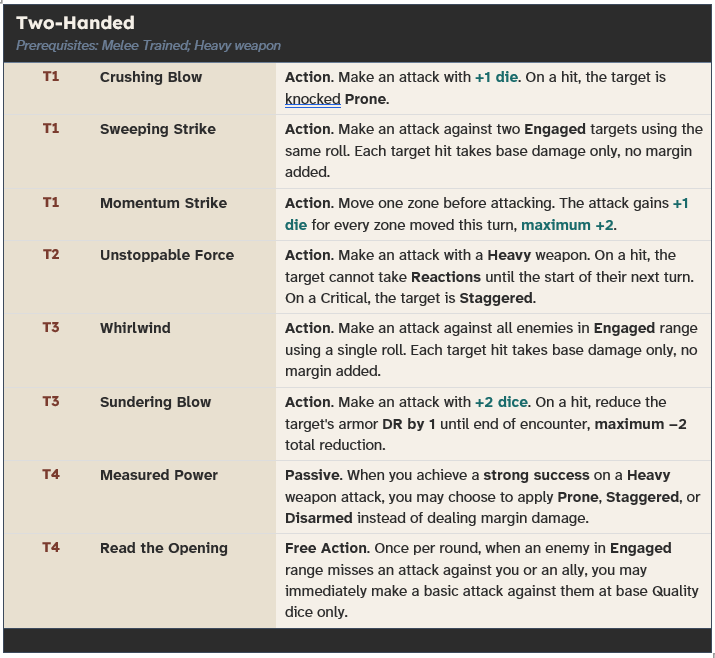
This is what horizontal progression looks like in practice.
The Tier 1 choices let you enter through power (Crushing Blow), crowd control (Sweeping Strike), or mobility (Momentum Strike). All three are viable starting points. At Tier 2, you've learned Unstoppable Force—denying enemy reactions and controlling when they can respond. This is what makes Two-Handed fighters dangerous regardless of which Tier 1 entry you chose.
At Tier 3, you specialize. Whirlwind emphasizes hitting multiple targets while Sundering Blow focuses on breaking through armor. Two different refinements of the same core style. At Tier 4, Measured Power converts strong successes into tactical outcomes, while Read the Opening turns defensive moments into offense. Both are powerful, neither makes you superhuman.
You're not hitting for 50 damage instead of 5. You're controlling reactions, hitting multiple enemies, breaking equipment, and converting defensive success into offensive opportunity. That's mastery.
Keeping Martial Progression Grounded
This became one of the biggest design traps during development. A lot of systems feel pressure to make higher-tier martial abilities increasingly spectacular, which often creates progression that drifts into anime-style escalation. That works perfectly well for some games. Threshold isn't trying to be that game.
At multiple points, techniques started drifting into increasingly exaggerated territory. Whenever that happened, I asked myself: Could an exceptionally skilled—but still human—combatant plausibly do this? Not literally, but plausibly within the fiction. That question forced repeated rewrites.
Highly skilled? Absolutely. Superhuman? No. Mastery should expand options. It shouldn't turn martial characters into demigods unless that's the explicit fantasy your game is trying to deliver.
Kits — Starting Identity Without Class Locking
One of the biggest problems in flexible systems is onboarding paralysis. I kept watching new players stare at the technique trees and freeze. Thirty-five skills, nine attributes, dozens of techniques spread across multiple trees, weapon categories, tags, traits—where do you even start? Too much freedom at character creation becomes overwhelming. You need a starting point that doesn't lock you into a permanent path.
Kits solve that problem. A kit is a pre-assembled combat identity. It gives you starting equipment (armor, weapons, supplies), technique pathways (which trees align with this fighting style), Strain reduction on pathway techniques (cheaper to use abilities that fit your style), and a Signature Move that scales across all four tiers. Without making you a Tank forever or a Skirmisher forever.
There are seventeen kits organized into five role families:
Tanks — Plate & Steel (shield user), Armored Crusader (heavy armor bruiser), Armored Destroyer (two-handed devastation)
Mobile Strikers — Skirmisher (light armor hit-and-run), Twin Blades (dual wield pressure), Unarmed Adept (no gear necessary)
Ranged — Longshot (archer/distance fighter), Gunslinger (firearms), Blade & Throw (dagger specialist)
Versatile — Blade & Bow (every range covered), Great Weapon Master (mobile two-hander), Ward & Weapon (light shield fighter)
Reach & Control — Polearm Guard (zone control), Scourge (chain & rope specialist), Net Fighter (restraint specialist)
High Risk/High Reward — Berserker (unarmored aggression), Robes & Staff (pure mage)
You pick one at character creation. It tells you what gear you start with, which techniques align with your style, and gives you a Signature Move. Six sessions later, your Plate & Steel tank might have learned Chain & Rope techniques. Your Skirmisher might have picked up Brawling. The kit was the starting point, not the destination.
Signature Moves
Every kit includes a Signature Move—a technique that's always available, costs no Strain, and scales across all four tiers. Here's an example from the Plate & Steel kit:
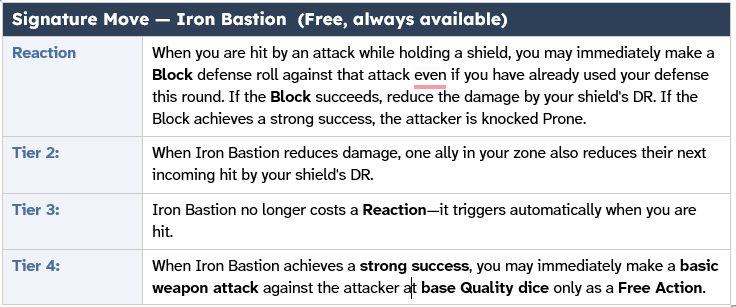
This scales horizontally. At Tier 1, it's an emergency defensive option. At Tier 2, you're protecting allies. At Tier 3, it's always on—no action economy cost. At Tier 4, you counter-attack when they fail. The numbers don't change. The capabilities expand.
That's the philosophy behind every Signature Move: your core fighting identity remains accessible even when Strain is depleted, and it grows with you across your entire campaign.
What I Worked On
This phase focused on connecting equipment to tactical identity without creating loot treadmill pressure.
The weapon list went through multiple iterations. Early drafts had fifty+ weapons, most of them functionally identical. I kept asking: does this weapon create a different gameplay experience, or is it just historical taxonomy? That question cut the list down significantly.
The technique trees took longer. I had to balance horizontal growth (expanding options) against power creep (becoming superhuman). Every technique that started drifting toward anime-style spectacle got rewritten or cut.
The kit system came last. I needed something that said "here's a coherent starting point" without creating class restrictions. The Strain reduction on pathway techniques was the key—it nudges you toward certain styles without locking you out of others.
What Went Wrong
Early versions inherited too many assumptions from traditional fantasy systems: oversized weapon lists, unnecessary differentiation, loot progression assumptions, escalating martial spectacle. Removing those assumptions made the system significantly stronger.
What I Changed
I shifted combat identity toward functional abstraction, tags, horizontal progression, techniques, and kits. That created a system that feels far more expandable without becoming bloated.
What I'm Working on Next
The next step is magic.
So far, the system handles martial combat—attacks, defenses, techniques, equipment. But Threshold's world is shaped by magic as much as steel. The next post will explore how spellcasting works, how Forms determine what magic can do, and how the resource systems (Mana, Strain, and Attunement) create pressure without overwhelming complexity.
Magic in Threshold needs to feel powerful and dangerous—not just for enemies, but for the world itself. Every spell drains finite life energy. That ecological cost shapes the entire setting, so the mechanics need to reflect those stakes.
Questions
Do you prefer highly detailed weapon systems or broader abstraction?
Should martial progression remain grounded or become increasingly mythic?
How much freedom at character creation is too much before players need stronger onboarding systems?

Combat in Threshold — Resolution and Consequence
In the previous post, I outlined how combat is structured in Threshold.
Initiative, turn flow, positioning, and player agency define how a fight unfolds at the table.
This post answers the next question:
What actually happens when actions resolve?
How Games Resolve Combat
Different systems handle this in very different ways, and those differences shape the entire feel of combat at the table.
Some games separate resolution into multiple steps. You roll to see if you hit, then roll again to see how much damage you deal. D&D and Pathfinder follow this model. It creates clarity—each roll has one job—but it also introduces variance on top of variance and adds procedural steps. I've watched combat turns stretch longer than the moments they represent, especially when a single attack requires three or four dice interactions.
Other systems collapse resolution into a single roll. Dice pools like those in World of Darkness or Blades in the Dark count successes and translate them directly into outcomes. This produces more consistent results and speeds up play. The tradeoff is that you lose some of the dramatic variance that comes from rolling multiple times—sometimes that's good, sometimes it's not.
There are also systems that introduce multiple axes of outcome simultaneously. Genesys, for example, produces success/failure on one axis and advantage/threat on another, allowing a roll to succeed while introducing complications or fail while creating opportunities. This expands the narrative space significantly, but it increases interpretation load. Every roll requires the table to parse what the combination of symbols means, which can slow decision-making.
I tested variations of all three approaches during early playtests.
Why Single-Roll Resolution
I wanted faster resolution without sacrificing meaningful outcomes.
In many two-roll systems—attack then damage—combat felt like it took forever. Each exchange required multiple resolution steps, multiple die rolls, multiple calculations. The procedural weight accumulated quickly, especially in fights with multiple combatants.
Some systems solve this by removing the attack roll entirely. MCDM's system does this—you always hit, you just roll for effect. That didn't feel right for Threshold. This isn't heroic fantasy where skilled warriors never miss. Characters are grounded, capable, but mortal. Missing should be possible. The question of whether you connect matters as much as how hard you hit.
Other systems remove the damage roll instead, folding the effect directly into the attack outcome. Systems like Into the Odd, Cairn, and their descendants use automatic damage—if you hit, your weapon deals its listed damage, no additional roll. Games like 13th Age and Mutants & Masterminds tie damage scaling to other factors (escalation dice, power levels) rather than separate damage rolls. These approaches resonated with me: a weapon in and of itself doesn't change how much damage it does—how well you connect with that weapon does.
That led me toward margin-based damage: one roll determines both success and effect. Your successes over the target number become your margin, which adds directly to damage. A solid hit naturally deals more damage than a glancing one, without requiring a second roll to adjudicate it.
This keeps the resolution loop tight: roll, count successes, compare to TN, calculate damage. One decision point, one set of dice, one outcome.
Early playtests confirmed this felt faster without losing tactical clarity. Players could see the quality of their roll translate directly into effect, and combat moved at the pace I wanted—sharp moments rather than prolonged procedures.
The Core Resolution Loop
Every action in combat follows the same structure established in the resolution mechanics post:
Declare intent
Roll dice (stat + skill)
Count successes (5+)
Compare to Target Number
Determine outcome tier
Apply effect
What changes in combat is how those outcomes translate into pressure, damage, and consequences.
Attacking
When a character attacks, they roll against the target's Defense TN.
This value is fixed, derived from the target's capabilities rather than rolled each time. For player characters, Defense TN is based on stats and defenses. For enemies, it's set by their Threat level.
Outcomes determine the result:
Failure (0 successes): The attack misses or is deflected. No effect.
Partial Success (1+ successes, below TN): The attack connects but doesn't land cleanly. Deal base weapon damage only, no margin bonus.
Success (successes ≥ TN): Clean hit. Deal base weapon damage + margin of success.
Critical Success (TN exceeded by 2+): Exceptional strike. Deal base weapon damage + margin, plus additional effects depending on the situation—knock an enemy back, disarm them, create an advantage.
Margin is calculated as successes above the TN. If you need 3 successes to hit and you roll 5, your margin is 2. That margin adds directly to your weapon's base damage.
This creates a direct relationship between roll quality and effect, without requiring a second damage roll. A great attack roll produces great results. A barely-successful attack still lands, but it doesn't hit as hard.
A note on partial success: This definition—any successes below TN—is currently under review through playtesting. If the frequency or impact doesn't achieve my design goals, I may shift to a TN-1 model where partial success only triggers when you fall exactly one success short. That would make partials rarer but more predictable.
Defending
When a character is attacked, they roll to defend.
Defense is always player-facing. The GM doesn't roll for enemy attacks—players roll to avoid them. Defense doesn't cost an action or resource. It's always available.
Instead of a binary "do you get hit," players choose how they defend based on their character and the situation.
The four defensive approaches came directly from combat experience. In most physical confrontations, these are your actual options: dodge the attack, parry it, block it, or allow it to hit you and endure it.
Dodge — Get out of the way entirely. Roll Agility + relevant skill.
Parry — Deflect or redirect the attack. Roll Might or Agility + relevant skill, defender's choice.
Block — Meet the attack with a shield or barrier. Roll Might + relevant skill. Requires a shield.
Tank — Don't avoid it—absorb it. Roll Vitality + Armor to reduce damage.
Players narrate how their character responds, and that narration determines which approach they're using. The choice is fiction-forward: a veteran soldier and a nimble duelist might both defend against the same attack, but they'll do it very differently.
Outcomes determine how much of the attack lands:
Failure (0 successes): Full damage, plus a consequence tied to your defensive approach. A failed Dodge leaves you badly repositioned. A failed Parry means you're grappled. A failed Block staggers you. A failed Tank leaves you prone.
Partial Success (1+ successes, below TN): The attack hits, but you got your guard up. Damage is reduced by the number of successes you rolled. This is where partial success becomes tactically important—even a desperate defense with one or two successes can mean the difference between taking a serious wound and walking away bruised.
Success (successes ≥ TN): You negate the attack entirely.
Critical Success (TN exceeded by 2+): You not only negate the attack, you gain an advantage. The specific advantage depends on your approach. A critical Dodge gives you +1 die on your next attack. A critical Parry creates a free counter-attack opportunity. A critical Block knocks the attacker prone. A critical Tank can frighten the attacker if your Presence exceeds their Willpower.
This creates a dynamic exchange where both attack and defense rolls matter. Combat isn't just "did the attack land?"—it's "how well did you attack, and how well did they respond?"
The four approaches also create meaningful differentiation without locking characters into rigid builds. Two characters with similar capabilities can feel very different based on how they choose to defend, and those choices carry real consequences when things go wrong.
This system also makes multi-attacker scenarios more dynamic. A character engaged with three enemies can defend against all three attacks in the same round—dodging one, blocking another, parrying a third—each defense a separate choice with separate consequences.
Making defense free was partly about this cinematic quality. "The attack misses" is a mechanical outcome, but "I duck under the first blade, catch the second on my shield, and redirect the third with my sword" is a moment. The all-player-roll model combined with free defense lets players stay active and engaged even when they're being swarmed, rather than passively watching the GM roll multiple attacks and announcing the results.
This also reinforces the grounded protagonist design. You're not avoiding attacks because you have superhuman reflexes—you're making real tactical choices about how to handle each threat as it comes, and those choices matter when things go wrong.
Damage and Mitigation
Damage is calculated as:
Base Weapon Damage + Margin − Armor DR
Armor reduces damage after the outcome is determined, not before.
This was a deliberate choice. Subtracting DR from the final damage number preserves the full distribution of attack outcomes while still making armor meaningfully relevant.
If armor raised defense TN instead, it would conflate two distinct fictional things: how hard you are to hit versus how well you're protected when hit. A knight in plate armor isn't harder to land a blow on—the blow lands, the armor absorbs it. TN modification collapses that distinction.
It also creates a secondary problem: it makes lightly-armored but highly-skilled defenders and heavily-armored but slow defenders feel mechanically identical. That undercuts the entire defense approach system. I want a nimble duelist who dodges and a heavily-armored knight who tanks to feel fundamentally different, and armor-as-TN-modifier erases that difference.
If armor reduced success count before calculating damage, it would interact with the margin formula in ways that are harder to predict. Stripping successes before damage calculation means the formula doesn't run cleanly, and it creates weird edge cases where a strong hit gets reduced to a weak hit rather than a strong hit that armor absorbed.
Post-calculation flat DR keeps attack resolution clean and the armor effect legible: the hit happened, here's how bad it was, here's what your armor stopped.
The risk with flat DR is that it creates a breakeven problem at low damage values. If base weapon damage plus margin routinely sits close to DR values, armor becomes effectively binary—either it negates the hit entirely or it barely matters. That's the damage scaling calibration gap I've flagged elsewhere. I need to verify that weapon output stays consistently above armor DR for meaningful hits, while still allowing DR to matter.
The second concern is that flat DR advantages high-single-hit builds over high-frequency-low-damage builds disproportionately. A character landing one big strike per turn bypasses more armor than a character landing multiple small strikes. That's not inherently wrong—it creates real build diversity—but it's something I'm watching in playtesting to make sure it doesn't become oppressive.
Magical damage bypasses armor entirely. This is both thematic and mechanical. Armor protects against physical force, not magical energy. This also gives magic a distinct tactical role in combat without requiring separate resistance systems.
Damage Types and Tags
Not all damage is the same, but I didn't want to track multiple damage types with separate resistance rules.
In Threshold, damage is divided into two broad categories: Physical and Magical.
This distinction matters primarily for interaction with armor and defenses. Physical damage is reduced by armor DR. Magical damage bypasses it.
Beyond that, most differentiation comes from tags.
Tags describe how damage is delivered and what effects it can produce. A weapon or ability might carry tags like Blunt, Penetrating, or Fire, which determine what kinds of conditions or secondary effects can occur.
These tags aren't separate systems—they're part of how outcomes translate into consequences. Rather than tracking multiple damage types with separate math, the system uses tags to define how damage behaves in specific situations.
Tags are applied based on how the attack is narrated—the same weapon used differently can invoke different tags and effects. A sword thrust through a gap in armor might use the Penetrating tag, while a heavy swing with the same blade might use a different tag entirely.
The full structure of tags and how they interact with techniques and abilities will be expanded in the techniques post.
Stress and Wounds
Damage is applied to Stress first—a buffer representing fatigue, near-misses, and accumulated pressure.
Stress capacity is Vitality × 5. At Tier 1 (Vitality 2), that's around 10 Stress. At Tier 4 (Vitality 5), it's around 25 Stress.
More serious consequences are tracked as Wounds.
Wounds occur when:
A single hit exceeds the Wound Threshold (Vitality × 3), bypassing Stress entirely
Stress is fully depleted and damage carries over
Wound capacity is Vitality + 1. At Tier 1, that's 3 Wounds. At Tier 4, it's 6 Wounds.
Each Wound imposes a −1 die penalty to all rolls. This represents genuine physical deterioration—your body is failing, not just tired. Three Wounds at Tier 1 means you're critically impaired, barely functional.
This creates a layered pressure system:
Stress tracks short-term combat pressure. It recovers relatively quickly through rest. Running out of Stress doesn't end you immediately, but it means the next hit is going to hurt.
Wounds track lasting impact. They don't recover quickly. They require medical treatment and time. Accumulating Wounds means you're genuinely injured, and those injuries carry forward into subsequent encounters.
This two-tier system reinforces the grounded protagonist design. Characters don't have massive HP pools that make them untouchable. They have enough Stress to feel capable in a fight, but Wounds accumulate when things go badly, and those Wounds matter.
The Wound Threshold mechanic also means that a single devastating hit can bypass your buffer entirely. A critical strike or a powerful enemy attack can deal a Wound directly, even if your Stress is full. That keeps high-damage threats dangerous throughout a campaign, regardless of how much Stress a character has accumulated.
Strain and Pressure
Strain allows characters to push beyond their limits, but it doesn't modify rolls directly.
Instead, it expands what a character can do within the action economy:
Take additional movement (2 Strain per extra Maneuver)
Interrupt initiative (2 Strain to Seize Initiative, once per encounter)
Fuel abilities and techniques
This keeps probability stable while shifting decision-making under pressure. You're not rolling bigger dice pools by spending Strain—you're gaining tactical options.
Strain also serves as an attrition resource across encounters, which I covered in detail in the Combat Structure post. It doesn't fully reset between fights, which means the cost of previous encounters is visible in the next one.
The full scope of Strain is still being refined through playtesting, particularly how it interacts with techniques. Whether techniques have their own costs, consume Strain, or operate independently will shape how advancement feels in practice.
Conditions
Conditions represent temporary disadvantages or disruptions that emerge from combat outcomes.
They are binary states—you either have the condition or you don't—and most are short-lived, clearing at the end of the affected character's next turn or through specific actions.
Conditions are applied through outcome tiers rather than separate mechanics. A strong hit might impose Slowed. A critical hit might impose Stunned. This keeps them tied to the resolution system rather than existing as a parallel layer.
The base condition list includes:
Bleeding — Take 1 Stress per turn. Requires Medicine check or healing magic to stop.
Blinded — −2 dice to attacks, can't use Perception for sight-based checks.
Burning — Take 2 Stress per turn. Requires a full Action to extinguish or immersion in water.
Deafened — Can't hear. Perception checks relying on sound are impossible, concentration on spells becomes difficult.
Frightened — −1 die to attacks against the source of fear, cannot willingly move closer to the source.
Grappled — Speed reduced to 0, −1 die to physical actions. Requires successful Might or Agility check to escape.
Poisoned — Exists in two severity tiers (Sickened/Poisoned). Causes domain die reduction. Requires Medicine check or rest to clear.
Prone — Strips skill dice from rolls, movement costs an extra Maneuver to stand.
Restrained — Speed reduced to 0, domain die reduction, skill dice stripped. Requires tool use or strength-based escape.
Shocked — Lose Reaction until end of next turn. Auto-clears.
Slowed — Movement costs 2 Maneuvers per zone instead of 1, domain die reduction for physical actions.
Staggered — Lose Action on next turn, keep Maneuver and Reaction. Clears at end of next turn.
Stunned — Lose Action and Maneuver on next turn, keep only Reaction. Clears at end of next turn.
Weakened — Lower condition application threshold by one tier for attacks carrying a specific tag.
Withered — Maximum Stress reduced by tier-based amount. Clears on 3rd Rest or longer.
These conditions interact with weapon tags, damage types, and outcome tiers to create tactical variety without requiring separate subsystems. Most trigger automatically based on margin of success or critical results, keeping resolution fast.
Failure and Consequence
One of the design goals of this system is ensuring that failure still produces meaningful outcomes.
A missed attack does nothing—but failed defenses often carry consequences beyond just damage. That asymmetry is intentional. Attacking is proactive. You swing, you miss, the moment passes. Defending is reactive. You fail to defend, and now you're in a worse position.
Similarly, partial success ensures that actions rarely result in complete stagnation. Even a barely-successful defense reduces incoming damage. Even a glancing attack deals some harm. The system is designed so that every roll contributes to the state of the fight, rather than creating dead air where nothing happens.
This ties back to the broader combat philosophy: fights should resolve quickly, but the outcomes should matter. Dice rolls shouldn't feel like they're spinning wheels—they should create pressure, momentum, and consequence.
What This System Is Doing
At a high level, this approach combines:
Consistency from dice pool success counting—you're not chasing swingy d20 results.
Clarity from structured outcome tiers—you know what each result means without interpretation paralysis.
Pressure from Stress, Wounds, and Strain—combat creates lasting consequences that carry forward.
Together, these create a system where outcomes scale with performance, decisions carry weight, and combat resolves quickly while leaving lasting impact.
What I Worked On
This phase focused on connecting resolution mechanics to combat outcomes.
The challenge wasn't building new systems—it was ensuring that everything interacted cleanly. Attack resolution needed to feed into damage calculation, which needed to interact with armor, which needed to respect the Stress/Wounds split, all while keeping the math simple enough to execute quickly at the table.
I ran dozens of sample combats on paper, testing different damage values against different armor ratings, checking how often Wounds triggered, and watching how quickly Stress depleted under sustained pressure.
What Went Wrong
The biggest issue was calibration.
Damage scaling, Stress pools, and outcome frequency all depend on each other. Small changes in one area create large shifts elsewhere.
If weapon base damage is too low, margin becomes the dominant factor and weapons feel interchangeable. If it's too high, margin doesn't matter and dice pools feel less rewarding. If Stress is too low, characters feel fragile. If it's too high, Wounds never trigger and the pressure system flattens.
These are still being refined through playtesting. The formulas are stable, but the specific numbers need validation against real table conditions.
The other challenge was partial success frequency. The "any successes below TN" definition makes partials common, which was intentional—I wanted failed actions to still produce something. But common partial successes can create a grind if they're not impactful enough. That's why it's flagged for potential revision to a TN-1 model.
What I Changed
Earlier versions relied more on binary outcomes and separate resolution steps.
Attack and damage were separate rolls, which created the procedural weight I was trying to avoid. Defense was passive—enemies rolled to attack, players just took damage or didn't. Conditions were separate status effects with their own tracking systems.
These were replaced with:
Margin-based damage in a single roll, which collapsed resolution into one step without losing granularity.
Unified outcome tiers that apply to attacks, defenses, and skill checks equally, reducing the number of systems players need to learn.
Player-facing defense rolls with distinct approaches, which kept players engaged during enemy turns and created meaningful tactical choices.
Layered health and pressure systems (Stress + Wounds + Strain) that interact to create escalating tension without requiring separate resource pools for every type of consequence.
This reduced complexity while increasing consistency. The system does more with fewer moving parts.
What I'm Working On Next
The next step is expanding on how these resolution mechanics interact with character options:
Techniques and special actions
How weapons differentiate beyond base damage
Magic integration and casting rules
So far, the system defines how actions resolve and what those resolutions produce.
Next, it defines how characters expand those actions into distinct playstyles and tactical approaches.
Questions
Do you prefer single-roll resolution systems, or layered ones with separate attack and damage steps? How does that preference change when you're playing versus running the game?
In systems you've played with player-facing defense, did choosing how to defend feel meaningful, or was there usually one obvious choice?
How often should partial success occur? Should it be common (rewarding any progress) or rare (marking near-success specifically)?

Combat in Threshold — Structure and Flow
Before getting into the details, a quick note on scope.
The previous post focused on what combat is meant to be in Threshold—its role in the game, how it fits into the broader experience, and what kinds of outcomes it should produce.
This post is different.
This is about how combat actually runs at the table.
How Different Games Structure Combat
Once you move from intent to implementation, you start to see how differently games approach the same problem.
Some systems lean into structured tactics. Combat is broken into discrete turns, positioning is precise, and the rules define exactly what a character can do at any given moment. Dungeons & Dragons and Pathfinder are the most familiar examples of this approach. It provides clarity and depth, but it can slow the game as complexity increases.
Others treat combat as another form of conflict, using the same core mechanics that handle everything else. In games like Blades in the Dark and FATE Core, a fight may resolve in a small number of rolls, with the focus placed on consequences rather than step-by-step execution. This keeps pacing tight, but trades away some tactical detail.
There are also systems that experiment with alternative turn structures. The Cosmere RPG, for example, uses a fast turn / slow turn model where players choose between acting early with fewer options or later with greater flexibility. It creates meaningful tradeoffs and keeps momentum high.
I strongly considered that approach.
In the end, I didn't use it—not because it doesn't work, but because it solves a different problem. Fast/slow optimizes for individual heroics—the skilled warrior who reads the moment and acts at exactly the right time. That's a protagonist-centered fantasy. One person making the perfect call.
Threshold prioritizes collective competence instead—a group of people who aren't individually superhuman using communication and planning to punch above their weight. The initiative system needed to reflect that thesis about what heroism looks like.
Initiative — Coordination Over Timing
Combat begins with an initiative roll.
Each character rolls Clarity at the start of the encounter. I chose Clarity over Agility deliberately—awareness of a situation is what lets you prepare mentally and physically, which felt more coherent than pure physical reflex speed as the determinant of who acts first.
From there, the system branches based on the situation:
If the party is prepared, players may freely rearrange their initiative order before the first round begins. This allows tactical coordination—the rogue can go first to create an opening, the defender can position before enemies close, the caster can delay until the right moment.
If the party is surprised or ambushed, initiative remains in rolled order. Characters react in the moment rather than coordinating beforehand.
Enemies always act in their rolled order.
After the first round, the order becomes fixed.
There is one exception: Seize Initiative. A character may spend 2 Strain to act immediately, interrupting the current order. This can be used once per encounter.
I evaluated several alternatives before landing here. Static initiative (roll once, fixed order) was too passive—it removes coordination as a meaningful choice entirely. Contested initiative each round (like the Cosmere model) created too much overhead. A popcorn/side initiative system where players choose to pass to an ally or enemy after each turn maximized coordination but required a decision every single turn, compounding drag across the encounter. It also assumed clean two-sided conflicts, which doesn't hold for the morally complex, multi-faction encounters Threshold's setting implies.
What I kept from those alternatives was the tactical coordination of popcorn—players can arrange their order to set up combos—without the per-turn overhead. You make that decision once, before round one, and then execute. Seize Initiative preserves the emergency override that popcorn builds in structurally, but gates it behind a resource cost and a once-per-encounter limit so it doesn't become routine.
The surprise condition matters because coordination is the mechanical expression of Threshold's core fantasy. If coordination is always available regardless of circumstances, it loses meaning. Being caught unprepared doesn't just mean you act in a bad order—it means you lose the thing that makes your group effective. That's a more meaningful consequence than "you rolled low initiative."
Fast/slow systems have no equivalent vulnerability. Your timing trade-off is always available because it's an individual decision that doesn't depend on your relationship to your allies.
Turn Structure — Three Categories That Do Different Jobs
Each turn consists of three parts:
1 Action 1 Maneuver
1 Reaction
Actions represent meaningful commitments—attacking, casting a spell, or taking a decisive step.
Maneuvers cover movement and smaller adjustments—repositioning, taking cover, or interacting with the environment.
Reactions allow characters to respond outside their turn.
I tested several alternatives before settling on this structure.
Pathfinder 2e's three-action pool offers maximum flexibility but creates decision paralysis and makes ability balancing harder—if everything costs actions, you have to carefully price every technique across the entire system. For a game being built through playtest refinement, that's a fragile foundation.
D&D 5e's Action + Bonus Action + Move + Reaction has too many categories, and the Bonus Action creates feat tax problems where certain builds depend on having something to do with it.
A single "one meaningful thing per turn" model collapses the distinction between acting and existing in space. A character who crosses a room and then attacks isn't doing one thing—they're doing two things that flow together. A single-action model either makes movement free (removing positioning as a meaningful decision) or makes it cost your only action (creating fundamentally different experiences for mobile versus stationary fighters with no mechanical acknowledgment).
The three-category split maps directly onto three distinct questions a player answers each turn:
What do I do? (Action — the meaningful, stakes-carrying activity)
How do I position? (Maneuver — tactical adjustment that doesn't carry stakes on its own)
How do I respond? (Reaction — off-turn agency)
That third category is load-bearing in a way specific to Threshold's design. Reactions provide a structural slot for off-turn agency—interposing yourself to protect an ally, triggering a readied action, responding to something unexpected in the moment. They create opportunities for dramatic choices that fall outside the normal turn sequence.
Separating Maneuvers from Actions lets positioning be a real decision without making it costly. Under minimal resource pressure, players shouldn't feel like moving costs them their turn. Movement is always available, but going beyond standard positioning costs Strain. That's minimal-resource-pressure design with tactical depth preserved.
In practice, these categories are easy to use but harder to define precisely for edge cases. The system is currently driven by examples rather than strict classification rules, with the underlying structure still being refined through playtesting.
Positioning Without Precision Counting
Movement is handled through a zone-based system rather than exact measurement.
Horizontally, positions are divided into:
Engaged
Close
Near
Far
Extreme
Vertically:
Ground
Elevated
Airborne
Beyond
A standard Maneuver allows a character to move one zone.
This approach is grounded in how distance is actually experienced during action. Through training and repetition, you develop an intuitive sense of what is within reach and what isn't. Whether that's striking distance, effective range with a weapon, or how far you can move before someone can respond, those judgments come from familiarity rather than measurement.
My military training and time in combat arts taught me this: when you're moving and fighting, distance is understood intuitively rather than calculated.
That's the perspective I wanted Threshold to capture.
Zones preserve the importance of positioning without requiring constant calculation. Players can make decisions based on intent and relative positioning rather than exact distances.
There are still open questions around zone density and edge cases, but the core system is already functioning as intended.
Strain — Pushing Beyond Limits
Strain serves two roles simultaneously, and the tension between them is intentional.
Within an encounter, Strain is a tactical resource—a budget for pushing past your baseline capabilities. Every spend is a decision: burn Strain now to move an extra zone or seize the initiative, or hold it in reserve because the fight isn't over. That spend-now-versus-save-for-later pressure creates meaningful choices without adding mechanical complexity to every single action.
Across encounters, Strain becomes an attrition resource. It doesn't fully reset between fights, which means the cost of the last encounter is visible in the next one. A party that burned through Strain taking down a patrol arrives at the fortress gate already depleted. That's a design choice rooted in the world of Threshold—this is a setting defined by scarcity and slow collapse, and the resource system should reflect that.
Without Strain, combat becomes a series of isolated tactical puzzles with no connective tissue between them. Characters would be functionally fresh every fight, which contradicts everything Threshold is trying to say about the weight of living in a dying world.
What Strain Does
At this stage of development, Strain's primary combat uses are:
Take additional Maneuvers (2 Strain each) — Extra movement or tactical adjustments beyond your base allotment.
Seize Initiative (2 Strain, once per encounter) — Act immediately, interrupting the current turn order.
The full scope of Strain is still being refined through playtesting. The core principle is clear—it creates meaningful decisions about when to push beyond your baseline—but the exact range of applications is still in active development. I'm also evaluating how Strain and techniques should interact: whether techniques have their own costs, whether they consume Strain, or whether they operate independently. That relationship will shape how advancement feels in practice.
Pool Size and Scaling
Strain pools run 10 to 14 for most characters, derived from 8 + Essence + Force—the two Quality scores underlying physical endurance and mental discipline.
The pool is intentionally flat. Base stats are capped at 1-3 for most characters, with investment pushing toward 4-6 only through deliberate building choices. The difference between an uninvested character (pool of 10) and a heavily invested one (pool of 14) is real but not dramatic. A maximum-investment character hits 20, but that requires significant resource commitment across both relevant stats.
This flatness is a feature. Strain represents your innate threshold for pushing past what your body and mind want to do—the kind of grit that's more about who you are than how hard you've trained. Working out every day doesn't fundamentally change how far you can push yourself past your limits; it changes what your baseline limits are.
Advancement in Threshold gives characters better tools for managing Strain—techniques that cost less, abilities that trigger at low Strain, more efficient recovery—not a dramatically larger pool. That's horizontal progression in practice.
Recovery
Strain recovers through Threshold's four-rest progression, and the amounts are deliberately modest:
1st Rest (10 seconds, combat action): Half Vitality, round down, minimum 1. A battlefield breather—enough to matter, not enough to reset.
2nd Rest (10 minutes): Vitality × 2 if Strain is your primary recovery choice; Half Vitality minimum 1 if you prioritized Stress instead. The choice between resources is itself a meaningful decision.
3rd Rest (1 hour): Full Strain recovery if chosen as primary; Half Vitality minimum 1 if secondary.
4th Rest (8-10 hours): Full recovery of both Strain and Stress, progression resets.
The key principle here is that the 2nd and 3rd rests force a choice between recovering Strain or Stress—you can't fully address both until a full night's sleep. A character depleted in both resources has to make a real decision about which gap matters more before the next fight. That's the grounded protagonist experience in mechanical form: you don't fully reset between fights, and managing that depletion is part of what skilled play looks like in Threshold.
Why Strain Supports the Design
Grounded protagonists: Strain doesn't fully reset between fights. The cost of every desperate sprint and every seized initiative accumulates and carries forward. Characters are capable people operating under real limits, not action heroes who shake off exertion between scenes. The four-rest progression ensures that recovery is earned through fictional action—taking shelter, catching your breath, tending to each other—rather than assumed.
Horizontal progression: The pool stays flat. Veterans don't have dramatically more Strain than fresh characters—they have better techniques, more efficient costs, and harder-won experience with when to spend and when to hold. That's the distinction Threshold draws between experience and power: you get more capable, not more superhuman.
Fast resolution, lasting consequences: Strain keeps the action economy from becoming a spam problem—extra maneuvers cost 2 Strain each, which means movement decisions have real weight without requiring complex opportunity attack rules or movement restrictions. At the same time, the attrition model ensures those costs don't disappear at the end of the encounter. The fight was fast; the consequences linger.
Flow of a Round
A round of combat follows a consistent structure:
Initiative is established. Players act in their determined order. Each character takes a turn using their Action and Maneuver. Reactions occur as triggers arise. The round advances.
The system provides enough structure to support coordination while avoiding unnecessary procedural overhead.
When Combat Ends
Combat does not end because a specific condition is met.
It ends when the situation changes.
One side may retreat, surrender, or disengage. The objective may be achieved. Continuing may no longer be viable.
As established previously, combat is not assumed to be a fight to the death. The structure supports that by allowing outcomes to emerge from the situation rather than enforcing a fixed endpoint.
What I Worked On
This phase focused on translating combat from a design goal into a usable structure.
The emphasis was on clarity, flow, and keeping players engaged without introducing unnecessary complexity.
What Went Wrong
The main challenge was classification.
Dividing actions into Actions, Maneuvers, and Reactions works well in play, but defining those categories cleanly—especially for edge cases—has proven more difficult.
Some systems also revealed dependencies that weren't immediately obvious, particularly around reactions and partial outcomes.
What I Changed
Earlier versions relied more heavily on rigid sequencing and precise positioning.
These were replaced with:
Flexible initiative that rewards coordination
Zone-based movement
Player-driven flow
Each change reduced friction and better aligned the system with its intended pacing.
What I'm Working On Next
The next step is to define how combat resolves at a mechanical level—what players actually do on their turns and how those choices create tactical depth:
Attack and defense interactions
The action economy in practice
How decisions during combat create meaningful consequences
Several parts of the system are functional but still being refined:
The exact definition of partial success in combat
Formal rules for engagement and reactions
Full mechanical definitions for conditions
The complete scope and scaling of Strain
These are active areas of development and will be clarified through playtesting.
This post establishes how combat runs. The next will establish what those actions produce.
Questions
Does coordinated initiative feel like meaningful flexibility, or unnecessary complexity?
How much structure do you prefer in turn order before it begins to slow the game down?
Do zone-based systems feel intuitive in play for you, or do they require additional scaffolding to remain consistent?

Combat — The Meaning of Violence in Threshold
Combat is one of the most visible parts of a tabletop RPG.
It's also one of the easiest places for a system to drift away from its own goals.
Before getting into initiative, actions, or mechanics, I want to step back and define what combat is actually supposed to be in Threshold. Not how it works, but what role it plays in the game.
Because once that's clear, the mechanical decisions become much easier to justify.
What Combat Does in Different Games
Combat tends to feel like a constant across tabletop RPGs, but its role varies more than it first appears.
In some systems, combat is the primary engine of play. It provides structure and challenge, and much of the game's depth comes from how encounters are approached and resolved. In games like Dungeons & Dragons, a large portion of the rules exist to support this kind of play.
In others, combat is simply one form of conflict among many. It sits alongside negotiation, stealth, and social pressure, often using the same core mechanics. Games like Blades in the Dark treat violence as one option rather than a default path.
There are also systems where combat is less about step-by-step resolution and more about consequences. A single roll or move can determine how an exchange unfolds, with the focus placed on what changes rather than how each moment is simulated. You can see this approach in games like Apocalypse World.
None of these approaches are inherently better than the others. They reflect different priorities.
What matters is that the mechanics align with the role combat is meant to play.
Combat as One Tool, Not the Default
In many systems, combat becomes the center of play almost by accident.
The rules for fighting are the most detailed. Character options often point in that direction. Encounters are structured with the expectation that violence will resolve them. Over time, this trains both players and GMs to treat combat as the default solution.
That isn't the direction I want for Threshold.
Combat is one way to engage with a problem. It sits alongside negotiation, exploration, manipulation, avoidance, and preparation. It should feel like a meaningful choice, not an assumed outcome.
When players choose violence, it should be because it makes sense in the moment, not because the system quietly funnels them toward it.
Stakes Before Strategy
It's easy for combat to become detached from the world it's happening in.
Once initiative is rolled, attention shifts toward positioning, sequencing, and optimization. The reasons the fight started can fade into the background.
I want those reasons to remain present.
Before a fight begins, there should be a clear sense of what's at risk. Who is involved, what happens if things go poorly, and what changes if the characters succeed.
Those questions should still matter while the fight is happening.
Winning isn't just about ending the encounter. It's about what that outcome means in context.
Fast Resolution, Lasting Consequences
One of the most consistent friction points I've run into with combat-heavy systems is pacing.
Fights expand to fill entire sessions. Turns stretch longer than the moments they represent. The table's attention shifts from decision-making to process.
That's not the experience I'm aiming for.
Combat in Threshold is designed to resolve quickly. Not because it's unimportant, but because it shouldn't crowd out everything around it. A fight should feel like a sharp moment rather than a prolonged procedure.
The outcome, however, should persist.
Damage carries forward. Resources are spent. Positions change. Relationships can shift. The world doesn't reset once the fight ends.
The contrast matters: resolution is brief, consequences are not.
Combat Is Not Binary
Many systems quietly assume that combat ends when one side is no longer standing.
That structure is simple, but it flattens behavior. Every fight becomes a question of endurance rather than judgment.
That isn't how conflict usually plays out.
Creatures respond to danger based on what they are and what they want. A wounded animal doesn't continue fighting if escape is possible. A pack may break once its leader falls. Something more cunning might withdraw early, choosing to regroup rather than risk a decisive loss.
Intelligent opponents go further. They assess risk, change tactics, and recognize when a situation has turned against them. Surrender, retreat, or negotiation can all emerge once the outcome is no longer in their favor.
That doesn't remove tension. It changes where that tension sits.
The question stops being "who survives to the last hit" and becomes "how far this situation escalates before someone chooses to end it."
Ending a fight also isn't the same as winning it. Driving something off, forcing a retreat, or reaching an uneasy pause can all resolve an encounter, but each leads somewhere different.
Combat becomes part of a larger chain of events rather than a closed loop.
Positioning Without Precision Counting
Positioning plays a meaningful role in combat.
Where you stand, what you can reach, and how you move all influence the outcome of a fight. Those decisions should remain visible to players.
At the same time, there's a point where precision stops helping.
Grid-based systems often push toward exact measurement. Counting squares can slow the flow of play and shift attention toward optimization rather than intent.
In practice, that's not how people actually experience distance in motion.
Through training and repetition, you develop a sense of what is within reach and what isn't. Whether that's striking distance, effective range with a weapon, or how far you can move before someone can respond, those judgments come from familiarity rather than measurement.
My military training and time in combat arts taught me this: when you're moving and fighting, distance is understood intuitively rather than calculated.
That's the perspective I wanted Threshold to capture.
Instead of tracking exact units, the system uses zones. The goal is to preserve the importance of positioning without requiring constant calculation. Players should be able to understand their options at a glance and act on them based on intent, not measurement.
Characters Are Capable, Not Untouchable
Power scaling has a direct effect on how combat feels over time.
In many systems, characters eventually reach a point where threats must escalate dramatically just to remain relevant. That escalation can disconnect the system from the world it's meant to represent.
In Threshold, characters become more capable, but they remain vulnerable.
They gain reliability. They expand their toolkit. They learn how to approach situations more effectively. What they don't gain is immunity from risk.
That keeps combat grounded. Stakes remain personal, and decisions continue to matter even at higher tiers of play.
Violence Has a Cost
This ties back to the broader themes of the setting.
The world of Threshold is already under strain. Environments are fragile. Resources are limited. Relationships are unstable.
Violence interacts with all of those.
A fight can solve an immediate problem, but it often creates others. It can escalate tensions, damage environments, or close off alternatives that might have been available earlier.
That doesn't mean combat is discouraged. It means it is consequential.
Choosing violence should feel like a decision, not a default action.
What This Means for the System
All of these ideas feed directly into the mechanics that follow.
The resolution system needs to be fast without becoming unclear—fights should feel like sharp moments, not prolonged procedures. Players need to stay engaged throughout, with meaningful decisions on every turn. Coordination matters, but rigid turn order can kill momentum. Positioning creates tactical depth, but counting squares slows everything down.
Most importantly, the results of a fight need to carry forward into the rest of the game. A combat system that resets the world to neutral after every encounter misses the point.
The system doesn't start with mechanics and hope they produce the right experience. It starts with the experience and builds toward it.
What I Worked On
This stage focused on clarifying the role combat should play in the game.
Rather than building mechanics immediately, I spent time examining how combat behaves in different systems and where it tends to pull attention away from the rest of play.
What Went Wrong
One recurring issue was how easily combat becomes the default focus of a game.
Even when that isn't the intention, systems tend to reward it simply because it is the most detailed and supported part of the rules.
What I Changed
The main shift was making the purpose of combat explicit.
Instead of assuming it would align naturally with the rest of the system, I treated it as something that needed clear boundaries and design goals.
That clarity makes it easier to evaluate every mechanical decision that follows.
What I'm Working On Next
The next step is to move from philosophy into structure.
How does a fight actually begin? How is initiative handled? What does a round represent, and what can a character do during it?
Those questions lead directly into the next post.
Questions
Two things I'm especially interested in:
In your experience, what causes combat to overtake a session? Is it the mechanics themselves, or how they're typically used?
Do you prefer combat systems that emphasize detailed tactics, or ones that resolve more quickly with broader decisions?
Next time, I'll break down how combat in Threshold is structured at the table, starting with initiative and the flow of a round.

Resolution Mechanics — The Engine Room of the Game
A quick note before we start.
Resolution mechanics sit at the center of almost every tabletop RPG. They determine how uncertainty is handled, how often players roll dice, and what success or failure actually means in play.
Because of that, this post is a little longer than the previous ones.
The goal here isn't just to explain the system used in Threshold. It's to walk through the design choices that led to it. Resolution mechanics are effectively the backbone of a game system. Once they are set, many other rules grow out of them: attributes, skills, combat pacing, difficulty scales, and how tension appears at the table.
So before getting into the specifics of Threshold, it's worth stepping back and looking at what I needed the resolution system to do in the first place.
What Resolution Mechanics Actually Do
Every tabletop RPG eventually reaches the same moment.
A player attempts something uncertain.
Maybe a character tries to climb a crumbling tower wall during a storm. Maybe they attempt to stabilize a dying ally. Maybe they try to read the motives of someone whose intentions are carefully hidden.
At that point the game has to answer a question:
What happens next?
Resolution mechanics are the procedures a game uses to answer that question. They translate fictional uncertainty into mechanical outcomes.
The specific tools vary widely—dice, cards, tokens, towers of wooden blocks—but the purpose is always the same. They determine whether an action succeeds, fails, or produces something in between.
The shape of that system has a profound effect on the experience of play. Some systems emphasize unpredictability and dramatic swings. Others favor reliability and modeling competence. Some prioritize narrative consequences over tactical precision.
Changing the resolution mechanic often changes the feel of the entire game.
What I Needed From Threshold's Resolution System
When I started designing the resolution mechanics for Threshold, I had a clear set of constraints based on the ability score and skill systems I'd already committed to.
I needed a system where:
Characters could improve without becoming untouchable. Advancement should feel meaningful, but it shouldn't remove risk entirely.
Competence felt reliable without becoming predictable. Skilled characters should succeed more often, but uncertainty needed to remain present even for experts.
Failure produced momentum rather than dead ends. I didn't want binary pass/fail outcomes. Partial successes and failures with consequences needed to be built into the core system.
The math stayed visible and direct. Following the principle from the ability scores post, I wanted the numbers players saw to be the numbers they used—no hidden conversions or lookup tables.
Those constraints immediately ruled out some approaches and pointed toward others.
The Options I Considered
I spent a lot of time analyzing how different resolution systems behave, particularly how their probability distributions shape the experience of play.
Flat Distributions: The d20 Model
The most familiar approach is the d20 system used in Dungeons & Dragons. Every result from 1 to 20 has exactly the same probability of appearing.
I've played enough D&D to know what this feels like at the table. The flat distribution creates dramatic swings. Experts can fail spectacularly, and novices can occasionally succeed through sheer luck. That volatility supports cinematic moments, but it makes competence feel inconsistent.
For a game built around grounded protagonists who grow through experience, that didn't fit. I wanted skilled characters to feel skilled, not just lucky.
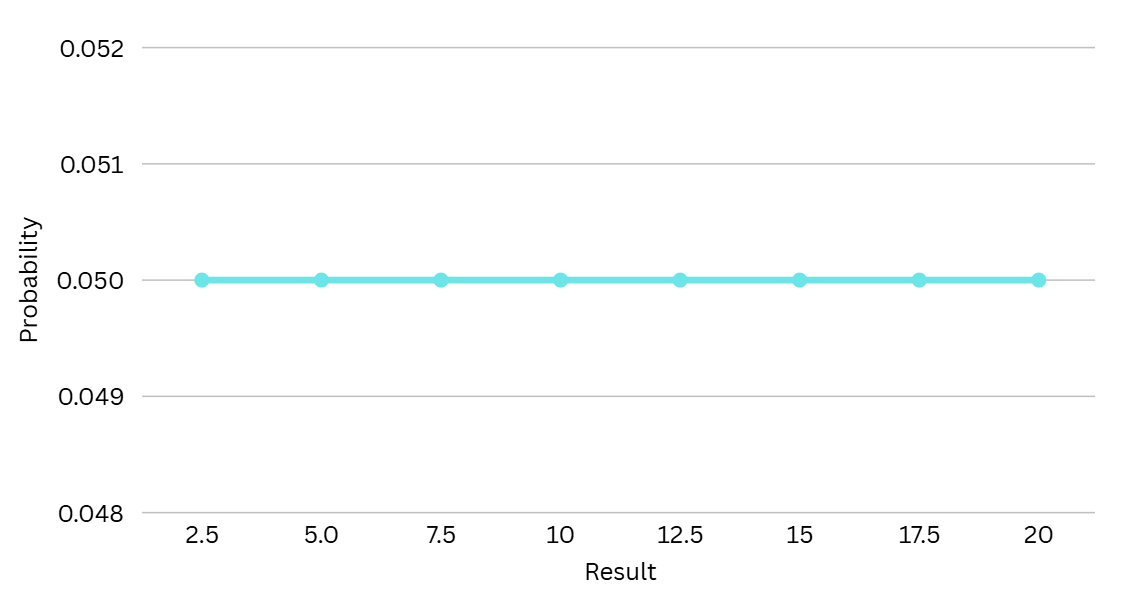
d20 distribution
Bell Curves: The 3d6 Model
Systems like GURPS roll multiple dice and add them together, often using 3d6. Because many dice are combined, results cluster toward the middle.
The bell curve produces something different. Skilled characters succeed more reliably, while extreme results become rare. This models competence well, but it has its own tradeoff: the math gets heavier. Addition slows down resolution, and modifiers pile up quickly.
More importantly, scaling becomes a problem. To keep difficulty meaningful as characters improve, you have to inflate both the target numbers and the bonuses. Eventually you're adding +15 to beat a target of 23, and the actual dice rolls start to feel ceremonial.
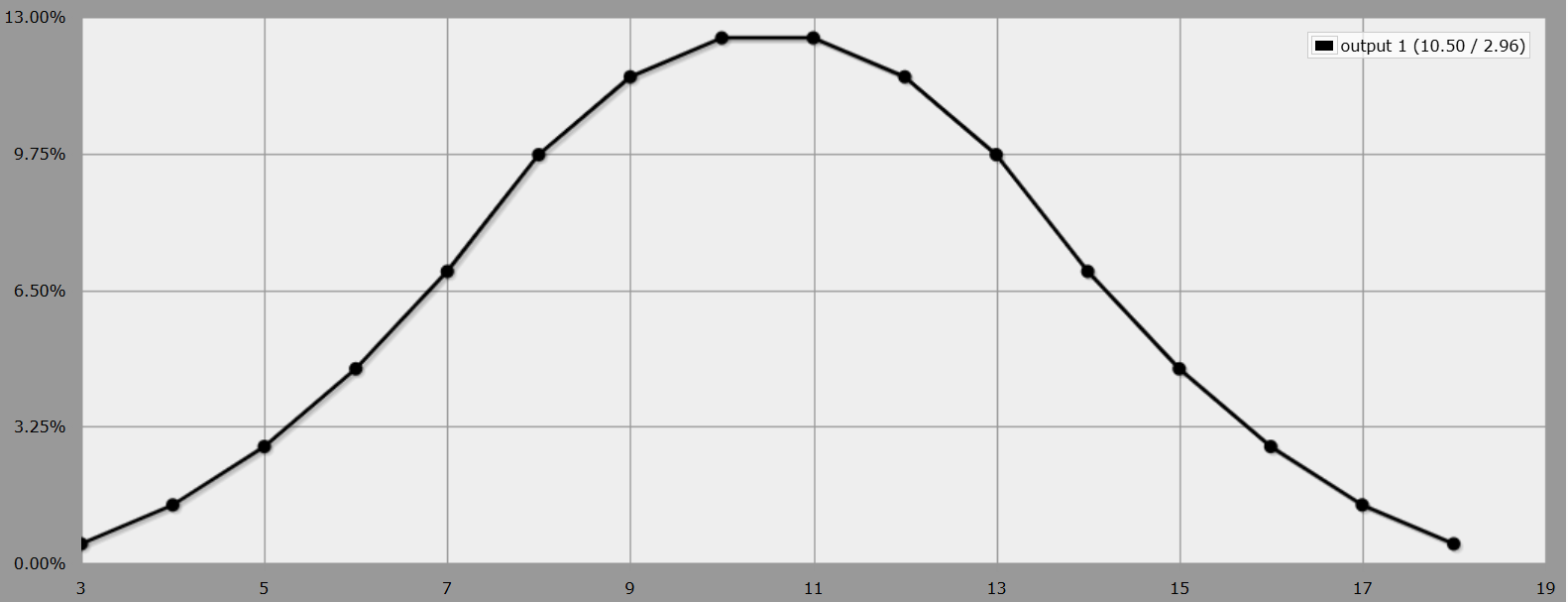
3d6 distribution
Dice Pools: Counting Successes
The third approach I examined was dice pools, where multiple dice are rolled and each die can contribute a success independently.
Games like Shadowrun, Blades in the Dark, and World of Darkness use variations of this pattern. The number of dice rolled reflects a character's competence, and results are interpreted by counting successes or selecting the highest die.
What appealed to me about dice pools was how they scale. Adding dice to the pool gradually increases reliability without requiring inflation. A character with 6 dice is meaningfully better than one with 3 dice, but they're still operating in the same mathematical space. The dice themselves don't change—just how many you roll.
This aligned with the horizontal progression model I wanted. Characters don't grow from rolling d6s to rolling d20s. They roll more dice, more reliably.
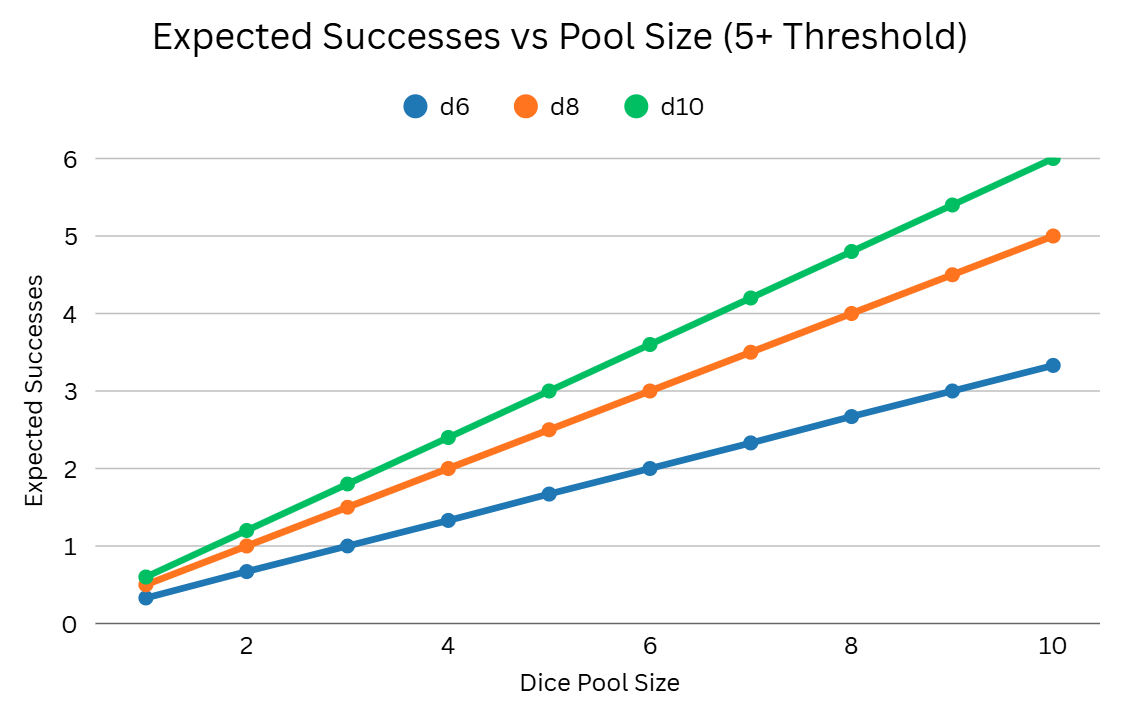
Expected Successes vs Pool Size
Other Models I Looked At
I also examined more unusual resolution systems to see what they prioritized.
Dread replaces dice entirely with a Jenga tower, creating physical tension during horror scenes. The tower's instability mirrors the characters' precarious situation, and every pull reinforces the genre. His Majesty the Worm uses tarot cards for action resolution, where the symbolic weight of each card adds interpretive depth to outcomes. Genesys uses custom dice with symbols instead of numbers, allowing a single roll to produce success, failure, advantages, and threats simultaneously.
What all of these systems have in common is that they integrate the feel of the game directly into the resolution mechanic. The dice aren't just producing numbers—they're reinforcing tone and genre expectations.
That's powerful, but it comes with a cost. Custom dice require learning a new symbolic language. Tarot cards demand interpretation. Jenga towers create physical tension but can't be used for every roll without losing impact.
For Threshold, I needed something that could handle frequent tactical decisions, environmental pressure, and long-term play without becoming unwieldy. The resolution system had to support the game's themes without slowing down adjudication every time someone climbed a wall or swung a sword.
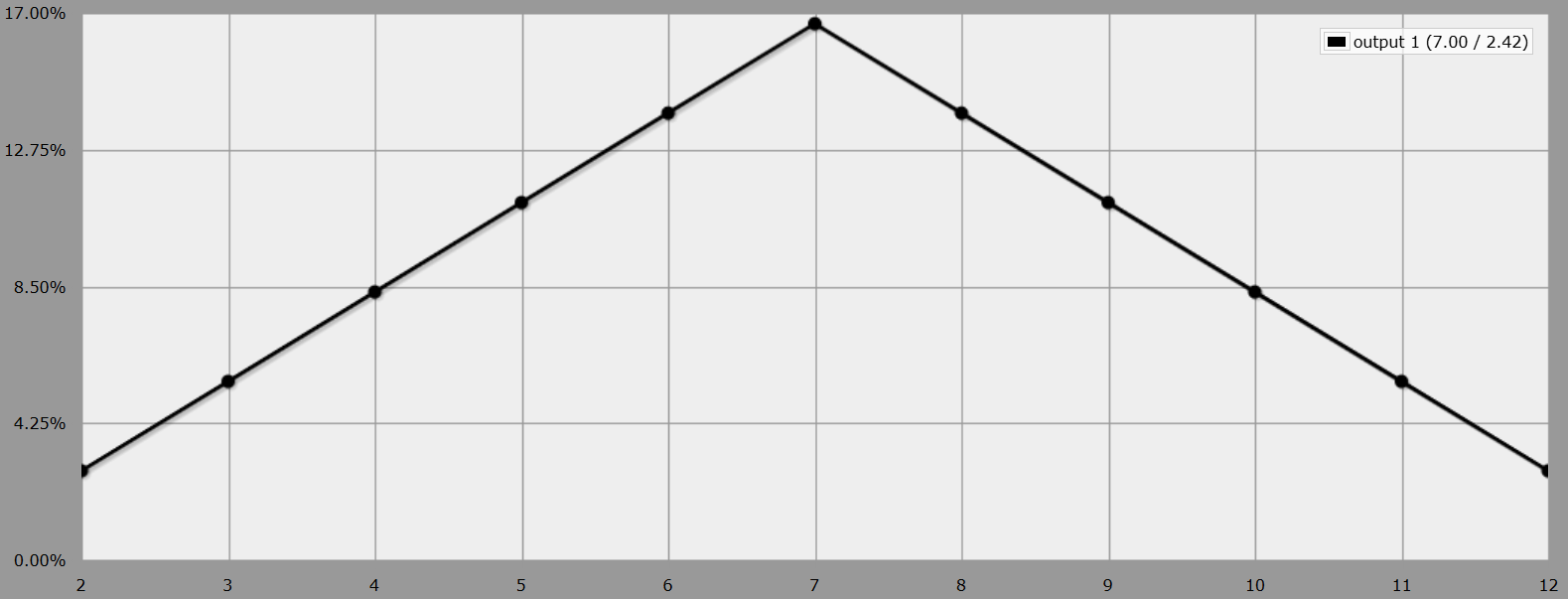
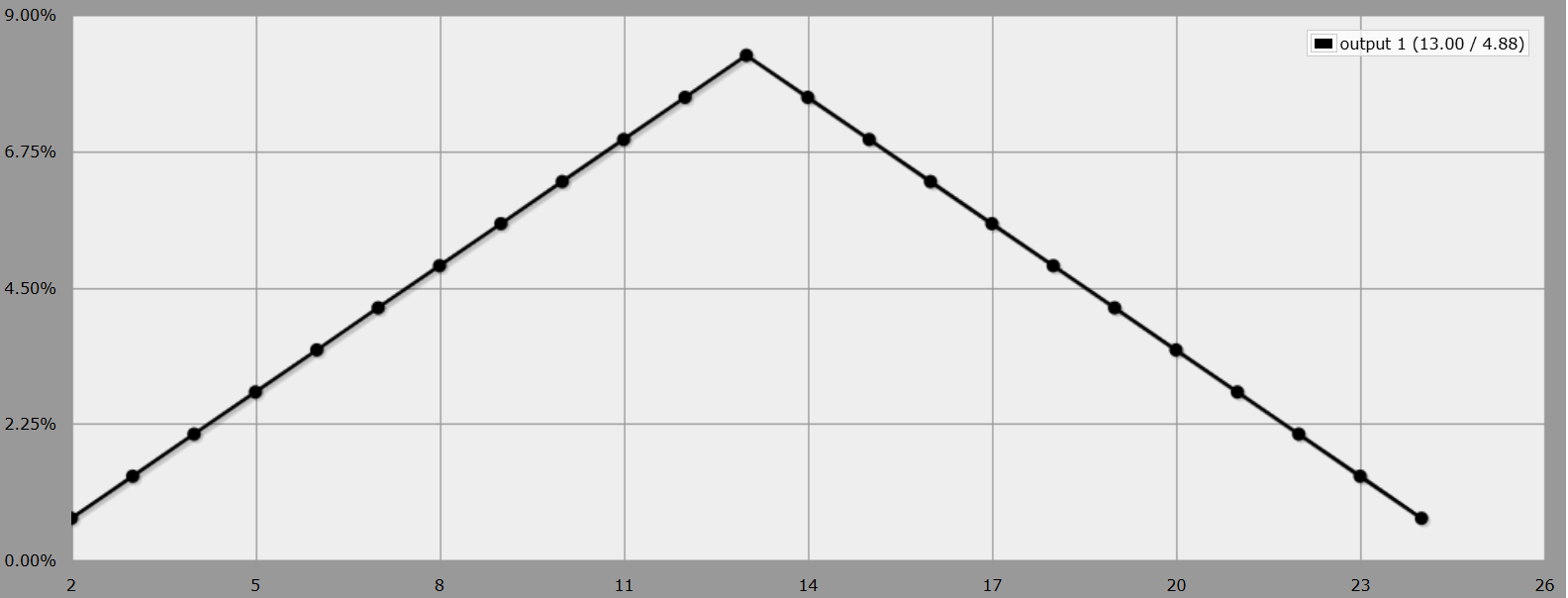
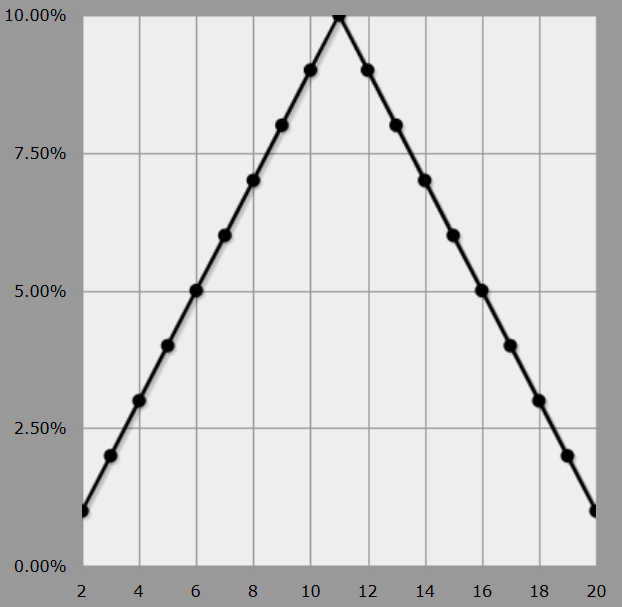
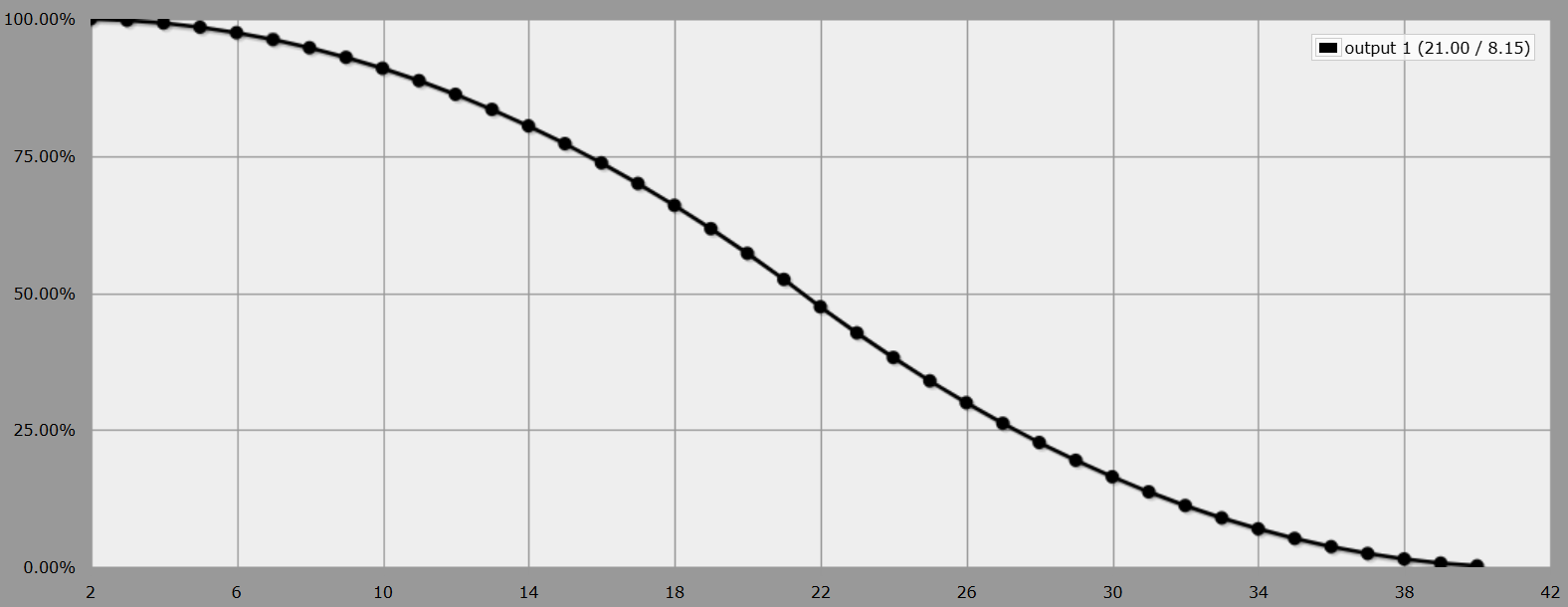
Distribution graphs for 2d6 (PbtA, Traveller), 2d12 (Daggerheart), and 2d10 (M.E.G.S, Draw Steel) and 2d20 (Modiphius) systems, all of which I considered.
Dice pools offered the right balance. They could scale elegantly, they used familiar tools, and they left room for the fiction to reinforce tone rather than demanding that the mechanics do all that work alone.
Why Dice Pools Fit Threshold
Dice pools solved several problems at once.
They allow characters to improve by becoming more reliable, rather than by inflating numbers to extreme levels. Additional dice gradually increase the likelihood of success while still allowing unexpected outcomes.
They support the grounded protagonist philosophy. A character with 8 dice in their pool is experienced and capable, but they're not superhuman. They can still fail. They can still be caught off guard.
They also make partial success easy to model. Instead of binary pass/fail, the number of successes naturally creates gradations of outcome. That became the foundation for the outcome tier system I'll explain below.
How Resolution Works in Threshold
Once I committed to dice pools, the core resolution process came together quickly.
The flow is straightforward:
A player declares an action.
If the outcome is uncertain and meaningful, a roll is called for.
GM sets Target Number (TN)
The player builds a dice pool from their attributes and skills.
Dice are rolled.
Results are evaluated by counting successes.
The number of successes is compared to the TN.
The final result falls into one of four outcome tiers.
Why Four Tiers?
I settled on four outcome tiers after testing several variants. Three felt too binary—you either succeeded or you didn't, with only one middle ground. Five created too much interpretation overhead and slowed down adjudication.
Four tiers gave me enough granularity to make partial success interesting without bogging down play.
The tiers work like this:
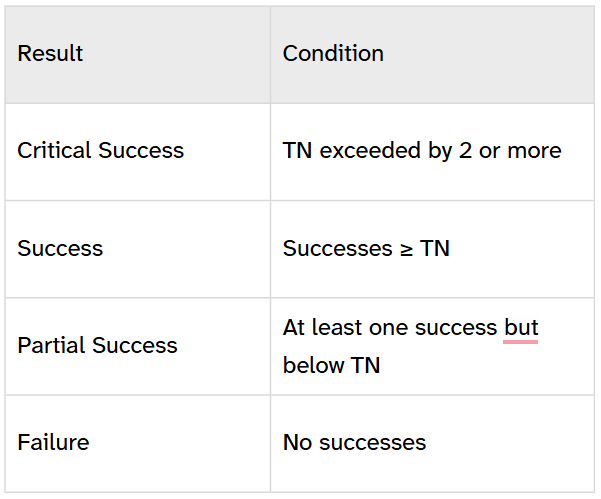
Critical successes produce exceptional outcomes or avoid complications. Successes achieve the intended result cleanly. Partial successes accomplish the goal but introduce costs, complications, or delays. Failures mean the attempt doesn't work—but they often create new problems or reveal information.
This structure allows the system to produce more nuanced outcomes than a simple success-or-failure model, which was one of my core design goals.
Building the Dice Pool
Dice pools in Threshold are constructed from three elements:
Attribute Quality determines the number of base dice.
Domain determines the die size (d6, d8, or d10).
Skill ranks add additional dice to the pool.
Every die showing 5 or higher counts as a success.
The choice of 5+ as the success threshold was deliberate. It creates approximately a 40–50% success rate per die depending on die size (33% on d6, 50% on d10), which sits in a useful middle ground.
If the threshold were lower—say, 4+—dice pools would succeed too reliably too quickly, flattening the risk curve and making advancement feel less meaningful. If it were higher—6+—early characters would struggle to generate any successes at all, and the system would feel punishing rather than tense.
At 5+, a small pool of 2–3 dice feels uncertain but not hopeless. A larger pool of 6–8 dice feels capable but not guaranteed. That's the reliability curve I wanted: competence matters, but it never removes risk entirely.
This approach creates a balance between specialization and flexibility. Skills increase the number of dice rolled, while attributes influence the quality of those dice.
The result is a system where characters improve primarily through greater reliability, not through exponential scaling.
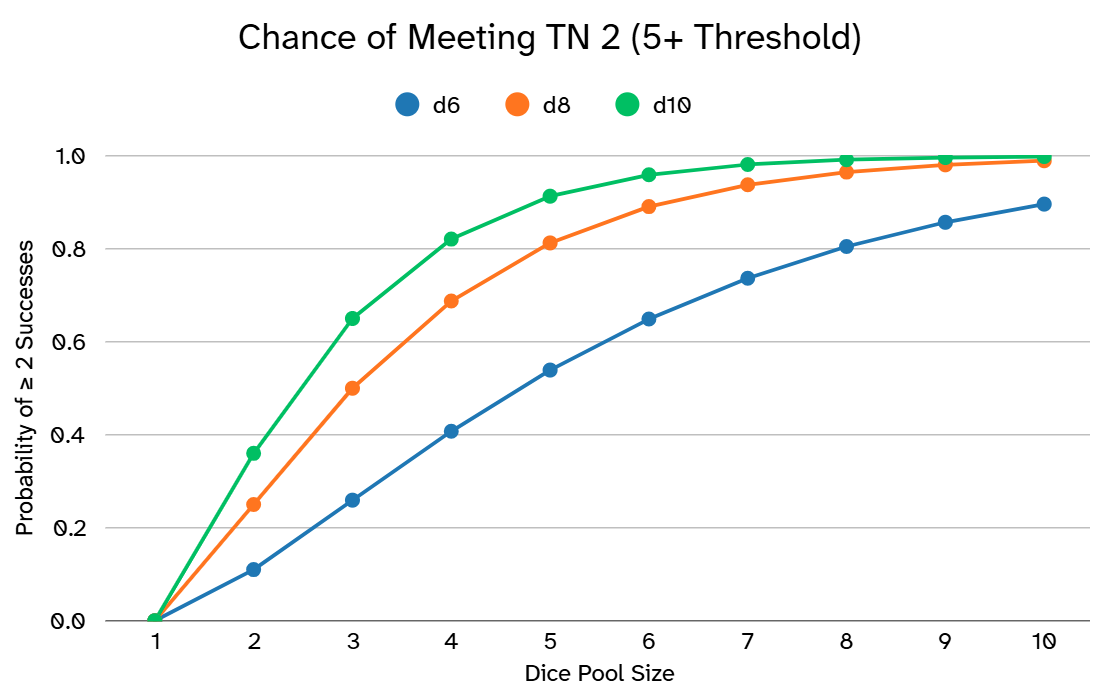
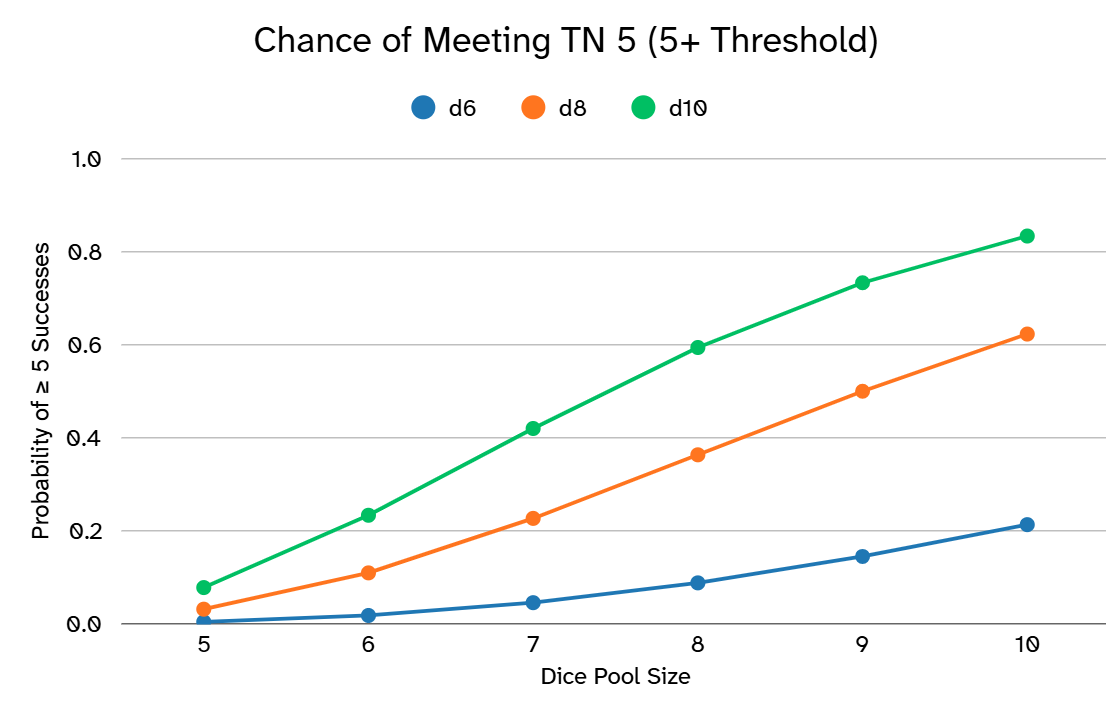
Target Numbers and When Rolls Actually Matter
Once the dice pool is defined, the system needs a way to interpret the results. That role belongs to the Target Number (TN).
In Threshold, most tasks fall into the following difficulty bands:
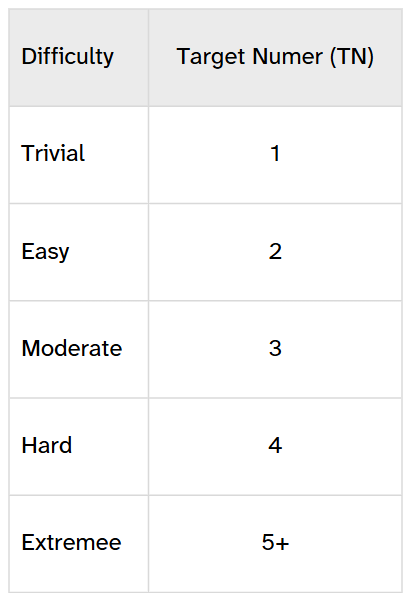
However, the numbers themselves are only part of the system.
A common pacing problem in tabletop RPGs is rolling for actions that should never meaningfully fail. Dice are rolled simply because rolling dice feels like participation.
That instinct is understandable, but it weakens the resolution system.
The outcome tiers only produce interesting results when all four outcomes are genuinely possible and distinct.
If failure carries no consequence, or if a critical success wouldn't change anything meaningful, then the roll isn't doing useful work.
The principle I kept coming back to was this: only call for a roll when all four outcome tiers are plausible.
If success is guaranteed, resolve the action without rolling. If failure is unavoidable, the attempt simply fails—no need to touch the dice.
Because of that principle, tasks with TN 1 rarely require rolls during normal play. They exist primarily for situations where a character is impaired, disadvantaged, or working under extreme pressure. Most meaningful rolls occur at TN 2 or higher, where uncertainty actually matters.
This keeps the dice focused on moments of tension rather than slowing the game with unnecessary checks.
Example: Two Approaches to a Locked Door
Two characters encounter a locked door blocking their path. The door is sturdy wood, and the lock looks a bit rusty. One character wants to pick the lock quietly. The other wants to break it down.
The Thief (Finesse specialist, precision approach)
This character relies on Wit (Mind Domain + Finesse Quality) and has trained extensively in Skullduggery.
Finesse Quality: 3 = 3 base dice
Mind Domain (Primary) = d10s
Skullduggery rank 2 = +2 dice
Final pool: 5d10
The GM sets the Target Number at 2 for picking the rusty lock. The rust makes the mechanism less precise and easier to manipulate.
The thief rolls: 6, 1, 7, 3, 3
Counting 5+: two successes (6, 7)
Result: Success. The thief meets the TN exactly and opens the lock cleanly and quietly.
The Barbarian (Force specialist, brute force approach)
This character relies on Might (Body Domain + Force Quality) and has some training in Athletics.
Force Quality: 3 = 3 base dice
Body Domain (Primary) = d10s
Athletics rank 1 = +1 die
Final pool: 4d10
The GM sets the Target Number at 3 for breaking down the sturdy wooden door. It's solid construction and will take real effort.
The barbarian rolls: 2, 7, 5, 4
Counting 5+: two successes (7, 5)
Result: Partial Success. The barbarian has successes but falls short of the TN. They break through the door, but it takes longer than expected, makes a tremendous amount of noise, or splinters the door frame badly enough to alert anyone nearby.
What This Shows
Both characters rolled similar pool sizes (5d10 vs 4d10) and got the same number of successes (2). But because they approached the problem differently, the outcomes diverged.
The thief's method had a lower TN because picking a rusty lock is relatively straightforward for someone with the right skills. Two successes were enough for a clean result.
The barbarian's method had a higher TN because breaking down a sturdy door requires significant force. Two successes got them through, but with complications.
This is how the system rewards different approaches. The choice of how to solve a problem matters as much as raw capability. A character optimized for precision can accomplish things quietly that would be loud and messy for someone relying on brute strength—even when both characters are equally competent in their own domains.
Player-Facing Rolls
Another structural decision in Threshold is that players make all the rolls.
When characters attack an enemy, players roll to hit. When enemies attack them, players roll to defend.
I tested both approaches during early playtests. Having the GM roll for enemies felt more traditional, but it consistently created dead air—players waiting to see what happened to them rather than actively responding. Player-facing rolls kept everyone engaged, even during enemy turns.
There's also a narrative reason. The story ultimately follows the characters. Their decisions and reactions drive events forward. Structuring the system so that players make the rolls reinforces that perspective.
An additional benefit is practical. Because players handle the rolls tied to their characters, the GM can focus on describing the world, portraying NPCs, and managing the broader flow of the scene.
What Comes Next
With the resolution system established, the next question is how characters actually interact with the world mechanically.
What can characters do on their turn in combat? How do attacks and defenses work in practice? How does the environment create pressure beyond just raising target numbers?
The next post will focus on combat structure and action economy, showing how the dice pool system translates into tactical decisions at the table.
What I Worked On
This stage of design focused on refining how actions are resolved at the table.
Much of the work involved stress-testing different probability models and evaluating how dice pools behave. I built spreadsheets comparing expected success rates across different pool sizes and target numbers. I ran sample combats on paper to see how often partial successes occurred and whether the four-tier outcome system actually produced the variety I wanted.
The biggest challenge wasn't the math itself—it was figuring out when the system should be used at all.
What Went Wrong
Early drafts encouraged rolling too often. If players constantly rolled for trivial tasks, the outcome tiers lost meaning and pacing suffered. More fundamentally, it trained players to expect dice for every action, which made it harder to establish narrative flow.
The other issue was target number calibration. Too many tasks defaulted to TN 3, making difficulty feel samey. I needed better guidance on spreading tasks across TN 2, 3, and 4.
I also tested different success thresholds (4+, 5+, 6+) to find the right reliability curve.
What I Changed
The biggest shift was reframing when rolls happen at all. The system now explicitly treats rolls as tools for resolving meaningful uncertainty—not routine procedures. Only call for a roll when all four outcome tiers are genuinely possible and distinct.
That principle reshaped how the TN table works. TN 1 exists primarily for impaired or disadvantaged situations. Most meaningful tasks start at TN 2 or higher.
Testing confirmed that 5+ as the success threshold created the reliability curve I wanted—small pools feel uncertain but not hopeless, large pools feel capable but not guaranteed.
What I'm Testing Next
The next step is observing how these mechanics behave in actual play with real groups.
Specifically, I want to test:
How quickly players internalize the dice pool system without extensive explanation
Whether target numbers feel intuitive during play, or if GMs struggle to calibrate difficulty on the fly
Whether the "only roll when all outcomes matter" principle holds up in practice, or if groups drift back toward rolling for everything
How the system performs across different play styles—tactical groups vs narrative-focused groups
Paper testing and spreadsheets can only tell you so much. The real test is whether the system supports the kind of play I designed it for when people actually sit down at a table.
Questions
When you play RPGs, do you prefer resolution systems that emphasize dramatic swings or consistent competence?
How often do you find yourself rolling for trivial actions at the table? One of the design goals of Threshold is making each roll feel meaningful rather than routine, and I'm curious how other groups handle that balance.
Have you played games with player-facing rolls? Did it change how combat felt, or did you find it awkward?

Skills as the Interface Between Character and World
When I first planned this series, I assumed I would move directly from ability scores into resolution mechanics.
Once I started outlining the dice system, it became clear I was skipping something foundational.
Ability scores describe what a character is. Resolution mechanics describe how uncertainty is adjudicated. But neither of those answer a more immediate question:
What is the character actually doing?
That's where skills live.
Skills are the interface between character and world. They are the means by which capability becomes action. Before talking about dice, it's worth asking what role skills are supposed to play in a tabletop RPG at all.
What Skills Are Actually Doing
Like attributes, every skill system makes quiet assumptions about what matters.
How specific should competence be? Should experience broaden capability or deepen it? Does advancement change who your character is, or how reliably they perform?
In many class-/level-based systems like D&D or 13th Age, skills are secondary. Your class defines your identity and growth curve. Skills fill gaps. They resolve uncertainty in social scenes, exploration, or downtime, but they rarely drive the core progression of the character.
In those systems, skills are often tightly bound to attributes. If a build prioritizes Strength, Intelligence-based competence becomes harder to justify mechanically. Certain combinations feel natural. Others feel mathematically discouraged.
That bundling makes characters easy to read and progression easy to pace. It also narrows how they can express themselves.
Skill-based systems take a different approach.
In games like Cyberpunk or Genesys, skills are the primary investment. Advancement is granular. What your character becomes good at is shaped by repeated choice rather than predefined packages.
This allows competence to emerge unevenly. Two characters can begin similarly and diverge based on what they practice. Growth feels accumulated rather than unlocked.
That flexibility introduces its own tension. Freedom of investment can create uneven builds. Some skills may prove situational. Without structural guidance, expressive choice can become accidental fragility.
Neither model is inherently superior. They produce different kinds of play.
For Threshold, the question was which model supported the kind of long-term play I wanted.
What Skills Represent in Threshold
In Threshold, skills represent refinement and reliability, not permission.
Characters can attempt almost anything that makes sense in the fiction. Being untrained doesn't mean you are incapable. It means you are inconsistent.
Training a skill doesn't unlock the ability to act. It increases the likelihood that your action produces the outcome you intend.
That distinction matters for tone.
In some systems, skills answer: Can you do this? In Threshold, they answer: How reliably can you do this under pressure?
Improvement deepens competence without redefining the character's nature. You are not becoming a different category of being. You are becoming practiced. That's what supports the grounded protagonist design I talked about in the last post.
Structure, Not Math
Skills in Threshold are organized into four categories: General, Knowledge, Combat, and Magic.
General skills cover practical interaction with the world. Knowledge skills represent accumulated understanding. Combat skills represent proficiency with different categories of weapons and defensive equipment. Magic skills align with the Forms I'll discuss when I cover the magic system in detail.
Each skill progresses through five ranks, Untrained>Trained>Expert>Master>Paragon. Advancement is incremental. Improvement is steady rather than explosive.
Currently, skills are structured as Broad + Specialization. A character may invest broadly or refine focus within a narrower expression of that skill. This allows identity to emerge through practice.
Permanent Investment
Skill investments are permanent.
That decision was deliberate. Growth should matter. Direction should matter. A character's history should shape their present.
At the same time, permanence increases the stakes of choice. In a skill-driven system, misaligned investment can have lasting consequences.
Why Skills Carry So Much Weight
Because most progression in Threshold lives in skills, they are the primary way characters grow over long campaigns.
Attributes establish baseline capability. Skills refine that capability. Over time, growth expresses itself as consistency and depth rather than scale escalation.
Characters don't become untouchable. They become prepared.
That distinction is subtle, but it's central to the tone of the game.
What Comes Next
With skills positioned as refinement and reliability, the remaining question is how the game resolves uncertainty when those skills are tested.
How do attributes and skills combine at the table? What determines difficulty? What distinguishes success from partial success?
That's the focus of the next post.
What I Worked On
This phase of design focused on clarifying the role skills play in the overall structure of the system.
Up to this point, I had a working list of skills and a progression framework, but I hadn't fully articulated what skills were supposed to represent. The distinction between attributes, skills, and techniques needed to be made explicit, especially since so much of character growth lives in skills rather than in large attribute increases.
I also spent considerable time adjusting the scope and structure of the skill list itself. The current framework includes 14 General skills, 8 Knowledge skills, 8 Combat skills, and 5 Magic skills—35 broad skills total before specializations. That's more granular than something like Blades in the Dark (12 actions) but much more consolidated than systems like GURPS or Rolemaster. Some skills that initially existed separately were collapsed into broader categories. Others were split to preserve meaningful distinctions. The question wasn't just what skills to include, but how many—too few and characters blur together, too many and progression fragments into increments that don't feel meaningful. These numbers may shift as I test different levels of granularity, but the current structure aims for meaningful differentiation without excessive bookkeeping.
At the same time, I was reviewing whether the current Broad + Specialization structure was supporting identity or simply adding complexity.
What Went Wrong
The biggest issue I ran into was granularity.
Allowing both broad skills and specializations creates strong identity and clear expertise, but it also makes extreme specialization possible. In some cases, characters could accumulate very large dice pools in narrow areas while remaining weak elsewhere. That isn't inherently bad, but it raises questions about balance, progression pacing, and long-term sustainability.
The other concern is cognitive load. More specialization means more decisions at character creation and advancement, which can slow onboarding and make early choices feel riskier.
What I Changed
I haven't made a structural change yet, but I have reframed how I'm evaluating the system.
Instead of asking whether specialization is realistic or expressive, I'm now asking whether it produces better long-term play. That shifts the focus toward sustainability and meaningful differentiation rather than simulation.
To address the investment risk that comes with permanent advancement, I've started outlining an archetype framework—not rigid classes, but structured guidance that signals which skills work well together and what kinds of characters the system supports. Think of them as proven templates that show you how the pieces fit, without locking you into a single path.
What I'm Testing Next
The next step is to test different levels of skill granularity in parallel.
One version keeps the current Broad + Specialization structure. Another collapses skills into broader categories. A third limits specialization primarily to combat, where differentiation has the most mechanical and narrative impact.
At the same time, I'll be evaluating how skill progression interacts with the resolution system. Since skills increase reliability rather than raw capability, the exact scaling matters.
The next post will focus on resolution mechanics and how attributes and skills combine to produce outcomes.
Questions
When have you felt most satisfied with how your character developed in a skill-based system? Was it when you had complete freedom, or when the system provided structure?
In systems you've played that allow specialization, when has narrow expertise felt rewarding versus when has it created problems? I'm curious whether deep focus tends to work better in certain types of campaigns or genres.
If you've played skill-heavy systems with permanent advancement, how did early investment decisions feel? Did you wish for more guidance up front, or did figuring it out through play feel like part of the experience?

Ability Scores: Deciding What a Character Is
I originally planned for this post to be about dice resolution. Once I started outlining it, though, I kept running into the same issue: the resolution system only makes sense if you understand what the game thinks a character is. What counts as capability, how growth is expressed, and what kinds of distinctions actually matter all get decided before you ever roll anything.
So before talking about how actions are resolved in Threshold, I want to step back and talk about ability scores.
Not just the ones I ended up with, but the role ability scores play in tabletop RPGs more broadly. If you only know them through the lens of D&D, it's easy to assume they're a fixed structure rather than a design choice. They aren't. They're one of the clearest ways a game communicates what it values.
What Ability Scores Are Actually Doing
In most tabletop RPGs, ability scores are treated as a given. Strength, Dexterity, Intelligence, and so on show up so often that it's easy to assume they're a universal solution rather than a specific design choice.
But ability scores aren't neutral. They encode assumptions. They're a statement about what the game thinks matters.
At a basic level, an ability score system answers a few core questions, whether the designer intends it to or not:
What kinds of competence does the game care about?
How granular should those distinctions be?
Are abilities descriptive, prescriptive, or both?
Do they define who a character is, or how well they perform?
Different games answer those questions in very different ways, and those answers ripple outward into progression, challenge, and tone.
The Kind of Characters I Wanted
Before I could decide what the ability scores in Threshold should be, I had to be clear about the kind of characters the game was meant to support.
I like heroic fantasy. I enjoy games where characters grow into figures of myth, where power scales dramatically and the stakes escalate until reality itself is on the line. That can be fun.
It just isn't the fantasy I wanted to design around here.
I'm more interested in games where characters remain recognizably human. Competent. Skilled. Dangerous in the right circumstances. Games like Blades in the Dark, Star Wars, or Cyberpunk tend to frame characters as people operating inside larger systems rather than standing above them. You learn. You adapt. You gain leverage. You survive longer. But you're never a one-person army.
That difference matters over time.
In traditional heroic fantasy, power growth is often vertical and exponential. Characters gain access to abilities that fundamentally rewrite the scale of the world. At higher levels, it becomes increasingly difficult to challenge players without resorting to equally absurd threats. The fiction starts to strain under the weight of the mechanics.
For Threshold, I wanted something else: grounded protagonists.
Characters who grow through experience, skill, and technique. Characters whose influence expands even when their raw power does not. Characters who remain mortal throughout the campaign, even at high tiers of play.
That goal shaped every decision that followed.
Familiar Approaches (and Their Tradeoffs)
The most recognizable model is the traditional six-ability framework popularized by D&D. Strength, Dexterity, Constitution, Intelligence, Wisdom, and Charisma cover a broad range of physical and mental capability, and they're intentionally generic. That generality makes them flexible, but it also means they carry a lot of historical baggage. Over time, they've accumulated assumptions about class roles, optimal builds, and "dump stats" that often matter more than what's happening in the fiction.
Different games give ability scores different jobs. Understanding which job your game needs them to do is the first step toward choosing the right approach.
Ability Scores as Physical and Mental Traits
The most familiar approach is to treat ability scores as fundamental traits of the character's body and mind. Strength represents physical force. Dexterity represents coordination. Intelligence represents reasoning ability.
This model is intuitive and easy to explain, and it maps cleanly to real-world concepts. You can usually look at a character sheet and immediately understand what the character is supposed to be good at.
The tradeoff is that these scores tend to do a lot of work at once. A single number often determines what a character can attempt, how often they succeed, and how effective they are when they do. Over time, that can collapse distinctions between characters and encourage optimization around a small subset of "important" traits, especially in combat-heavy systems.
Ability Scores as Broad Competence Bands
Other games use fewer, broader stats instead of six or eight narrow ones. Instead of many attributes, you get a few that represent general modes of action.
Games like Savage Worlds or Cortex Prime often take this approach. Characters are broadly capable, and the system relies on context, skills, or situational modifiers to differentiate outcomes.
The upside is speed and flexibility. Characters are rarely hard-locked out of an action, and the game can move quickly without referencing many separate stats. The downside is that it can become harder to express how characters differ in meaningful ways unless additional layers are added elsewhere in the system.
Ability Scores as Roles or Modes of Action
Other designs move away from physical traits entirely and define abilities around what characters do in the fiction. Instead of Strength or Intelligence, you might see attributes tied to aggression, caution, empathy, authority, or adaptability.
This is common in narrative-forward games such as Fate Core, where abilities help determine not just whether an action succeeds, but what kind of story that success produces. A character isn't just "strong"; they're effective when acting forcefully, decisively, or boldly.
The strength of this approach is clarity of intent. The ability score tells you how a character tends to solve problems. The limitation is that these systems rely heavily on shared understanding at the table. Without that, the boundaries between abilities can feel subjective or inconsistent.
Ability Scores as Resource Interaction
In some systems, ability scores primarily determine how characters interact with resources—stamina, stress, luck, momentum, or narrative currency—rather than how likely they are to succeed at individual actions.
Games like Blades in the Dark use attributes to govern stress, resistance, and long-term pressure more than moment-to-moment task resolution. Your abilities tell you how much strain you can absorb, how often you can push yourself, and what kinds of consequences you're best equipped to handle.
This approach works particularly well for games focused on attrition, risk management, or emotional endurance. It shines in longer campaigns where pressure accumulates and characters are defined as much by what they survive as by what they accomplish.
Ability Scores as Fictional Permission
Finally, some games treat ability scores less as numbers and more as permissions. Having a high score doesn't just make you better at something—it establishes that this is a space where your character belongs.
You can see this in games influenced by Powered by the Apocalypse design, such as Apocalypse World, where attributes determine which moves you have access to and how reliably you can trigger certain kinds of outcomes. In these systems, the numbers matter, but the fictional positioning often matters more.
This model is excellent for reinforcing character identity and spotlight protection. The challenge is maintaining flexibility without erasing meaningful differences between characters.
The Question Beneath All of These
All of these approaches work. They fail in different ways, and they excel at different things.
The real question isn't "Which ability scores are best?" It's "What job are these scores doing in this game?"
Are they there to gate access to actions, differentiate characters, shape narrative tone, manage pressure over time, or reinforce genre expectations?
Once you can answer that honestly, the actual list of abilities becomes much easier to reason about.
That question is what kept pulling me away from familiar models and toward something more specific for Threshold.
The Problem I Kept Running Into
For Threshold, the usual models kept breaking in subtle ways.
I wanted a game where:
Capability felt contextual rather than absolute
Characters could be broadly competent without becoming interchangeable
Growth was meaningful without turning into numerical inflation
The environment and situation mattered as much as raw aptitude
Traditional ability scores tended to collapse too many ideas into a single number. Either a character was "good at Strength things" or they weren't. That worked fine for combat math, but it didn't do much to support the kinds of decisions Threshold is built around.
On the other end of the spectrum, systems that flattened attributes too much made characters feel less distinct than I wanted. Everyone could attempt everything, but it became harder to express how they were different beyond narrative description.
What I needed was a way to separate what a character is capable of from how refined or reliable that capability is.
Progression Without Becoming Untouchable
One of the biggest pressures on any attribute system is how it handles progression.
I wanted advancement to feel meaningful and rewarding, but also sustainable over the lifespan of a long campaign. The game is meant to be played for years. That means the system has to support continued growth without turning the characters into something the setting can no longer meaningfully respond to.
That ruled out a few things early on.
I didn't want ability scores that inflated endlessly. I didn't want a system where higher numbers alone solved problems. I didn't want challenge to depend on constantly escalating threats just to keep pace with the characters.
Instead, I wanted progression to be mostly horizontal, punctuated by occasional moments of vertical growth. Players should gain more options, more reliability, more ways to approach problems. They should become better at navigating complexity, not simply overpowering it.
Ability scores, then, couldn't just be a measure of "how strong you are." They needed to express how a character engages with the world.
The Core Idea Behind Threshold's Ability Scores
The solution I kept circling back to was splitting ability into two related but distinct parts.
In Threshold, ability isn't a single value. It's expressed through Domains and Qualities.
Domains describe where a character is broadly capable. They're intentionally coarse. They answer questions like: what kinds of situations does this character meaningfully operate in? What spheres of action are within their reach?
Qualities describe how that capability manifests. They represent refinement, control, resilience, or precision within a Domain. Two characters can share a Domain and still feel very different because their Qualities shape how reliably or effectively they act within it.
This separation let me avoid a lot of problems I kept running into elsewhere. Domains establish scope. Qualities establish depth. Neither one has to do all the work alone.
What I kept running into was the need to separate two different ideas that are often collapsed into a single number:
Where a character is capable of acting, and
How they express that capability
In Threshold, those ideas are represented by two intersecting axes.
Domains describe scope. They answer the question: what part of existence does this character meaningfully operate in? Body, Mind, and Spirit aren't skills and they aren't traits. They're arenas of interaction.
Qualities describe expression. They answer the question: how does this character apply themselves within that arena? Force, Finesse, and Essence represent different ways of acting, not different power levels.
Neither axis works on its own. It's the intersection that matters.
Why This Fit the Setting
This structure also aligned cleanly with the kind of world Threshold is set in.
In a setting where magic, ecology, and environment are tightly linked, raw capability isn't enough. Context matters. A character might be powerful in one region and constrained in another. They might be broadly capable but lack the control to use that power safely.
By separating breadth from refinement, the system leaves room for:
Environmental pressure to matter
Consequences to scale naturally
Growth to feel earned rather than automatic
It also avoids tying identity too tightly to early decisions. Characters can expand into new Domains over time or deepen existing ones without locking themselves into a rigid progression path.
Threshold is a world defined by tension: between nature, technology, and magic; between tradition and progress; between preservation and exploitation. Those tensions aren't just political or philosophical. They're embodied in how people act, what they value, and how they apply power.
A character might have the strength to act, but not the restraint. Another might have deep internal conviction but limited ability to express it physically. Those distinctions matter in a world where consequences ripple outward and power always leaves marks.
Why I Wanted Scores to Matter
There was another pressure shaping this system, one that might sound mundane but turned out to matter: I don't like modifiers.
In a lot of games—especially ones descended from D&D—the number written on your character sheet isn't the number you actually use. Your Strength might be a 16, but what matters at the table is the +3 next to it. The score becomes a lookup value, rather than a decision-making tool.
I've always found that awkward.
It adds a small but constant layer of friction. When I want to do something, I have to mentally translate my character's ability into a different number before I can even think about the roll. Over the course of a long campaign, that translation happens hundreds of times, and it never gets more interesting.
More importantly, it disconnects the fiction from the mechanics. If my ability score doesn't participate directly in resolution, then it stops feeling like a measure of capability and starts feeling like bookkeeping.
For Threshold, I wanted the number you see to be the number you use. Fewer conversions. Fewer derived values. When you look at a stat, you should immediately understand what it means in play, without consulting a table or remembering a formula.
That preference pushed me away from systems where ability scores are largely ceremonial, and toward a structure where the score itself is the thing being used.
This also reinforced the decision to cap stats at a human scale. If the number you see is the number you use, it needs to stay legible. Six means something. One means something. There's no hidden math smoothing it out behind the scenes.
This emphasis on direct use fed naturally into the Domain and Quality grid. If stats are going to be used as-is, they need to describe how a character engages with the world, not just how large a bonus they provide.
Seeing the Structure
Once I stopped thinking about ability as a single value and started treating it as the intersection of two ideas, the structure became easier to reason about visually than verbally.
I sketched the system as a simple grid: Qualities running vertically, Domains running horizontally. Each stat lives at the intersection of where a character acts and how they act.
I've included the grid below. It's rough, but it captures the core idea more clearly than a paragraph of explanation ever could.
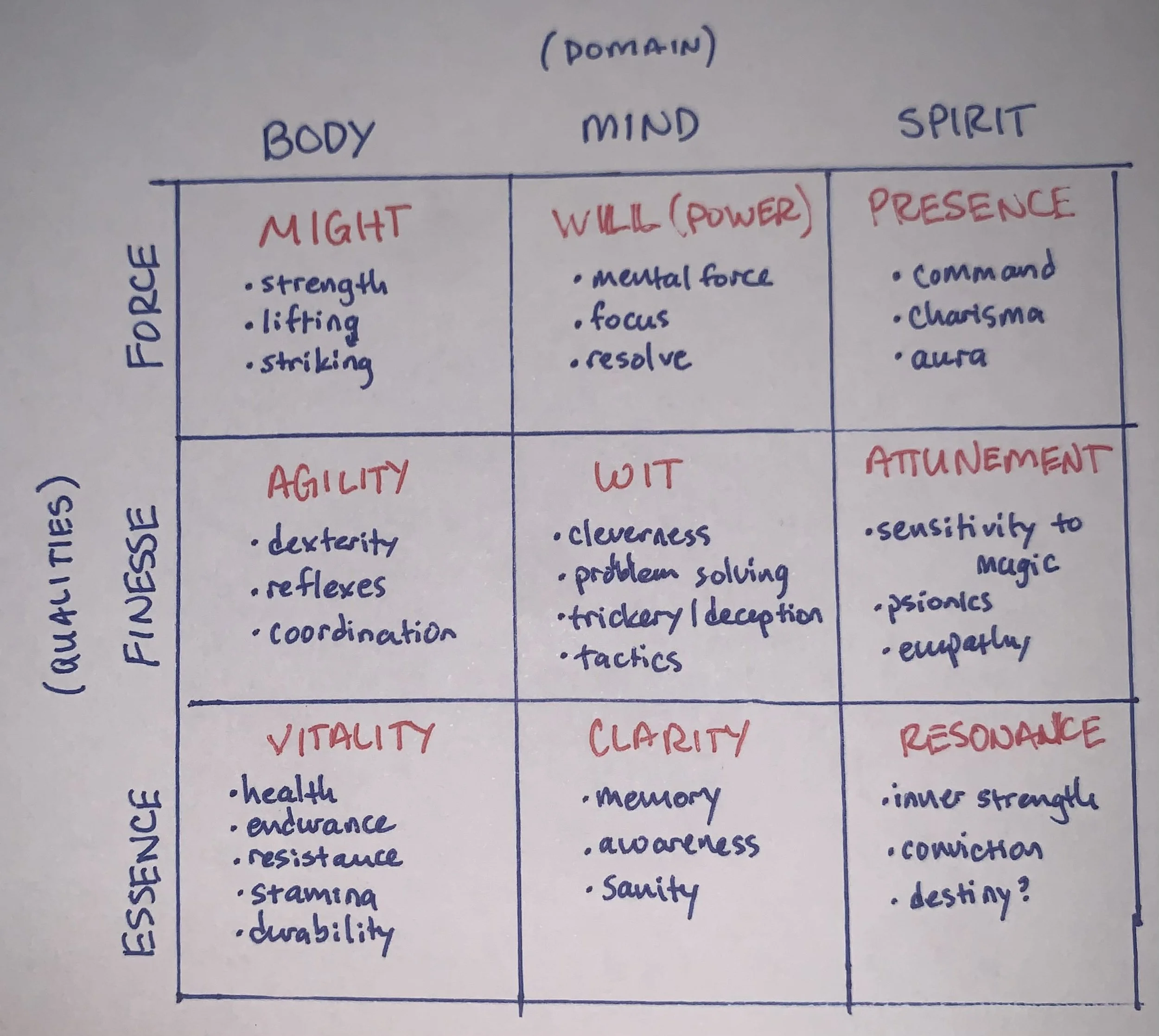
How I ended up drawing my stat grid.
The Attribute Grid
When you combine those two axes, you end up with nine derived attributes.
Force applied to the Body becomes Might. Applied to the Mind, it becomes Will. Applied to the Spirit, it becomes Presence.
Finesse expresses itself as Agility through the Body, Wit through the Mind, and Attunement through the Spirit.
Essence becomes Vitality, Clarity, and Resonance depending on where it's applied.
Each stat is rated from 1 to 6, with 6 representing peak human capability rather than superhuman extremes. Everyone has some baseline ability. No stat ever drops to zero. Characters aren't defined by what they can't do so much as how they choose to engage.
What matters more than the numbers is what the grid allows the system to express.
Two characters might both be capable in the same Domain, but express that capability very differently. Another might share a Quality but apply it in entirely different arenas. This lets characters feel distinct without forcing them into narrow archetypes or rigid class identities.
This caps-at-six approach reinforces the grounded protagonist goal: influence grows faster than raw power. You don't become untouchable. You become experienced.
What This Sets Up Mechanically
I'm intentionally stopping short of mechanics here.
What matters for now is that this ability score structure directly informs how the dice system works. It affects how pools are built, how success is measured, and how failure creates momentum instead of dead ends.
In the next post, I'll talk about how Domains and Qualities feed into the resolution system, why I chose a dice pool approach, and how outcomes are structured to support fast play with visible consequences.
What I Worked On
For this phase of design, I focused on pressure-testing the Domain and Quality grid conceptually.
I mapped it against the kinds of situations the game is meant to handle, compared it to earlier drafts, and checked whether it could support long-term play without collapsing into a single dominant approach.
What Went Wrong
Early versions either flattened distinctions too much or pushed too much weight onto a single axis and reintroduced the same problems I was trying to avoid.
Some drafts made Domains feel like reskinned attributes. Others turned Qualities into disguised power stats. In both cases, the system drifted away from the grounded feel I was aiming for.
Finding the balance took longer than expected.
What I Changed
Once I clarified that Domains handle scope and Qualities handle expression—and that stats emerge from their intersection rather than from raw power—the rest of the system stabilized.
What I'm Testing Next
The next step is integrating this attribute structure fully into the dice resolution system.
If the resolution mechanics don't reinforce this split—if they collapse it back into a single measure of success—then the entire approach fails. That's what the next post will focus on.
Questions
Do you prefer character progression that expands options over time, or progression that increases raw power?
At what point does "heroic" stop feeling grounded for you in a long campaign?

Making Environment More Than Scenery
Most fantasy games treat magic as something that happens to the world, then disappears.
A fireball explodes. A portal opens. Reality bends for a moment, and then everything snaps back into place. The spell ends, the numbers are updated, and the world itself remains fundamentally untouched. Magic changes the immediate situation without leaving marks.
That approach never quite worked for the kinds of worlds I've always been drawn to.
I'm more interested in settings where the environment isn't just a backdrop, but a system that responds to what people do to it.
Dune's full cycle shows ecosystems as layered transformations rather than static states. Arrakis wasn't always a desert: the sandworms created that. The Fremen's success in terraforming it green nearly destroys the spice cycle. There's no "correct" ecological state, only different configurations with different costs. Every solution reshapes the system in ways that create new tensions.
Dark Sun makes magical destruction mechanical and visible: defilers versus preservers as a fundamental choice where both paths have consequences.
Studio Ghibli films (especially Princess Mononoke and Nausicaä) refuse to create simple villains, showing instead how everyone believes they're doing what's necessary to survive. The tension between nature, technology, and spirituality isn't about finding the "right" answer—it's about recognizing that every choice preserves something while costing something else.
Even Sword Art Online: Alicization explores what happens when a world's rules are strained or pushed past their intended limits; systems under pressure behave in unexpected ways.
What all of these have in common is that the world itself feels alive. Not in the sense of having consciousness, but in the sense that it responds to what happens within it. The environment has momentum. It participates. And critically, none of them tell you the answer. They make you think about the tradeoffs.
Coming from a more science-y background, the alternative has always felt hollow to me. If magic really existed and had been used for generations, it wouldn't just create individual dramatic moments. It would reshape ecosystems and influence how societies develop.
But it's more than that.
Most fantasy games treat magic as something that exists on top of a mundane world—medieval Europe plus wizards. The societies function like historical Earth despite having teleportation. Economies work like pre-industrial markets despite conjured materials. Warfare looks like historical battles despite reality-warping power.
Magic is everywhere, but it doesn't fundamentally change anything.
I wanted the opposite. In Threshold, magic isn't cosmetic. It's inherent to how the world functions. Societies organize around it, and factions emerge as responses to it. Geography reflects its history. Even the people trying to avoid magic are defined by their relationship to it.
So instead of asking "What cool places can players visit?" I started asking "What kind of world would actually exist if this was how reality worked?"
That question led to Dead Zones, decay gradients, regions under different stages of ecological stress, and factions built around competing philosophies about how to survive in a world that's breaking down. The setting didn't grow out of a map. It grew out of cause and effect.
Which brings me to the actual design work.
Vision is one thing. Implementation is another. This post is about the gap between "I want environment to matter" and "here's how environment actually functions as a game system."
What I Worked On
The conceptual challenge: Make environment a core mechanical system, not just atmospheric description.
In Threshold, power doesn't vanish when the spell ends. It leaves marks. Magic alters the land and creates consequences that accumulate over time. The world is under strain: some regions are still functional, others are collapsing, and a few have been pushed past recovery entirely.
If that's the reality of the setting, then environment can't just be set dressing. The state of the land needs to affect what resources are available, what creatures live there, how magic functions, and what choices feel viable.
This meant creating a system that tracks environmental degradation in a way that's:
Visible to players (not hidden GM bookkeeping)
Mechanically consequential (affects gameplay directly)
Narratively meaningful (reinforces the themes)
Scalable (works from local to continental levels)
The result is what I'm calling the Threat Level system—a gradient from 0 (pristine) to 5 (“irreversibly” corrupted) that describes the ecological state of any given region.
Threat 0-1 regions still have healthy forests, clear water, and abundant wildlife. Threat 2-3 regions show visible decay: thinning vegetation and corrupted creatures appearing. Threat 4-5 are Dead Zones where natural life has been replaced by ecosystems that feed on death and corruption instead of sustaining life cycles.
Players experience this through travel, resource availability, encounter types, and the visible consequences of their own actions.
The mechanical challenge: Connect player actions to environmental change without making magic feel punishing.
Here's where vision collided with playability.
In my setting, magic drains life energy from the environment. That's thematically central—it's part of why the world is dying. But I ran headfirst into a fundamental design tension:
If casting spells damages the environment, and environmental damage is bad, then casting spells is bad. Which means players using one of the game's primary features are being punished for engaging with the system.
That's not a game about hard choices. That's a lecture with dice.
I needed mechanics that created meaningful dilemmas rather than moral scolding. Players should feel the weight of their decisions, not the weight of my judgment.
At the same time, I had to address a parallel problem: technology.
Magic isn't the only force reshaping the world. Alongside it, early industrial methods are emerging—tools, infrastructure, extraction techniques meant to impose order on a world already under strain. Sometimes this includes magitech hybrids. Sometimes it's purely mechanical.
Either way, technology isn't presented as a clean alternative to magic. It's another way of exerting control, and it creates its own pressure. Strip mining for resources damages land differently than draining it with magic, but the outcome is similar: stressed ecosystems and accelerating decay.
The game needed mechanics that acknowledged this reality without creating a false binary where ‘magic = bad’ and ‘nature = good.’ The actual tension is more interesting: all forms of power carry costs, and the question is which costs you're willing to accept.
What Went Wrong
Problem 1: The "Don't Play the Game" Problem
My initial approach was straightforward: every spell cast pulls life energy from the surrounding area. Small spells wither grass. Medium spells kill trees. Large spells create localized dead zones.
Simple. Thematically coherent. Catastrophically unfun.
The message players received: don't cast spells.
In a game where magic is supposed to be one of the core character paths—where Spiritualists, Magists, and hybrid approaches all rely on spellcasting—this was design suicide. I was actively discouraging players from using their primary abilities.
The system told players that using magic made them complicit in the world's decline, but offered no alternative except "don't cast spells." That's not a meaningful choice—it's a trap designed to make you stop engaging.
Problem 2: The "Healing Is Impossible" Problem
The flip side to that was restoration mechanics.
If magic damages the environment by pulling life energy out, then logically, healing that damage requires putting life energy back in. Which is expensive. Brutally expensive.
My first pass had restoration costing 10x to 100x more than the damage dealt. One spell might kill a tree; healing that tree required sustained ritual work over days or weeks, draining the caster's own life force in the process.
Thematically? Perfect. It reflects the real-world truth that breaking ecosystems is easy, fixing them is hard.
Mechanically? It meant players choosing the Spiritualist path (focused on environmental restoration) were signing up for a Sisyphean nightmare. They could heal small areas through exhausting personal sacrifice, but the scope of the world's decay was so vast that their efforts felt meaningless.
I imagined the perspective of players would be: "Why would I choose this path? I can't actually fix anything."
And they’d be right.
I'd created a game about futility rather than difficult decisions. The problem was too big to solve and the solutions were too costly to attempt. Futility isn't interesting—it's just depressing.
What I Changed
Solution 1: Make Environmental Cost Optional, Not Mandatory
The breakthrough came from reframing the question.
Instead of "Should players be punished for using magic?" I asked: "What if players could choose whether to pay the environmental cost?"
This led to a split-cost system:
Full Cost Casting:
Pay the spell's entire Mana cost from your personal pool
No environmental damage
This represents using your own internal life energy
Environmental Pulling:
Pay only part of the Mana cost (or none at all)
Pull the rest from the surrounding environment
Causes immediate, observable environmental damage proportional to energy drawn
NPCs (and possibly PCs) notice and react based on their philosophy
Suddenly, magic wasn't inherently destructive. It was a choice.
A character facing a life-or-death situation can pull from the environment to survive. That's understandable. Desperate. Human.
A character casually nuking their surroundings for convenience? That's a different statement entirely.
The mechanics now create actual moral weight rather than mechanical punishment. Players aren't being told "magic is bad." They're being asked "how much are you willing to cost others for your own power?"
That's the question I actually wanted the game to explore.
Visibility and Reaction:
When someone pulls from the environment, it's not subtle:
Grass withers in an observable radius
Nearby plants lose leaves or wilt
Small animals flee or die
The ground may crack or darken
And crucially, people see this happen.
A Naturalist witnessing someone drain life from the forest doesn't see "necessary magic use." They see violence against the land. A Spiritualist sees someone taking what they've spent years trying to restore. A Magist sees normal operating procedure. A Technologist sees vindication; why non-magical solutions are needed.
The same action generates different reactions based on philosophy, and those reactions have consequences: social, economic, and sometimes violent.
This turns environmental cost from an abstract penalty into a social calculation. Not "can I afford this mechanically?" but "can I afford the response this will provoke?"
Solution 2: Make Restoration Brutal But Meaningful
For the restoration problem, I leaned into the difficulty rather than softening it.
Healing environmental damage remains exponentially more expensive than causing it. A Spiritualist attempting to restore a dying region is making a genuine sacrifice—spending their own life force (HP and Mana both) over extended periods to give energy back to the land.
But I changed the scope and framing.
What Spiritualists Can Actually Do:
Threat 1 (Depleted): One person can stabilize and begin healing. Takes days to weeks. Exhausting but achievable. This is one Spiritualist maintaining a sacred grove or healing a battlefield scar.
Threat 2 (Withering): One person can maintain one area OR multiple Threat 1 zones. Takes weeks to months. Visibly draining—the Spiritualist ages faster, weakens, but the land responds.
Threat 3 (Barren): Requires multiple Spiritualists working together, rotating effort to avoid individual death. Takes months to years. Creates a small oasis in a larger wasteland.
Threat 4+ (Dead/Void): Requires generational community effort. Success uncertain. This is the work of lifetimes, sustained by communities who dedicate resources to supporting the Spiritualists attempting the impossible.
The key change: Spiritualists aren't trying to save the world. They're trying to save a place.
A Spiritualist can create and maintain an oasis in a dying region. A sanctuary where life still flourishes. That's not a global solution, but it's meaningful. It matters to the people living there. It's a small victory, but it's real.
And importantly, it creates interesting narrative choices:
Do you maintain three Threat 1 zones scattered across the region, helping more people with smaller efforts, or focus all your energy on healing one Threat 2 area completely?
Do you try to heal the ancestral land your people lived on for generations, knowing the effort might kill you, or do you preserve something smaller that you know you can save?
When a desperate community begs for help with their dying fields, do you spread yourself thinner, or do you stay focused on the commitments you've already made?
These are compelling questions. The answers depend on values, not optimization.
Parallel Pressure: Technology Isn't Innocent Either
One reason the split-cost system works is that it doesn't create a false binary where magic = destruction and nature = purity.
Technologists point to magic use and say "See? This is why we need alternatives." They're not wrong. Magic does drain the world when used carelessly.
But their solutions aren't cost-free either. Mining for metals scars the land. Factory runoff pollutes waterways. Deforestation for lumber and farmland creates its own form of ecological collapse.
The game presents this honestly: all forms of power apply pressure. Magic drains life energy directly. Technology extracts resources and creates waste.
The mechanics don't pick winners. They show costs and let players decide which they're willing to pay.
What I'm Testing Next
The system has structure now, but several pieces still need refinement:
Environmental Effects on Magic:
What happens when you cast spells in a Dead Zone? The environment there isn't providing life energy anymore—it's sustaining itself on corruption and death. Do you pull from that inverted cycle instead? Does that affect the caster? Create different spell results? Risk corruption spreading to the character?
Right now this is a gap. I know it should matter, but I haven't settled on how.
Corruption Mechanics for PCs:
Does prolonged exposure to Dead Zones corrupt characters? If so, what does that look like mechanically? A separate track that fills as you spend time in corrupted regions? Wounds that don't heal normally because your body is adapting to the inverted cycle? Stat degradation? Or is the risk entirely environmental (hostile creatures, toxic conditions, resource scarcity) without direct mechanical corruption?
This ties into the larger question of how much the game tracks slow degradation versus acute dangers.
The Restoration Math:
I have rough cost ratios (10x-100x more expensive to heal than to damage), but I need to run numbers to see if this creates the experience I want. Is a 10x multiplier enough to feel significant? Is 100x so brutal that even the small victories feel Pyrrhic?
The goal is "difficult but achievable," and that's a narrow target.
NPC Reaction Depth:
I know NPCs should react to environmental damage based on their philosophy, but how granular should this be? Does a Naturalist attack you on sight for pulling from the environment, or do they give warnings first? How do different factions balance their ideological positions against practical needs?
A starving Naturalist community might overlook environmental damage if you're helping them survive. A prosperous one won't. How does the system track that nuance without becoming a social simulation?
These questions need playtesting to answer. Design in a vacuum only gets you so far.
The Broader Design Philosophy
Here's what I learned from wrestling with this:
The goal is reflection, not prescription.
This is where those influences converge into actual design philosophy.
In Princess Mononoke, Lady Eboshi isn't wrong to want to protect her people through industry. The forest spirits aren't wrong to defend their home. San isn't wrong to fight for the forest. Ashitaka isn't wrong to seek peace between them. They're all right from their perspectives, and the tragedy is that they can't all have what they need.
That same principle runs through all the works that shaped this game. Dune doesn't tell you whether desert or garden is "correct." Dark Sun doesn't tell you defiling is always wrong—sometimes it's survival. None of them present simple answers.
I want players to have that same experience—not as passive observers, but as active participants making those choices themselves.
When you pull from the environment to save your party, you're not "playing wrong." You're making the same calculation characters in these worlds make: "What am I willing to cost the world to protect what I love?"
The system doesn't judge that choice. It just shows the consequence and asks: was it worth it?
That's where the reflection happens. Not from me or the GM telling you the answer, but from you deciding what you value and seeing the result play out in the world.
The world reacts to power because that's how systems work.
The original system was prescriptive—it told players "magic drains the world, restoration is brutally difficult" without giving them meaningful agency in that reality.
The revised system presents the same facts but frames them as forces within a larger system rather than moral judgments. The world reacts to power because that's how ecosystems work, not because I'm standing over your shoulder.
Hard problems don't need easy solutions, but they need achievable ones.
The world in this game is dying. That's not fixable at the scale of a single campaign, and pretending otherwise would undermine the setting's entire premise.
But individual characters can still make a difference in specific places, for specific people. That localized impact is enough to make the struggle feel worthwhile. A Spiritualist who spends years maintaining a single sanctuary isn't solving the global crisis, but they're preserving something real. That matters.
Visibility creates weight.
When magic leaves marks, when regions reflect their history of use, when NPCs respond to what they witness, power stops feeling abstract. The choice to pull from the environment isn't just a numbers trade—it's an act with consequences people can see.
That's what transforms "should I spend resources?" into "what am I willing to cost others?"
Mechanics should support multiple philosophies, not endorse one.
The system doesn't tell players whether Naturalists, Spiritualists, Magists, or Technologists are "right." It shows the logic behind each philosophy and the costs each approach carries.
Naturalists preserve what remains but struggle to keep pace with decay. Spiritualists heal through sacrifice but can't scale their efforts. Magists advance through power but drain the source of that power. Technologists innovate through industry but create different forms of destruction.
All of these are internally consistent positions. The game supports all of them. Which one players gravitate toward says something about their values, not about "correct" play.
Questions for Readers
On environmental cost mechanics:
When games give you the option to do something harmful for immediate benefit, what makes that choice interesting rather than just frustrating? What's the difference between a meaningful consequence and feeling punished for engaging with core systems?
On restoration as gameplay:
Have you played games where "fixing things" is a major mechanic? What made that engaging or tedious? How much visible progress do you need to see to feel like the effort matters?
Next post will likely dig into resolution mechanics—how the dice actually work, what kind of play the game supports, and why that matters. I'll walk through different systems and what I settled on.
- TTRPG Traveller

Vision & Goals: Designing a game for a world that’s ending (now)
This post is about the shape of the game I’m trying to make.
Not the mechanics (yet), nor the process behind them, but the assumptions everything else rests on: the tone of the world, the kind of play it’s meant to support, and the boundaries I’m deliberately working within. If future posts focus on how individual systems evolve, this one is about what those systems are meant to serve.
These goals aren’t immutable. They will change as the game is tested and revised. For now, they function as constraints. When something later breaks (and it will break) or needs to be reworked, this is the lens I’ll be evaluating it through.
A World That Hasn’t Ended Yet
This isn’t a post-apocalyptic game, but rather a pre-apocalypse fantasy setting.
The world hasn’t collapsed into ruin, but the cracks are showing that it’s about to fail. The crisis is present and uneven. Some regions are already scarred beyond recovery. Others are only beginning to show signs of strain. That means the world isn’t a ruined wasteland yet. Life still exists, and that’s part of the pressure—because you can still see what’s being lost.
The tone I’m aiming for is melancholic urgency. Time matters here. Decay is visible rather than abstract, and choices leave marks that don’t fade quietly. Hope still exists, but preserving it requires tradeoffs, and those tradeoffs are visible in the world.
This is more nobledark than grimdark. Mortality is real, but despair isn’t the point. Meaning still exists, and the world remains worth engaging with even as it deteriorates.
A Post-Divine Reality
The gods are gone.
There is no divine intervention waiting to correct mistakes or validate moral choices. Prayers go unanswered. Whatever happens next is the responsibility of mortals acting with incomplete information and competing values.
Magic exists, but using it leaves marks. Drawing on power affects the land and alters ecosystems. Those consequences are meant to be immediate enough that they can’t be ignored. Magic isn’t separate from the world’s decline; it is entangled in it.
Alongside magic, technology is emerging as another response. Not steampunk spectacle or modern machine hand-waving, but early industrial pressure. It represents an attempt to impose solutions on a world that is already strained. These approaches can alleviate suffering in one place while accelerating collapse in another, and the game is interested in that tension rather than presenting any option as clean or correct.
What Play Is Meant to Feel Like
This game can support short campaigns and one-shots, but it’s built to deepen with continued play. The longer a group stays with it, the more its systems begin to interlock and matter.
A full campaign, moving from Tier 1 through Tier 4, is expected to run somewhere between forty-five and seventy sessions, with around sixty sessions being typical. At the low end, that looks like about a year of weekly play. At the high end, it can stretch to several years for tables that meet biweekly.
That length assumption is intentional. The systems are designed to support accumulation and slow change, both in characters and in the world, without relying on runaway numbers to maintain interest.
The structure is tiered, but not exponential. Early play stays local and grounded, focused on understanding how the world works and where tensions lie. As the campaign progresses, decisions begin to ripple outward. The final tier isn’t about becoming untouchable; it’s about legacy. The question is no longer whether the characters matter, but what will remain because of them.
Within those arcs, individual sessions are meant to stand on their own. Players can miss sessions without collapsing the campaign, and the consequences of earlier choices continue to surface even when play is episodic.
What Players Are Deciding About
When players are deciding what to do, I want their attention pulled toward a specific kind of question.
The most important decisions are philosophical. Which approach do you support? What are you willing to sacrifice? Are you making things better, or just differently worse? These choices are reinforced through exploration—where players go, what they investigate, and what knowledge they decide is worth uncovering.
Resource tension sits alongside those questions. Power is finite. Relationships can fray. Land can be damaged or preserved. Deciding when to spend something, and when to hold back, is meant to matter.
Tactical play still has a role, but it is secondary. Positioning and choice should be meaningful, but combat is meant to resolve quickly. Fights are one way the world pushes back. They are not the center of the game. Character relationships, problem-solving, negotiation, and preparation are all expected to carry as much weight as direct confrontation at different stages of play.
The Role of the GM
The GM’s primary role is facilitator and arbiter.
They present the world and its problems without prescribing solutions. They adjudicate rules consistently and show consequences clearly. The GM is not playing against the table, and they are not guiding the group toward a predetermined story. The game is meant to be played to find out what happens.
Secondarily, the GM shapes the world in play. They establish regional texture, portray faction motivations, and make the state of the land visible. Everyone believes they are acting reasonably. The GM’s job is to make those beliefs understandable, even when they collide.
Design Priorities
At the system level, everything is filtered through a small set of priorities.
I’m optimizing for clarity under pressure. Rules need to remain usable when attention is divided and stakes are high. I’m comfortable with complexity when it produces meaningful decisions, but not when it exists for its own sake. Longevity matters as well. Mechanics need to hold up after dozens of sessions, not just during the opening arc.
Equally important are the things I’m deliberately avoiding. I don’t want grid-dependent combat pacing. I don’t want consequence-free magic or exponential inflation of numbers. I’m not interested in rigid class identities locked in early, or in bookkeeping that pretends to be realism. Moral binaries disguised as alignment systems don’t serve this project either.
Constraints I’m Treating as Fixed (For Now)
Some decisions are already solid enough that I treat them as boundaries rather than experiments.
Mechanically, the game assumes freeform spell construction rather than fixed lists. Using magic carries visible environmental cost. Combat is zone-based and resolves quickly. Health is split between stress and lasting wounds. Progression is skill-based rather than class-locked. Resources are abstracted to create tension without accounting overhead. Defense is active, requiring players to roll and make choices rather than hiding behind static numbers.
Narratively, the crisis is unfolding now. There are no evil races, and culture is not biology. Ecology is structural rather than decorative. Dead Zones represent drained and inverted environments rather than generic cursed areas. Regions exist along a visible decay gradient, and the absence of the gods is a permanent condition rather than a mystery waiting to be solved.
These constraints are what keep the game from drifting toward easier, more familiar solutions.
Inspirations and Cautionary Tales
Inspiration here isn’t about copying systems. It’s about recognizing patterns.
I’m drawn to worlds where ecological tension drives conflict and moral disagreements come from incompatible values rather than villains. I’m cautious of patterns I’ve seen repeatedly: magic treated as a consequence-free resource, combat expanding to fill entire sessions, scaling that turns the world into background noise, and lore that exists only to justify encounters.
This project is an attempt to hold on to what works for me while avoiding the irritating parts I keep running into.
Where the Design Is Right Now
The game is not a blank page, and it isn’t playtested yet.
Core systems exist on paper, including the resolution engine, the character framework, baseline combat, and the magic system. Other areas—advancement details, combat techniques, equipment catalogs, bestiary ecology, and GM tools—are still being built.
That unevenness is intentional. I’m focusing first on the systems that create the most downstream pressure, knowing that later revisions will cascade outward. The next major milestone is a playtest-ready Tier 1, with enough supporting material to run the first five to ten sessions without inventing rules on the fly.
Questions for readers
In long-running campaigns you’ve enjoyed, what tends to break first? (ex. pacing, tone, power curve?)
When magic carries visible environmental cost, what feels compelling at the table—and what crosses into frustration?
My christmas gift …
to myself and others: Beginning the design blog
Now that I’m on my Christmas holiday I’ve had time to think about things, and especially after reading Taron Pounds (Indestructoboy)’s Patreon post I’ve decided that this is a good time for me to get my feet wet. So before I start getting into the nitty gritty, I wanted to kind of go over my intent for this blog.
First and foremost, this blog is a design journal.
It isn’t a guide on how to design a tabletop roleplaying game, and it isn’t an attempt to present a finished philosophy. What I’m documenting here is the process of designing a single TTRPG from start to finish—MY TTRPG—including the parts that don’t work, the assumptions that turn out to be wrong, and the revisions that only make sense in hindsight.
The goal isn’t to arrive at clean conclusions. It’s to record decisions as they’re made, while the outcome is still uncertain.
Why This Project Exists
This project started for a simple reason.
Rather than continuing to mold my ideas into existing systems—compromising here, house-ruling there—I wanted to see what would happen if I designed the game I actually wanted to play. One built from the ground up around my own interests, sensibilities, and tolerances as both a player and a GM.
I’m not trying to make a “D&D killer.” I don’t expect this project to become widely popular, commercially successful, or definitive in any meaningful way. At its core, this is a selfish project in the most literal sense: it exists because I want it to exist.
If other people end up enjoying it, that’s great. If they borrow ideas from it, even better. But those outcomes aren’t the motivation. They’re side effects.
Designing without the pressure to appeal broadly frees me to be explicit about tradeoffs, to lean into ideas that might not be universally appealing, and to discard conventions that don’t serve my own table. That constraint—designing for myself first—is what gives this project its shape.
Why Write About It Publicly?
Most design write-ups are written after the fact. By the time they’re shared, the messy parts have already been edited out. The logic is clean, the narrative is linear, and the uncertainty has been resolved.
This blog is meant to capture the opposite.
Each post is written during the design process, while ideas are still in motion and outcomes aren’t guaranteed. That means you’ll see mechanics before they’re refined, changes that contradict earlier decisions, and solutions that introduce new problems instead of cleanly fixing old ones.
Writing publicly forces me to slow down and articulate why something feels right or wrong, not just whether it works. Even when a change doesn’t pan out, understanding why it failed tends to be more useful than the version that replaces it.
If there’s value here for anyone else, I expect it to come from that transparency rather than from any particular result.
On Notes, Drafts, and Process
A lot of this design work starts on paper.
I tend to sketch ideas, mechanics, and diagrams by hand first—often without a clear endpoint—before coming back later to translate them into something more structured on the computer. As a result, some posts will include photos of handwritten notes, margin diagrams, or half-formed ideas alongside more formal write-ups.
Those notes aren’t meant to be artifacts or conclusions. They’re snapshots of where my thinking was at a particular moment. In many cases, the ideas in them will change or be discarded entirely by the time they’re written out properly.
I’m including them anyway, because they’re part of how the design actually happens.
How These Posts will be Structured
Every entry will follow the same basic format (as best as I’m able):
What I worked on
The specific system, mechanic, or design problem I was focused on.What went wrong
Where assumptions didn’t hold, friction emerged, or testing revealed unintended consequences.What I changed
The adjustments I made in response, and why they seemed reasonable at the time.What I’m testing next
The next iteration or experiment, before I know how it will turn out.Questions
One or two focused questions, or occasionally a poll. Feedback is welcome and considered, but not every suggestion will be adopted.
This structure isn’t meant to be prescriptive. It’s just a way to keep each post grounded in concrete decisions rather than abstract theory.
On Feedback and Expectations
Comments and critique are encouraged. Disagreement is expected.
That said, this isn’t a community-designed game. Feedback helps surface blind spots and alternative approaches, but final decisions are filtered through the goals and constraints of the project as a whole—most of which are rooted in my own preferences as a player.
Sometimes a suggestion is good in isolation but doesn’t fit the direction I want the game to go. Other times it solves a problem the game simply isn’t trying to address.
When feedback isn’t adopted, that doesn’t mean its being ignored—it just means it didn’t belong here.
What This Blog Will Cover
Over time, this journal will touch on several broad areas:
Vision & Goals – What I want this game to do, and what I’m intentionally not designing for.
Core Mechanics – Resolution systems, action economy, and failure states.
Supporting Systems – Advancement, resources, and long-term play considerations.
Playtesting – How testing is conducted, what I’m paying attention to, and what surprised me.
Revision & Polish – Cutting, consolidating, and refining.
Release & Reflection – What worked, what didn’t, and what I’d change next time.
These topics won’t necessarily be addressed in order. Design rarely moves in a straight line.
A Final Note
Mistakes will show up here. Some will be obvious. Others won’t be apparent until much later. That’s part of the point.
This is a record of one person designing one game for their own table. If that perspective is useful to others, great. If not, the project still succeeds on its own terms.
The next post will start with the first real design question.
We’ll see where it goes from there. I hope you join me on this journey.
- TTRPG Traveller
What to expect
It all begins with an idea.
As those who have been following me in Discord or my Patreon may know, in the little spare time I have, I have been working on the concept of a new ttrpg. This is a new journey for me, and I expect many others find themselves wandering this same road. My hope is that by sharing this design journal, it will help others who are looking to start to see a process, just not the only process. Everyone’s journey is different, but that doesn’t mean we can’t help one another to our destination.