
Weapons, Techniques, and Combat Identity in Threshold
At first glance, weapon systems seem straightforward.
Characters pick a weapon.
That weapon deals damage.
Combat happens.
Simple.
Except weapon systems often reveal far more about a game than people realize. They communicate what kinds of choices matter, tell players where combat identity comes from, and reveal whether a game values realism, tactical specialization, loot progression, aesthetic expression, simulation, or abstraction. And the systems built around weapons—combat feats, techniques, traits, equipment progression, crafting systems—often reveal what kind of power fantasy the game is actually trying to deliver.
What Weapon Systems Tell Us About a Game
Different games approach weapons very differently because they're solving different design problems. I spent time with a lot of these systems before designing Threshold—not just reading them, but playing them enough to see where they succeeded and where they broke down at the table.
Traditional Fantasy Systems
I played a lot of D&D before designing Threshold, and I kept noticing that weapon choice felt... hollow. In modern editions, a longsword, battleaxe, and warhammer often differ by minor statistical variations that rarely reshape how you actually play. You pick one at character creation, and unless you find a magical upgrade, it doesn't matter much.
That works for D&D because combat identity lives elsewhere—in class features, subclasses, spells, magical gear progression. The weapon is just the delivery mechanism for your class abilities.
Trait-Based Systems
Pathfinder Second Edition takes the opposite approach—weapons differentiate through traits. Reach, Fatal, Sweep, Agile, Trip, and dozens of others create genuine tactical distinctions. A flickmace plays differently from a bo staff, which plays differently from a halberd.
The upside is real tactical depth. The downside is cognitive load—you need to remember what Fatal d10 means versus Fatal d12, what Sweep does, when Agile matters. I wanted something between these extremes.
Moveset-Based Systems
Games like Monster Hunter and the Soulsborne series make the weapon itself the entire playstyle. A greatsword feels fundamentally different from dual daggers because the moveset completely changes how you engage with combat—timing, spacing, recovery windows, everything.
That depth is incredible, but it requires designing dozens of unique movesets. It's also not trying to be a tabletop RPG.
Narrative Systems
Blades in the Dark often abstracts weapons almost entirely. A blade might simply be "fine gear"—mechanically identical to any other fine weapon. That works because the game prioritizes outcomes and consequences over tactical simulation. The weapon matters narratively, not mechanically.
None of these approaches are wrong. They're simply prioritizing different player fantasies. For Threshold, I wanted weapons to feel mechanically meaningful without becoming an encyclopedia of nearly identical gear.
Why I Rejected Weapon Bloat
This was one of the earliest problems I ran into. A lot of fantasy systems inherit enormous weapon lists built around historical specificity rather than meaningful gameplay distinction. That's how you end up with systems where longsword, falchion, saber, katana, and arming sword all require separate entries despite often filling nearly identical gameplay roles.
That level of granularity rarely creates meaningful decisions. It usually creates spreadsheet clutter.
So I started asking a simple question: Does this weapon create a meaningfully different gameplay experience? If the answer was no, it didn't need its own mechanical identity.
This means the weapons listed in Threshold are representative examples, not an exhaustive catalog. If a weapon a player wants isn’t listed, find the entry that most closely matches its size, weight, and function, then apply the appropriate base damage and tags.
A katana may aesthetically be a katana, but mechanically, it might function as a longsword. A naginata may visually be distinct, but mechanically, it may function as a glaive. Mechanical differentiation should come from functional differences—not historical taxonomy. It also makes homebrewing dramatically easier.
Weapon Categories
Weapons are grouped into broader combat families: Brawling, Light Melee, Melee, Polearms, Chain & Rope, Light Ranged, Heavy Ranged, Firearms, Armor & Shield. These categories tie directly into skill investment and combat specialization. Players invest in fighting styles—not hyper-specific weapon taxonomies.
Physical vs Magical Damage
Rather than maintaining massive damage-type charts, Threshold simplifies damage into two broad categories: Physical and Magical. This primarily exists for defensive interaction—armor mitigates physical damage while magical damage bypasses conventional armor. From there, nuance comes from tags.
Base Damage
Weapons in Threshold deal flat base damage values rather than rolling separate damage dice.
A dagger deals 2 damage. A longsword deals 5 damage. A greatsword deals 6 damage. These values are fixed—the weapon itself doesn't vary in how much harm it causes.
As discussed in the previous post, what varies is how well you connect with that weapon. When you attack, your margin of success—the number of successes above the target number—adds directly to the weapon's base damage. A solid hit with a longsword (5 base damage + 3 margin) deals 8 damage. A glancing blow with the same weapon (5 base damage + 0 margin) deals only 5 damage.
This keeps damage consistent and predictable while still rewarding skilled attacks. You know what your weapon does. The question is how well you use it.
After calculating total damage (base + margin), armor DR subtracts from the final number. A longsword hit for 8 damage against 2 DR armor becomes 6 damage delivered. The weapon's base damage and your attack quality determine the hit's severity—armor mitigates what gets through.
Tags and Traits
This is where weapon identity gets interesting. Rather than creating dozens of separate damage categories, weapons use identifiers.
Before getting into specific weapons, it's worth establishing vocabulary, because this is where Threshold diverges from how most systems handle weapon properties.
Most games use a single term—"traits" in Pathfinder 2e, "properties" in D&D 5e, "tags" in City of Mist (and Legend in the Mist)—for everything a weapon or ability does. I tried that. The problem is that not everything a weapon does is the same kind of thing. Some properties are categorical: they change how the weapon interacts with the system at a structural level. Others are behavioral: they describe a specific thing the weapon does in a specific situation. Lumping both under one word forces the reader to hold a distinction in their head without any linguistic signal that the distinction exists.
Threshold separates these into two formal terms.
A tag is a categorical label. It classifies something and changes how the system interacts with it—which rules apply, which techniques are available, how damage is calculated. Tags don't instruct; they sort. A trait is a specific functional behavior with a discrete mechanical effect that triggers in defined circumstances. Traits don't sort; they instruct.
In practice on a weapon statblock: Penetrating is a tag. It changes how armor DR is calculated—structural, categorical. Reach is a trait. It describes a specific thing the weapon does in a specific situation—behavioral, functional. Both appear on every weapon entry, but they're doing different jobs, and the terminology reflects that.
Why Blunt and Penetrating Instead of the Classics
Early drafts used the traditional fantasy damage types: bludgeoning, slashing, piercing. The problem surfaced immediately: some things don't fit cleanly. If a giant rips someone's arm off, is that slashing or bludgeoning? If a halberd tears through armor and shreds tissue, is that slashing or piercing? The fiction didn't map cleanly onto the taxonomy.
I realized I was inheriting a categorization system that doesn't actually reflect how trauma works. Medically, there are two types of physical trauma: blunt force and penetrating force.
Blunt force is impact—energy transferred through a surface. It causes crushing injuries, broken bones, concussions, internal hemorrhaging. Penetrating force is intrusion—something breaks through the surface. It causes lacerations, puncture wounds, bleeding, organ damage. That's it. Everything else is a subcategory.
A giant ripping an arm off? Blunt force—tissue torn by mechanical force. A halberd tearing through armor? Penetrating force—the weapon broke through. A sword swing with the flat of the blade? Blunt force—impact, not penetration. A thrust with the same sword? Penetrating force—the blade enters tissue.
This means weapons don't have fixed damage tags. The tag applied depends on how the attack is narrated. A longsword isn't "a slashing weapon" or "a piercing weapon"—it's a weapon that can deliver either type of force depending on how it's used. This fiction-forward approach eliminates the edge cases and lets the narrative determine the mechanical outcome naturally.
What Tags Do
Tags determine what conditions can be applied and how armor interacts with the attack.
Blunt damage means armor DR applies in full and may cause Staggered on Wounds. It represents crushing impact that armor mitigates but doesn't eliminate. Penetrating damage reduces target armor DR by 2 (minimum 0) and may cause Bleeding on Wounds. It represents attacks that punch through or bypass armor.
Beyond the damage type tags, weapons have functional traits that define their tactical properties: Heavy, Reach, Versatile, Thrown, Ranged, Reload [X], Defensive, Concealed, Disarming, Trip, Entangling. These traits determine what techniques you can access and how the weapon behaves in specific situations.
Traits I Cut and Why
Early drafts had more traits that didn't survive.
Finesse was removed because the intent-based attack system made it redundant. Any weapon can be used with Agility if the player declares a precision-based intent—you don't need a trait to permit it.
Brutal created an escalation problem. It encouraged critical fishing and made some weapons mathematically superior in ways that undermined horizontal progression. Cut.
Mounted only mattered for one weapon (lances), and even then, the mounted bonus could live in the weapon's individual entry rather than needing a shared trait. Mounted combat does have an associated technique and, as a broader system, lives in GM guidance.
Armor Piercing worked better as a tag (applied to specific ammunition or enchantments) than a permanent weapon trait. Non-Lethal became a combat procedure rather than a weapon property—most weapons can be used non-lethally with the right intent.
The surviving trait list is tight: every trait creates a meaningful tactical distinction or gates access to techniques.
Enchanted Weapons
Enchanted weapons are a partial exception to the physical tag system. A weapon imbued with Fire magic still delivers a physical attack—defense rolls apply, armor DR applies—but on a successful hit it carries the Fire tag in addition to its physical damage tag, enabling Burning as a condition alongside any wound-based effect. The Form-to-condition table governs what each enchantment can produce. The full magic system, including Forms and their interactions, will be covered in the next post.
Weapons Do Not Scale Vertically
This was one of the biggest philosophical decisions in the system. Weapon progression often becomes a disguised loot treadmill, and that works perfectly well in games built around loot progression.
I, like many people who grew up in the early 2000s, played an absurd amount of World of Warcraft and Diablo. There's a very specific dopamine loop those games create: run content, get better gear, watch numbers go up, repeat. And to be clear—that loop can be incredibly fun. It just wasn't the fantasy I was trying to build.
Threshold isn't a game about replacing your sword every few levels because a slightly stronger version dropped from a dungeon boss. I wanted growth to come from mastery—learning new techniques, expanding tactical options, becoming more dangerous because of experience rather than because your sword gained +2 damage.
Techniques Create Mastery
Weapons define your foundation. Techniques define your mastery. This is where combat identity becomes highly specialized.
Techniques are organized into trees—each tree represents a distinct fighting style or tactical approach. The structure is deliberate:
Tier 1 offers multiple entry points. Three different techniques, all requiring only Trained rank in the relevant skill. This lets you choose which tactical emphasis fits your character—power, control, mobility, defense—without locking you into a single path.
Tier 2 is the convergence point. One technique that requires Expert rank and any Tier 1 technique from that tree. This defines the core identity of the style—the thing that makes practitioners of this fighting method distinctly dangerous.
Tier 3 branches into specializations. Two options, both requiring Expert rank and the Tier 2 technique. Here you commit to a particular refinement of the style.
Tier 4 offers capstone techniques. Two options, each requiring Master rank and a Tier 3 technique. These represent the highest expression of that particular specialization.
Rather than describing what techniques might do, here's what one tree actually looks like:
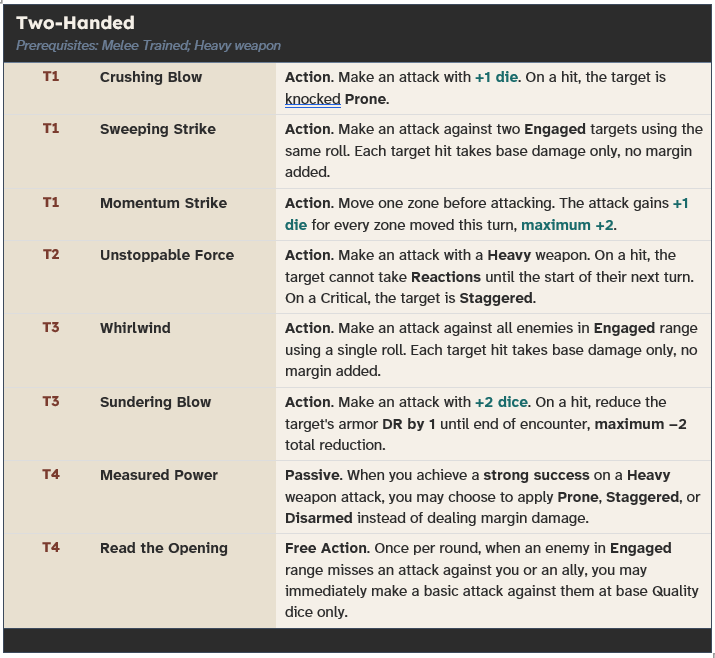
This is what horizontal progression looks like in practice.
The Tier 1 choices let you enter through power (Crushing Blow), crowd control (Sweeping Strike), or mobility (Momentum Strike). All three are viable starting points. At Tier 2, you've learned Unstoppable Force—denying enemy reactions and controlling when they can respond. This is what makes Two-Handed fighters dangerous regardless of which Tier 1 entry you chose.
At Tier 3, you specialize. Whirlwind emphasizes hitting multiple targets while Sundering Blow focuses on breaking through armor. Two different refinements of the same core style. At Tier 4, Measured Power converts strong successes into tactical outcomes, while Read the Opening turns defensive moments into offense. Both are powerful, neither makes you superhuman.
You're not hitting for 50 damage instead of 5. You're controlling reactions, hitting multiple enemies, breaking equipment, and converting defensive success into offensive opportunity. That's mastery.
Keeping Martial Progression Grounded
This became one of the biggest design traps during development. A lot of systems feel pressure to make higher-tier martial abilities increasingly spectacular, which often creates progression that drifts into anime-style escalation. That works perfectly well for some games. Threshold isn't trying to be that game.
At multiple points, techniques started drifting into increasingly exaggerated territory. Whenever that happened, I asked myself: Could an exceptionally skilled—but still human—combatant plausibly do this? Not literally, but plausibly within the fiction. That question forced repeated rewrites.
Highly skilled? Absolutely. Superhuman? No. Mastery should expand options. It shouldn't turn martial characters into demigods unless that's the explicit fantasy your game is trying to deliver.
Kits — Starting Identity Without Class Locking
One of the biggest problems in flexible systems is onboarding paralysis. I kept watching new players stare at the technique trees and freeze. Thirty-five skills, nine attributes, dozens of techniques spread across multiple trees, weapon categories, tags, traits—where do you even start? Too much freedom at character creation becomes overwhelming. You need a starting point that doesn't lock you into a permanent path.
Kits solve that problem. A kit is a pre-assembled combat identity. It gives you starting equipment (armor, weapons, supplies), technique pathways (which trees align with this fighting style), Strain reduction on pathway techniques (cheaper to use abilities that fit your style), and a Signature Move that scales across all four tiers. Without making you a Tank forever or a Skirmisher forever.
There are seventeen kits organized into five role families:
Tanks — Plate & Steel (shield user), Armored Crusader (heavy armor bruiser), Armored Destroyer (two-handed devastation)
Mobile Strikers — Skirmisher (light armor hit-and-run), Twin Blades (dual wield pressure), Unarmed Adept (no gear necessary)
Ranged — Longshot (archer/distance fighter), Gunslinger (firearms), Blade & Throw (dagger specialist)
Versatile — Blade & Bow (every range covered), Great Weapon Master (mobile two-hander), Ward & Weapon (light shield fighter)
Reach & Control — Polearm Guard (zone control), Scourge (chain & rope specialist), Net Fighter (restraint specialist)
High Risk/High Reward — Berserker (unarmored aggression), Robes & Staff (pure mage)
You pick one at character creation. It tells you what gear you start with, which techniques align with your style, and gives you a Signature Move. Six sessions later, your Plate & Steel tank might have learned Chain & Rope techniques. Your Skirmisher might have picked up Brawling. The kit was the starting point, not the destination.
Signature Moves
Every kit includes a Signature Move—a technique that's always available, costs no Strain, and scales across all four tiers. Here's an example from the Plate & Steel kit:
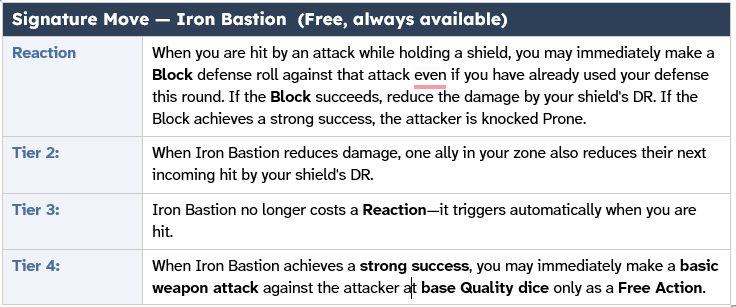
This scales horizontally. At Tier 1, it's an emergency defensive option. At Tier 2, you're protecting allies. At Tier 3, it's always on—no action economy cost. At Tier 4, you counter-attack when they fail. The numbers don't change. The capabilities expand.
That's the philosophy behind every Signature Move: your core fighting identity remains accessible even when Strain is depleted, and it grows with you across your entire campaign.
What I Worked On
This phase focused on connecting equipment to tactical identity without creating loot treadmill pressure.
The weapon list went through multiple iterations. Early drafts had fifty+ weapons, most of them functionally identical. I kept asking: does this weapon create a different gameplay experience, or is it just historical taxonomy? That question cut the list down significantly.
The technique trees took longer. I had to balance horizontal growth (expanding options) against power creep (becoming superhuman). Every technique that started drifting toward anime-style spectacle got rewritten or cut.
The kit system came last. I needed something that said "here's a coherent starting point" without creating class restrictions. The Strain reduction on pathway techniques was the key—it nudges you toward certain styles without locking you out of others.
What Went Wrong
Early versions inherited too many assumptions from traditional fantasy systems: oversized weapon lists, unnecessary differentiation, loot progression assumptions, escalating martial spectacle. Removing those assumptions made the system significantly stronger.
What I Changed
I shifted combat identity toward functional abstraction, tags, horizontal progression, techniques, and kits. That created a system that feels far more expandable without becoming bloated.
What I'm Working on Next
The next step is magic.
So far, the system handles martial combat—attacks, defenses, techniques, equipment. But Threshold's world is shaped by magic as much as steel. The next post will explore how spellcasting works, how Forms determine what magic can do, and how the resource systems (Mana, Strain, and Attunement) create pressure without overwhelming complexity.
Magic in Threshold needs to feel powerful and dangerous—not just for enemies, but for the world itself. Every spell drains finite life energy. That ecological cost shapes the entire setting, so the mechanics need to reflect those stakes.
Questions
Do you prefer highly detailed weapon systems or broader abstraction?
Should martial progression remain grounded or become increasingly mythic?
How much freedom at character creation is too much before players need stronger onboarding systems?
